- Animals
- ›Chordates
- ›Vertebrates
- ›Birds
- ›Pelicans, Herons, Ibises, and Allies
- ›Ibises and Spoonbills
- ›Platalea
On eBird ↗
Royal Spoonbill
Live sightings near you, the range map, bar charts of when it is seen, and Macaulay Library photos and recordings.
Royal Spoonbill
Platalea regia
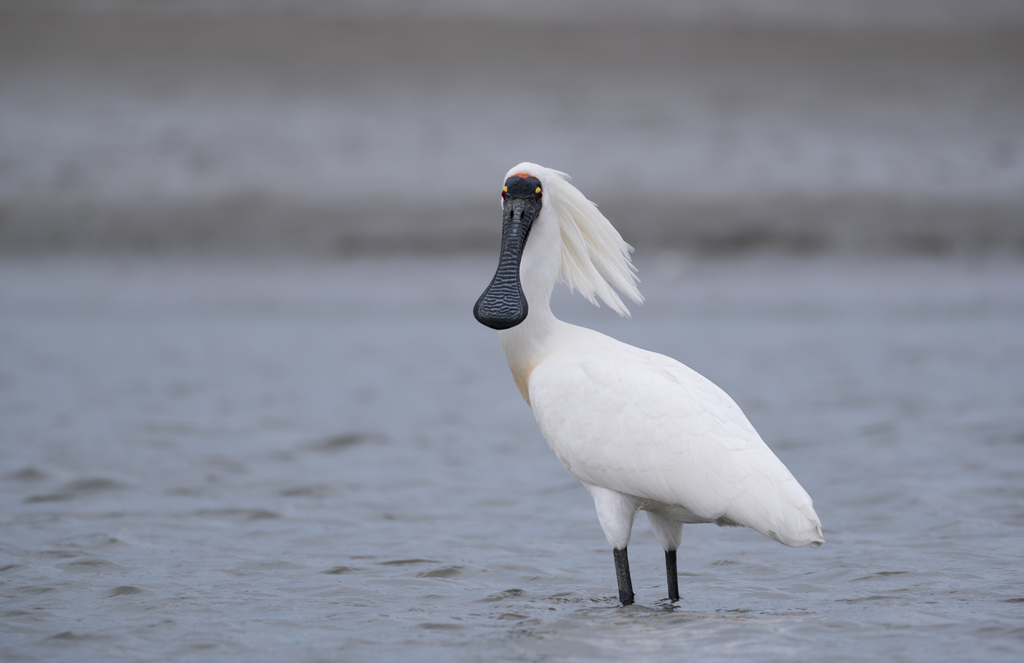
The royal spoonbill (Platalea regia), also known as the black-billed spoonbill lives in intertidal flats and shallows of fresh and saltwater wetlands in Australia, New Zealand, Indonesia, Papua New Guinea, and the Solomon Islands. (In New Zealand, it is also known by the Māori name kōtuku ngutupapa.) It has also been recorded as a vagrant in New Caledonia. It is one of 6 spoonbill species world wide. The royal spoonbill lives in wetlands and feeds on crustaceans, fish and small insects by sweeping its bill from side to side. It always flies with its head extended. Widespread throughout its large range, the royal spoonbill is evaluated as Least Concern on the IUCN Red List of Threatened Species.
From the article Royal spoonbill on Wikipedia (CC BY-SA), quoted section by section
Description
The royal spoonbill is a large, white bird with a black, spoon-shaped bill. It is approximately 80 cm (31 in) tall, 74–81 cm (29–32 in) and a weight of 1.4–2.07 kg (3.1–4.6 lb). It is a wading bird and has long legs for walking through water. It eats fish, shellfish, crabs and amphibians, catching its prey by making a side-to-side movement with its bill. The end of the bill of the royal spoonbill is broader and works more like a pair of tongs than the narrower bill of the yellow-billed spoonbill, which acts like a forceps.
What it does
The royal spoonbill is carnivorous, catching small animals by sweeping its bill through shallow water and swallowing prey once detected. When slow sweeping, the spoonbill walks slowly with the bill perpendicular to the water surface (i.e. vertical) with the bill tip open about 2 to 4 cm (1 to 1.5 in), sweeping an arc of around 100 degrees in front of the bird. The bird walks slowly, kicking up debris and small animals from the bottom of the body of water, which it senses and catches with its bill. When an item is sensed, the spoonbill switches to intensive sweeping of a small area. Royal spoonbills also probe submerged plants directly for prey, and seize prey such as spiders above ground. They have also been observed dragging their bills through shallow water alongside them while walking. Prey items recorded at Lake Cowal include freshwater crustaceans such as the common yabby (Cherax destructor), shrimp of the genus Macrobrachium and family Atyidae, insects, particularly aquatic bugs of the families Notonectidae and Corixidae, fish such as mosquitofish (Gambusia affinis) and goldfish (Carassius auratus), and occasionally freshwater snails and plant material such as medic burr (Medicago polymorpha).
Wikipedia: “Feeding”
Listen
Looking for field recordings…
Where it lives
Recorded sightings
—
geo-referenced records in GBIF, from museums, herbaria and field observers.
Drag the globe to turn it. Dots are where records exist, not a range map; darker means more records.
In the stacks
Searching the stacks…
Every page naming Platalea regia in the Biodiversity Heritage Library →
This page is assembled live from iNaturalist, GBIF, Wikipedia, the Source Library and the Internet Archive. It is not yet part of the hand-edited codex. iNaturalist taxon 3733.