- Animals
- ›Chordates
- ›Vertebrates
- ›Birds
- ›Swifts and Hummingbirds
- ›Hummingbirds
- ›Brilliants, Coquettes, and Allies
- ›Coquettes and Allies
- ›Oxypogon
On eBird ↗
Blue-bearded Helmetcrest
Live sightings near you, the range map, bar charts of when it is seen, and Macaulay Library photos and recordings.
Blue-bearded Helmetcrest
Oxypogon cyanolaemus
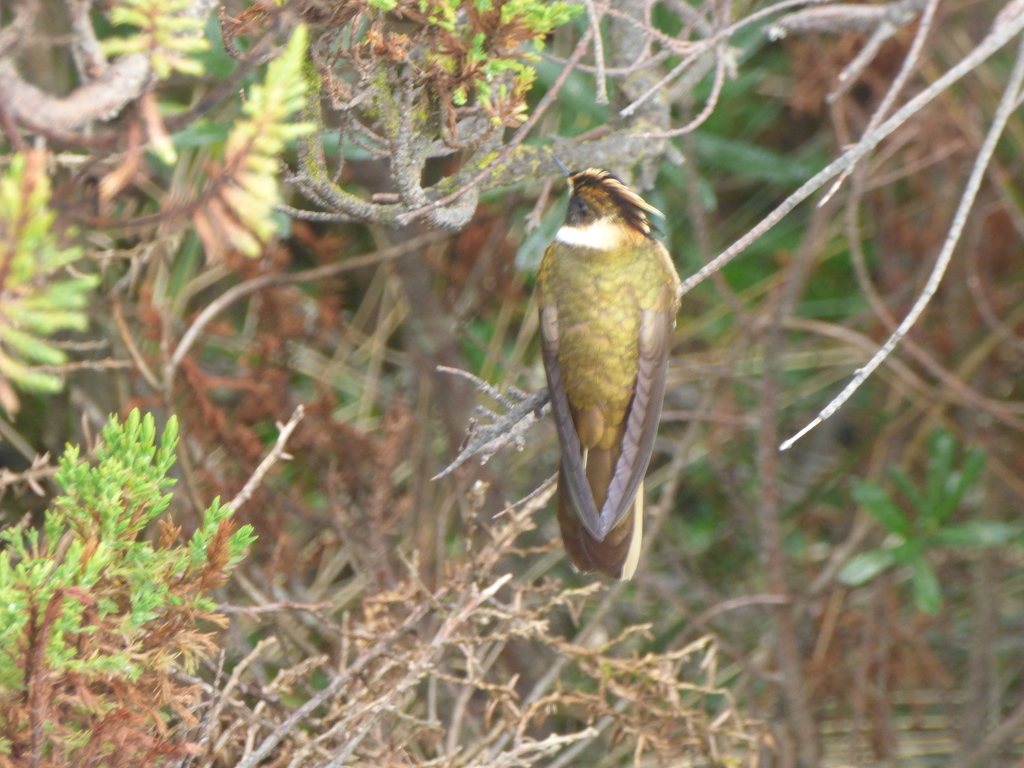
The blue-bearded helmetcrest (Oxypogon cyanolaemus) is a species of hummingbird endemic to the Santa Marta Mountains in northeastern Colombia. It has elongated purply blue throated feathers, which assemble in the form of a beard and a prominent white crest. The white frame from the face extends from the rear of the head, around the ear coverts and down to the breast side
From the article Blue-bearded helmetcrest on Wikipedia (CC BY-SA), quoted section by section
Description
The blue-bearded helmetcrest is about 11.5 cm (4.5 in) long. It has a short straight bill. The male has a long black and white crest and a mostly dusky face with a buffy-white "collar". Its upperparts are olive green. Its throat has a thin white "beard" with a purplish blue center stripe. The rest of the underparts are dingy buff with olive spots that blends to buffy white on the undertail coverts. The tail is moderately long and forked. The upper side of the central tail feathers is bronzy olive and the rest are white with reddish bronze fringes and tips, and the underside is cream with wide olive tips. The adult female is similar to the male but lacks the crest and beard, is overall duller, and has a white throat. Juveniles resemble the adult female but without the white throat.
Range & habitat
The blue-bearded helmetcrest is found only in the isolated Sierra Nevada de Santa Marta of northern Colombia. It inhabits páramo grasslands at elevations between 3,000 and 4,800 m (9,800 and 15,700 ft).
Wikipedia: “Distribution and habitat”
What it does
Little is known about the blue-bearded helmetcrest's diet or feeding method. It has been observed feeding on nectar at a few species of flowering herbs and shrubs, both by hovering and by clinging to the flowers. Its primary food source appears to be Libanothamnus occultus.
Wikipedia: “Feeding”
Listen
Looking for field recordings…
Where it lives
Recorded sightings
—
geo-referenced records in GBIF, from museums, herbaria and field observers.
Drag the globe to turn it. Dots are where records exist, not a range map; darker means more records.
In the stacks
Searching the stacks…
Every page naming Oxypogon cyanolaemus in the Biodiversity Heritage Library →
This page is assembled live from iNaturalist, GBIF, Wikipedia, the Source Library and the Internet Archive. It is not yet part of the hand-edited codex. iNaturalist taxon 367516.