- Animals
- ›Chordates
- ›Vertebrates
- ›Birds
- ›Swifts and Hummingbirds
- ›Hummingbirds
- ›Brilliants, Coquettes, and Allies
- ›Coquettes and Allies
- ›Sappho
On eBird ↗
Red-tailed Comet
Live sightings near you, the range map, bar charts of when it is seen, and Macaulay Library photos and recordings.
Red-tailed Comet
Sappho sparganurus
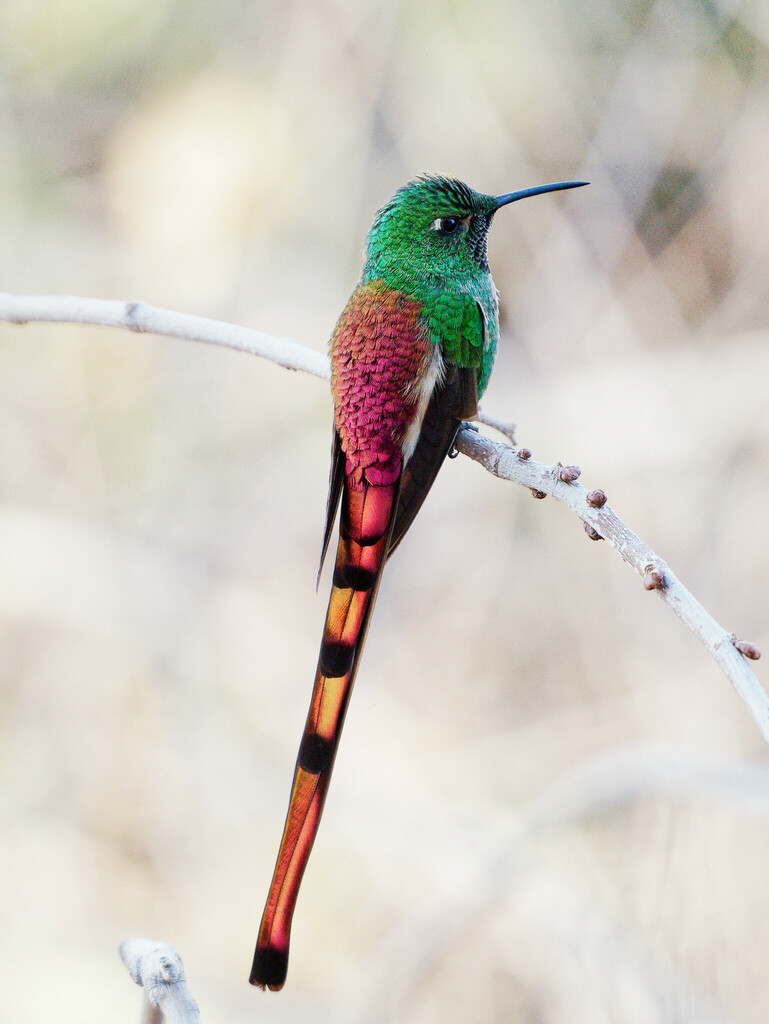
The red-tailed comet (Sappho sparganurus) is a medium-sized hummingbird belonging to tribe Lesbiini of subfamily Lesbiinae, the "coquettes". It is found in Argentina and Bolivia and possibly Chile and Peru.
From the article Red-tailed comet on Wikipedia (CC BY-SA), quoted section by section
Description
Male red-tailed comets are 19 to 20 cm (7.5 to 7.9 in) long including their 7 to 10 cm (2.8 to 3.9 in) tail. Females are 12 to 14 cm (4.7 to 5.5 in) long. The species weighs about 4 to 6.5 g (0.14 to 0.23 oz). Adult males of the nominate subspecies have a shining green head with a golden green or emerald green gorget. Their back and rump are reddish purple and their underparts mostly green with buffy undertail coverts. Their tail is long and deeply forked. Its upper surface looks reddish purple to green depending on the angle of the light striking it. The tail feathers have a wide velvety black to dusky purple tip. Adult females are overall duller than males and have a shorter tail. Their head and back are shining green and their rump reddish purple. Their throat and underparts are pale buff with small green speckles on the throat, breast, and upper belly. Their outer tail feathers have white or buffy white outer webs. Juveniles are similar to adult females but have dull bronzy green upperparts with a slightly coppery rump and more white on their outer tail feathers. Subspecies S. s. sapho is paler than the nominate and is golden orange where the nominate is reddish purple. Both sexes of both subspecies have a reddish brown iris, a black bill, and black legs and feet.
Range & habitat
Sources do not agree on the red-tailed comet's range. According to the South American Classification Committee of the American Ornithological Society it is found only in Argentina and Brazil. Other taxonomic systems and authors add to its range Chile, possibly Peru but not Chile, both Chile and Peru, or Peru and possibly Chile. The sources also differ in the distributions of the two subspecies. The nominate subspecies is variously placed in northern Bolivia and possibly extreme southern Peru, in northern and central Bolivia, and in northern and central Bolivia and accidentally in southern Peru. Subspecies S. s. sapho is variously placed in central Bolivia and northern and western Argentina, in southern Bolivia, northern and western Argentina, and east-central Chile, and from southern Bolivia to western Argentina and northern Chile. The red-tailed comet inhabits arid montane scrublands on the eastern slope of the Andes and in valleys within the Andes. The landscape is characterized by scattered trees, a bushy understorey, and dense tangles in ravines. It also occurs in Polylepis woodlands. In elevation it ranges mostly between 1,500 and 4,200 m (4,900 and 13,800 ft) but has been reported as low as 400 m (1,300 ft).
Wikipedia: “Distribution and habitat”
What it does
The red-tailed comet feeds primarily on nectar and also includes small arthropods in its diet. It collects nectar both while hovering and while perched; it captures arthropods in flight and sometimes by gleaning them from vegetation. Males defend flower patches as feeding territory.
Wikipedia: “Feeding”
Listen
Looking for field recordings…
Where it lives
Recorded sightings
—
geo-referenced records in GBIF, from museums, herbaria and field observers.
Drag the globe to turn it. Dots are where records exist, not a range map; darker means more records.
In the stacks
Searching the stacks…
Every page naming Sappho sparganurus in the Biodiversity Heritage Library →
This page is assembled live from iNaturalist, GBIF, Wikipedia, the Source Library and the Internet Archive. It is not yet part of the hand-edited codex. iNaturalist taxon 367514.