On eBird ↗
Tapajos Hermit
Live sightings near you, the range map, bar charts of when it is seen, and Macaulay Library photos and recordings.
Tapajos Hermit
Phaethornis aethopygus
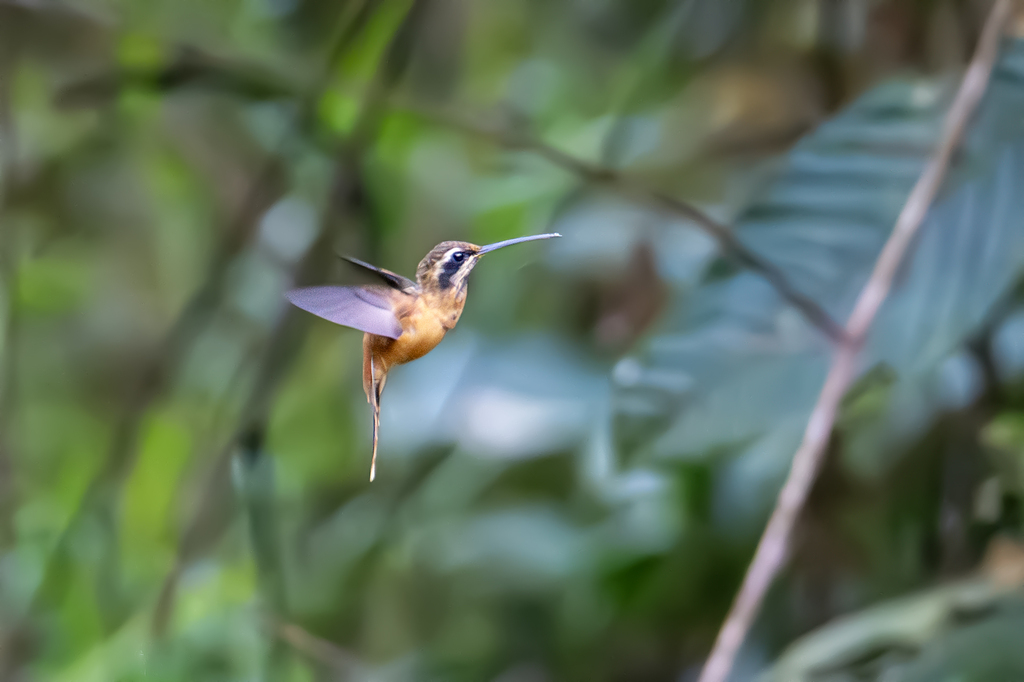
The Tapajós hermit (Phaethornis aethopygus) is a species of hummingbird in the Trochilidae family. It is found in the south-eastern Amazon in Brazil, and its common name refers to the Tapajós River, which forms the western border of its distribution. This small hermit has rufous underparts, rump and tail-tips, white to the base of the tail, and a dark throat. Females are paler and longer-tailed than males.
From the article Tapajós hermit on Wikipedia (CC BY-SA), quoted section by section
Description
The Tapajós hermit is about 9 cm (3.5 in) long. The male has a metallic olive green crown and back with reddish edges to the feathers and a rich reddish rump. The tail is rounded; the feathers are dusky brownish with reddish shafts and all but the outermost have white at their base. The face is blackish with a pale supercilium and a reddish malar stripe. The chin is white and the throat black becoming rufous on the neck, chest, and belly. The female is similar but with a paler rump and buffy olive underparts with a reddish tinge.
Range & habitat
The Tapajós hermit is found in Brazil between the Tapajós and Xingu Rivers, north-flowing tributaries of the Amazon River. It inhabits primary forest but also tolerates logged and burned areas. It has been observed in a heavily disturbed terra firme area.
Wikipedia: “Distribution and habitat”
What it does
The Tapajós hermit feeds on nectar and is assumed to also consume small insects and other invertebrates.
Wikipedia: “Feeding”
Listen
Looking for field recordings…
Where it lives
Recorded sightings
—
geo-referenced records in GBIF, from museums, herbaria and field observers.
Drag the globe to turn it. Dots are where records exist, not a range map; darker means more records.
In the stacks
Searching the stacks…
Every page naming Phaethornis aethopygus in the Biodiversity Heritage Library →
This page is assembled live from iNaturalist, GBIF, Wikipedia, the Source Library and the Internet Archive. It is not yet part of the hand-edited codex. iNaturalist taxon 367512.