- Animals
- ›Arthropods
- ›Hexapods
- ›Insects
- ›Winged and Once-winged Insects
- ›Dragonflies and Damselflies
- ›Dragonflies
- ›Libelluloidea
- ›Emerald Dragonflies
- ›Somatochlora
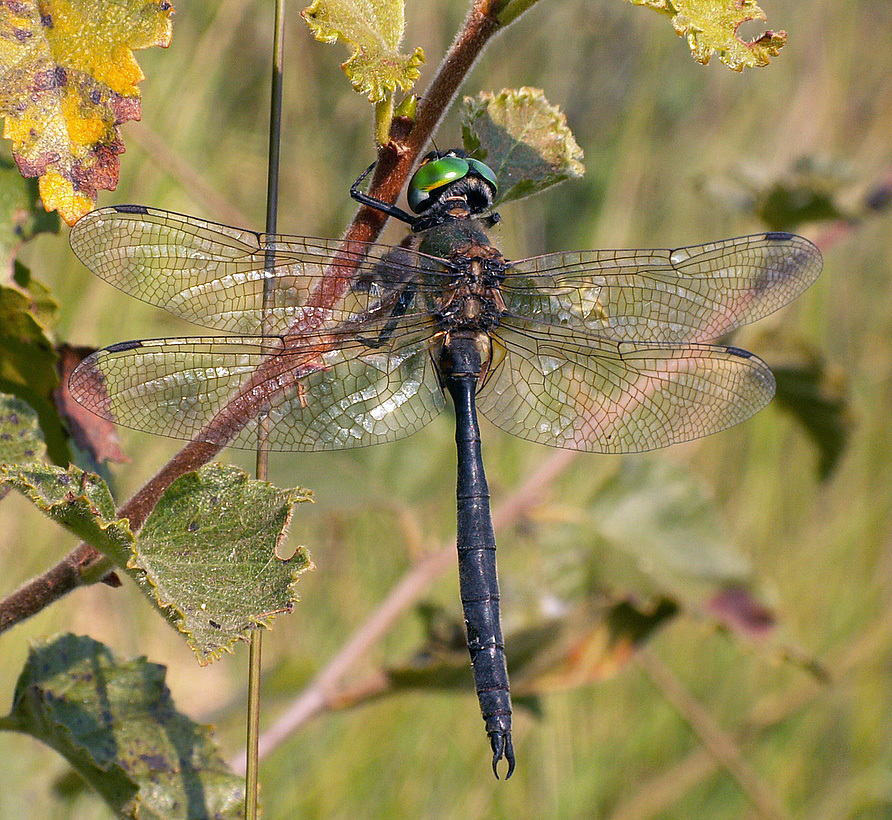
Northern Emerald
Somatochlora arctica
The northern emerald (Somatochlora arctica) is a species of emerald dragonfly found in northern and middle Eurasia. The species was first described in 1840 from Scandinavia. It is a relatively small dragonfly, just 4 to 5 centimetres (1.6 to 2.0 in) long, and is recognizable by its hairy thorax, dark abdomen, and bright green eyes. The males have narrowly waisted abdomens, while the females have straight ones; the females are also recognizable by the two lateral yellow spots behind the thorax. Northern emeralds pass two years as larvae in sphagnum-rich bog pools before emerging as adults which hunt above peat bogs, wet meadows, and open woodlands. Despite being assessed as a least-concern species by the IUCN, northern emeralds are threatened by habitat loss caused by human activity, and climate change is expected to exacerbate the problem. The northern emerald is found from Japan and the Kamchatka Peninsula through much of Russia. It is abundant throughout Fennoscandia, and is also well-known from the Alps and the Scottish Highlands. Its distribution in lowland Europe is sparse, but the dragonflies can be hard to find and record.
From the article Northern emerald on Wikipedia (CC BY-SA), quoted section by section
Description
Members of the genus Somatochlora are generally medium-sized dragonflies with metallic green to black colouration and bright green eyes. Northern emeralds (Somatochlora arctica) are smallish dragonflies with dark abdomens and lighter, hairy thoraxes, usually measuring from 41 to 51 millimetres (1.6 to 2.0 in) long and a wingspan of around 67 millimetres (2.6 in). The colour of the abdomen is blackish, while the head and thorax are bronzey green. Females have two characteristic oval yellow spots on the abdomen next to the thorax, similar to spots on brilliant emerald females. Both sexes have characteristic yellow spots on their faces next to the eyes, which are bright green in mature individuals.
Northern emerald wings are not completely clear but rather are "suffused with a yellowish tint" which becomes strongest close to the leading edge of the wing. The base of the wings is also pale ochre, especially the male inferior wing. Populations of the dragonflies in west Siberia, particularly in bogs on the Vasyugan Plain, exhibit wings "smoked" with amber-brown. A similar phenomenon has been recorded in Somatochlora flavomaculata specimens from the same area. The pterostigmata – pigmented spots on the front corners of each wing – are black-brown in males and dark brown in adult females, paler brown in immature ones. …
Range & habitat
The northern emerald is regarded as a "bog specialist". The larvae develop and hunt in bog pools, especially among waterlogged sphagnum moss; adults can be found flying around bogs, in wet meadows and heaths, open woodlands, and lightly treed moors. Early 20th century observations made by Kenneth Morton in the Austrian Tyrol reported them to be found abundantly in wet meadows there. Breeding often takes place in wet areas close to woodlands where adults hunt. A 2024 study published in the Journal of Insect Conservation looked at the prevalence of northern emerald larvae in different habitat conditions. They found that there was little correlation between S. arctica larvae abundance and water acidity, temperature, or depth, but they were significantly more abundant in "pools located close to woodland and with high Sphagnum coverage". The larvae usually live in clumps of moss about 15 centimetres (1⁄2 ft) beneath the surface of bog pools. When pools dry up, larvae have been found in deep clumps of wet, half-rotten moss up to 30 centimetres (1 ft) below the surface. …
Wikipedia: “Habitat”
What it does
Northern emeralds mate in what is called the "wheel formation". First, using the appendages on the tip of his abdomen, the male grasps the female behind the head: this is called the "tandem formation". The male leads the female into the tree canopy. She then curls her abdomen to the male's secondary genitalia, which are located on the underside of his thorax. By this means the female's eggs are fertilized. Mating takes up to an hour. Once it is done, the female leaves to deposit her eggs alone. (In some dragonfly species, the male guards the female while she does this.) Usual oviposition sites are small pools closely protected by vegetation, such as in clumps of underwater sphagnum moss.
The larva is the "main life stage" for the northern emerald dragonfly, and it lasts at least two years. Northern emerald larvae are distinctly hairy creatures, and moult several times during their development. The larval abdomen has no spines on the back or sides, unlike some other Somatochlora species, and the hind-leg's third and longest segment (femur) is relatively short, reaching only as far as the abdomen's sixth segment. The larva's "mask" – actually the prehensile lower lip, extended to catch prey – has numerous somewhat shallow crenations, each sprouting five bristles. They are squat, and their longish legs give them a spider-like appearance. …
Wikipedia: “Reproduction and development”
In human culture
The northern emerald was first scientifically described under the name Aeschna arctica in 1840 by Johan Wilhelm Zetterstedt. Zetterstedt provided a brief physical description and wrote he had discovered the dragonfly in August of 1821, noting it was found in sub-alpine parts of Finland and Norway. The original description was published in his thousand-page work Insecta Lapponica, a description of the insects of Lapland intended to supplement Linnaeus' Fauna Svecica of nearly a century before. The very same year as Zetterstedt published his description, Belgian aristocrat and entomologist Edmond de Sélys Longchamps – considered a "founder of odonatology" – described a species he called Cordulia subalpina from Belgium. In a paper in the journal Bulletins de l'Académie Royale des Sciences et Belles-Lettres de Bruxelles he described a species, discovered in June 1840 by Monsieur Putzeys, a Crown prosecutor in Arlon. He noted it was similar to Somatochlora alpestris (then called Cordulia alpestris). Ten years later, de Sélys published a comprehensive book, Review of the Odonates or Libellules of Europe, in which he gave Zetterstedt credit for ths species, listing his own Cordulia subalpina as a junior synonym. However, he did reclassify Zetterstedt's species into the genus Cordulia, producing the new name Cordulia arctica. …
Wikipedia: “Taxonomic history”
Listen
Looking for field recordings…
Where it lives
Recorded sightings
—
geo-referenced records in GBIF, from museums, herbaria and field observers.
Drag the globe to turn it. Dots are where records exist, not a range map; darker means more records.
In the stacks
Searching the stacks…
Every page naming Somatochlora arctica in the Biodiversity Heritage Library →
This page is assembled live from iNaturalist, GBIF, Wikipedia, the Source Library and the Internet Archive. It is not yet part of the hand-edited codex. iNaturalist taxon 358566.