- Animals
- ›Arthropods
- ›Hexapods
- ›Insects
- ›Winged and Once-winged Insects
- ›Flies
- ›Nematoceran Flies
- ›Gnats and Allies
- ›March Flies
- ›Bibioninae
- ›Bibionini
- ›Bibio
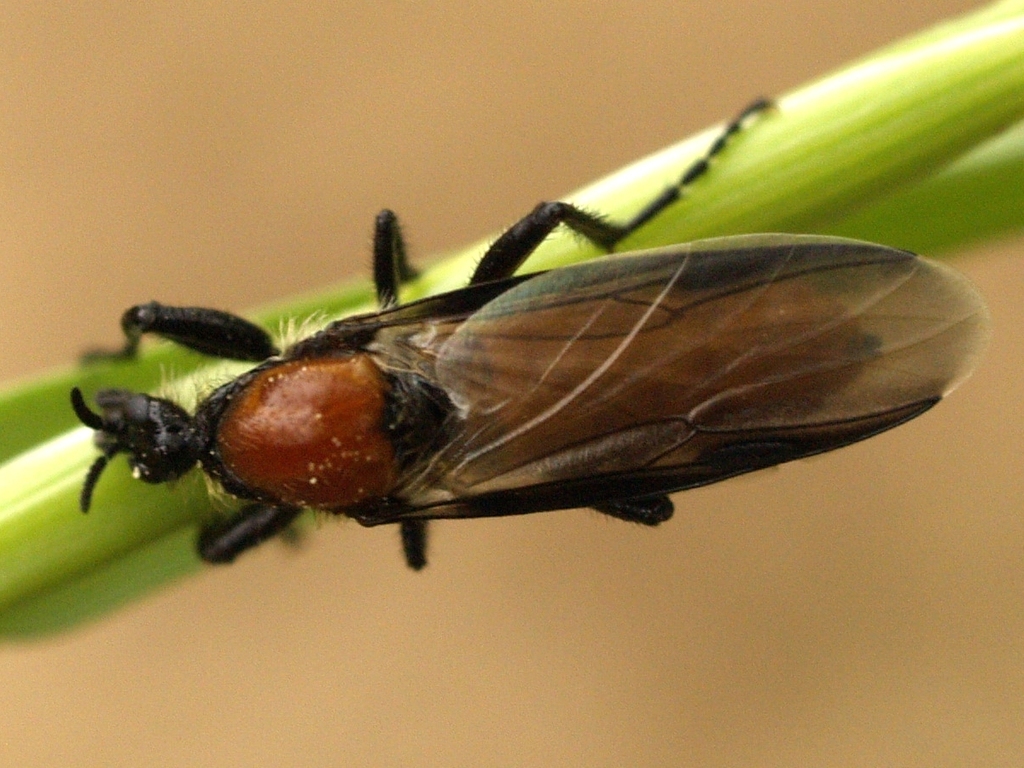
Garden March Fly
Bibio hortulanus
Bibio hortulanus, common name marchfly, is a species of fly from the family Bibionidae.
From the article Bibio hortulanus on Wikipedia (CC BY-SA), quoted section by section
Description
Bibio hortulanus can reach a body length of about 6.5–8.5 millimetres (0.26–0.33 in). Wing length is of about 9.5 mm. This species has an evident sexual dimorphism. The body of males is completely black and slightly smaller than the female. The thorax is covered by black hairs, with gray hairs on the sides of breast and abdomen. Head, proboscis and palpi are blackish-brown, whereas legs and halteres are black. The eyes are enormous and contiguous, while in the females they are smaller and clearly separated. The short and robust antennae are inserted under the eyes. Wings are transparent or whitish, but brownish along the costa. In the females the dorsal surface of the thorax and the abdomen is orange-red, while prothorax and sides are black. Head, antennae and palpi are black. Legs are black. Wings are brownish-yellow, with dark brown costa. This species is rather similar to Bibio pomonae, but this last species has red-colored femurs.
Range & habitat
This species is present in most of Europe (Austria, Belgium, British Islands, Czech Republic, Denmark, France, Germany, Greece, Italy, Latvia, Liechtenstein, Norway, Poland, Portugal, Slovakia, Spain, Sweden and Switzerland), in North Africa and in the Middle East.
Wikipedia: “Distribution”
Listen
Looking for field recordings…
Where it lives
Recorded sightings
—
geo-referenced records in GBIF, from museums, herbaria and field observers.
Drag the globe to turn it. Dots are where records exist, not a range map; darker means more records.
In the stacks
Searching the stacks…
Every page naming Bibio hortulanus in the Biodiversity Heritage Library →
This page is assembled live from iNaturalist, GBIF, Wikipedia, the Source Library and the Internet Archive. It is not yet part of the hand-edited codex. iNaturalist taxon 356329.