- Animals
- ›Arthropods
- ›Hexapods
- ›Insects
- ›Winged and Once-winged Insects
- ›True Bugs, Hoppers, Aphids, and allies
- ›True Hoppers
- ›Spittlebugs, Cicadas, Leafhoppers and Treehoppers
- ›Cicadas
- ›Typical Cicadas
- ›Cicadinae
- ›Painted Cicadas
- ›Leptopsaltriina
- ›Tanna
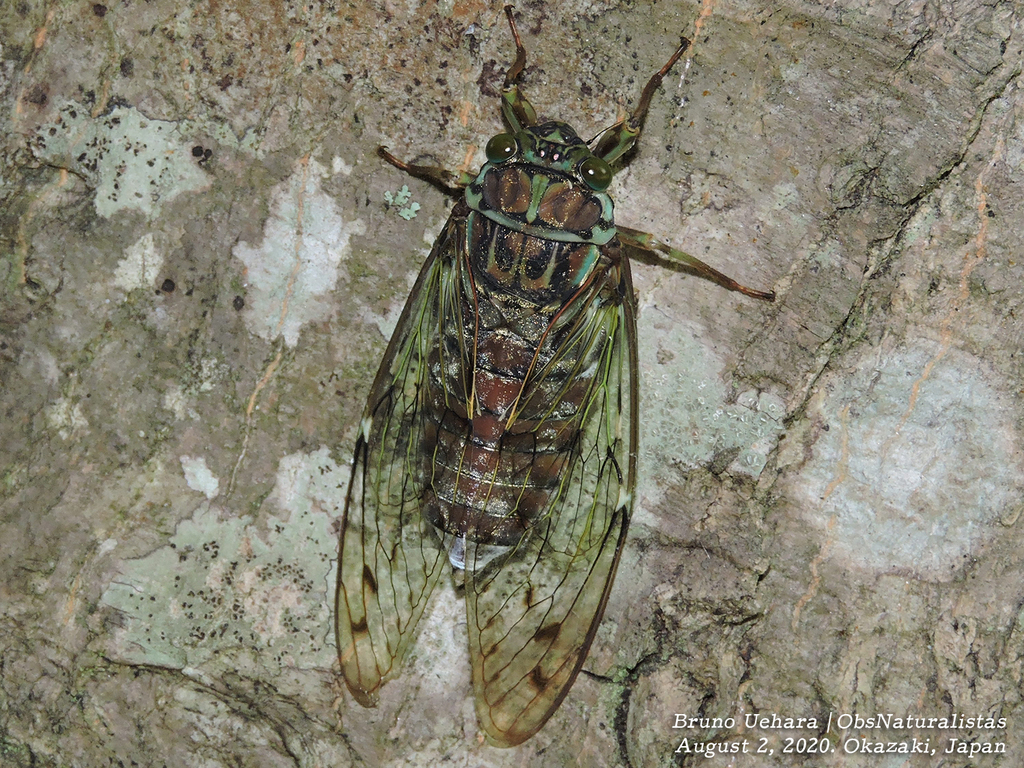
Evening Cicada
Tanna japonensis
Tanna japonensis, also called the evening cicada or higurashi (Japanese: 日暮, 蜩, 茅蜩, ひぐらし, ヒグラシ), is a species of cicada, a family of insects, and a member of the genus Tanna. It is distributed throughout East Asia, and is most common in Japan. Its shrill call can be heard most often in the morning and evening.
One of its possible kanji names (茅蜩) is derived from the character (茅) for a category of grasses that includes Miscanthus sinensis, a type of reed that it inhabits. In Japan, it is also known as kanakana (カナカナ) because of the noise that it makes.
From the article Tanna japonensis on Wikipedia (CC BY-SA), quoted section by section
Description
The adult male has a body length of 28–38 mm (1.1–1.5 in), the female is 21–25 mm (0.8–1.0 in). The male's abdomen is longer and thicker than that of the female, making it easy to distinguish between them. In addition, the intra-abdominal cavity of the male is more developed, giving it a more resonant call. The body is coloured reddish-brown with green around the compound eye and in the centre and back of the thorax; mountain dwelling specimens tend to be darker.
Wikipedia: “Characteristics”
Range & habitat
In Japan, their habitat ranges from temperate Hokkaido in the far north to subtropical Amami Ōshima, close to Taiwan (variants and subspecies, such as T. j. ishigakiana), and live in a wide range of habitats. They live in the cypress, cedar, and hardwood forests, from the mountainous regions in Hokkaido to the plains of northern Kyūshū, and even in southern Kyushu, they can be found in slightly higher mountain elevations.
Wikipedia: “Habitat”
What it does
The parasitic moth Epipomponia nawai uses the animal as a host for its eggs. The T. japonensis can also come under attack from flesh flies.
Wikipedia: “Ecology”
Listen
Looking for field recordings…
Where it lives
Recorded sightings
—
geo-referenced records in GBIF, from museums, herbaria and field observers.
Drag the globe to turn it. Dots are where records exist, not a range map; darker means more records.
In the stacks
Searching the stacks…
Every page naming Tanna japonensis in the Biodiversity Heritage Library →
This page is assembled live from iNaturalist, GBIF, Wikipedia, the Source Library and the Internet Archive. It is not yet part of the hand-edited codex. iNaturalist taxon 355995.