- Plants
- ›Vascular Plants
- ›flowering plants
- ›Dicots
- ›Sunflowers, Bellflowers, Fanflowers, and Allies
- ›Sunflowers, Daisies, Asters, and Allies
- ›Mutisioideae
- ›Mutisieae
- ›Gerbera
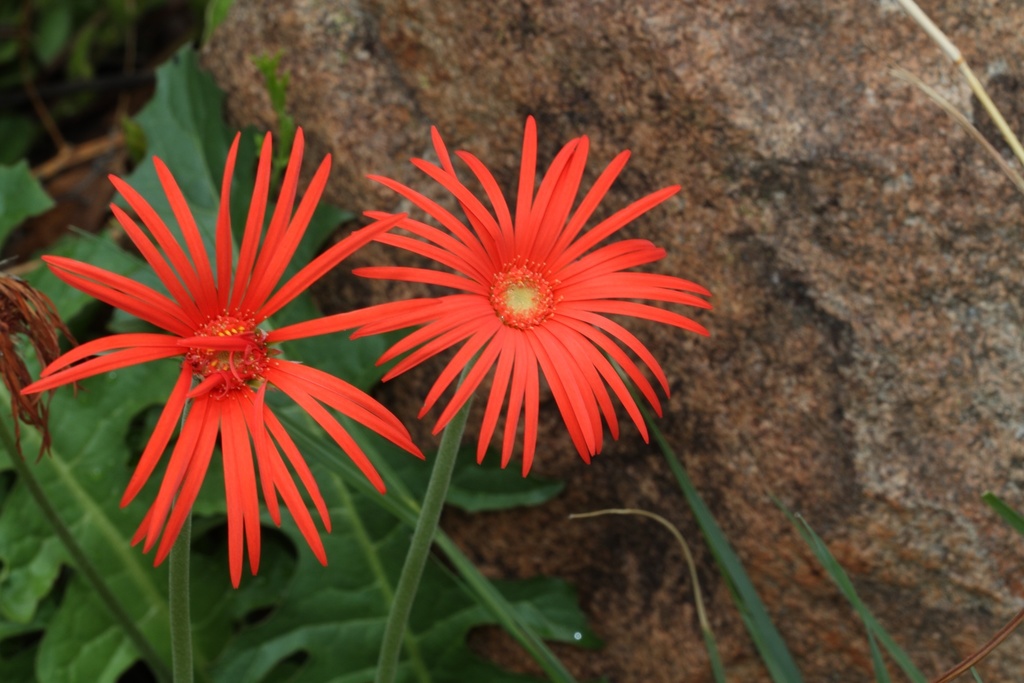
Barberton Daisy
Gerbera jamesonii
Gerbera jamesonii is a species of flowering plant in the genus Gerbera belonging to the basal Mutisieae tribe within the large Asteraceae (or Compositae) family. It is indigenous to South Eastern Africa and commonly known as the Barberton daisy, the Transvaal daisy, and as Barbertonse madeliefie or Rooigousblom in Afrikaans. It was the first species of Gerbera to be the subject of a scientific description, studied by J. D. Hooker in Curtis's Botanical Magazine in 1889.
From the article Gerbera jamesonii on Wikipedia (CC BY-SA), quoted section by section
Description
Gerbera jamesonii is a tufted perennial herb with the naked flowering scapes up to 75 cm high. Petiolate, deeply undulating or lobed leaves are 15–42 (up to 68) cm long and 4–14 cm wide, gathered in rosette. The plant produces spectacular flowers (capitula) of 4–5 cm in diameter with normally orange-red (rarely yellow, orange, white, pink) ray florets. It flowers from September to December, reproduces asexually. The seeds have a pappus of bristles.
Range & habitat
Gerbera jamesonii is endemic to Mpumalanga, Limpopo and Eswatini. The plant is introduced into several countries of Latin America, Equatorial Africa and Southeast Asia.
Wikipedia: “Distribution”
What it does
The species grows from 500 to 1670 m above sea level on rocky slopes in woodland, usually in some shade or under bushes and trees. The flowers are pollinated by bees and other insects. The seeds are light and easily dispersed by wind.
Wikipedia: “Ecology”
At the table
The species is the ancestor of all cultivated forms of Gerbera, or they originate from the cross Gerbera jamesonii and Gerbera viridifolia, originally made by R. I. Lynch in Cambridge, England about 1890. He named the hybrid as Gerbera × cantebrigiensis, known today as Gerbera × hybrida. Nowadays thousands of cultivars exist and they are the important article of trade belonging to the most important ornamental crops in the world together with rose, chrysanthemum, carnation, lily and tulip. The popular cultivars include "Sazou", "Sangria", "Rosalin", "Pink Elegance", "Tropic Blend", "Piton", "Winter Queen", "Savannah", "Primrose" and many others. They are propagated by tissue culture and by seeds.
Wikipedia: “Uses”
In human culture
The genus was named in honour of German botanist and medical doctor Traugott Gerber (1710—1743). The Gerbera jamesonii was named in honour of Robert Jameson, who collected the plant near Barberton. The species epithet was proposed by the prominent South African botanist Harry Bolus, but first published by Richard Wills Adlam in 1888, so should be ascribed to him.
Wikipedia: “Etymology”
Where it lives
Recorded sightings
—
geo-referenced records in GBIF, from museums, herbaria and field observers.
Drag the globe to turn it. Dots are where records exist, not a range map; darker means more records.
In the stacks
Searching the stacks…
Every page naming Gerbera jamesonii in the Biodiversity Heritage Library →
This page is assembled live from iNaturalist, GBIF, Wikipedia, the Source Library and the Internet Archive. It is not yet part of the hand-edited codex. iNaturalist taxon 349270.