- Animals
- ›Arthropods
- ›Hexapods
- ›Insects
- ›Winged and Once-winged Insects
- ›Butterflies and Moths
- ›Butterflies
- ›Brush-footed Butterflies
- ›Milkweed Butterflies
- ›Clearwings and Tigerwings
- ›Methona
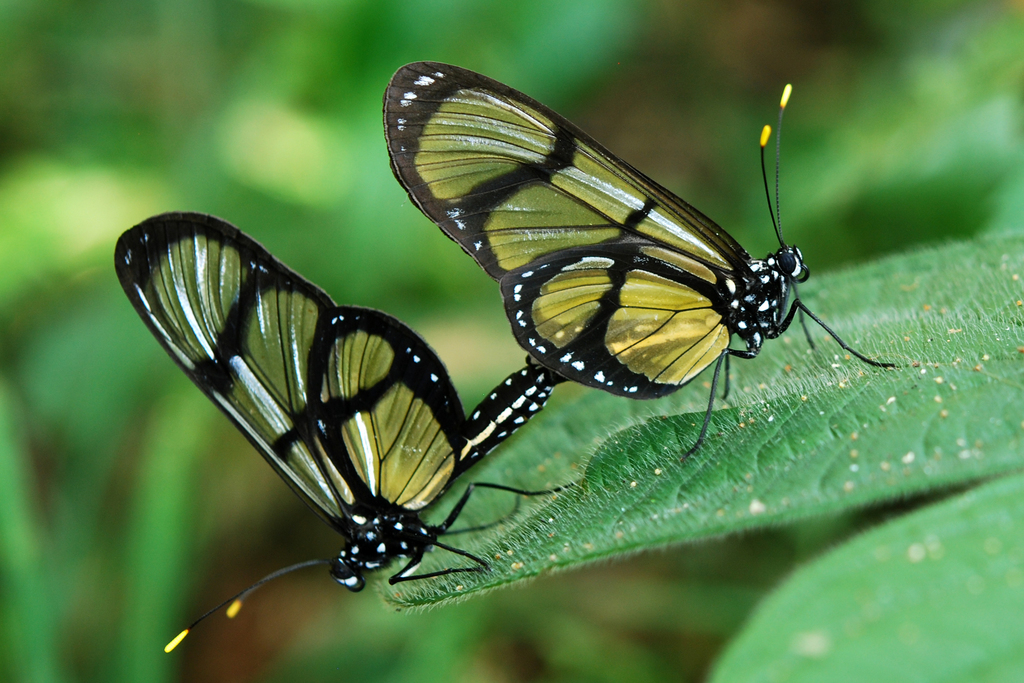
Confusa Tigerwing
Methona confusa
Methona confusa, the giant glasswing, is a species of clearwinged butterfly in the order Lepidoptera and in the family Nymphalidae. It can be found in some Central and South American countries in regions with forests and mountains.
From the article Methona confusa on Wikipedia (CC BY-SA), quoted section by section
Description
Methona confusa has a wingspan of about 11 cm. The wings do not have nanostructures and thus are transparent and reflective. It has black margins and black cross-bars on the forewings and the hindwings. Small white spots are present along the margin of the wing on the underside of the wing while there are also white spots on the abdomen and the thorax. Antennae are black with a yellow tip. M. confusa display Müllerian mimicry and Batesian mimicry through their wings.
Range & habitat
This species can be found in Brazil, Ecuador, Panama, Peru, Venezuela, Bolivia, Argentina, and Colombia. Specifically, M. confusa can be found in the Amazon basin. The population of M. confusa has been declining which could be due to the predation during the larval stage from ants and birds. During the pupal stage, they are impacted by parasitoid wasps (Eulophidae) and fungi.
Wikipedia: “Distribution”
What it does
To develop from an egg to an adult, it takes M. confusa about 45 days. The white eggs are found in clusters on the bottom side of Brunfelsia (Solanaceae). Some species of Methona could be monophagous. M. confusa and M. curvifascia have similar larval appearances. M. confusa has 12 stripes on the body while M. curvifascia has 11. M. confusa as an instar has dark brown and yellow stripes transversely across the body. As a pupa, it has a black cremaster and the wing pads have a black and gold color a couple days before emerging as an adult. This pupa stage lasts around 12 days.
For mating, males will copulate with the female in two sequences. The male would grab onto the female where they would fall to the ground. In the second sequence, the male would leap onto the female while flying. Methona confusa has also been known to display gregarious behavior as larvae and summit congregation behavior.
Wikipedia: “Life cycle and behavior”
Listen
Looking for field recordings…
Where it lives
Recorded sightings
—
geo-referenced records in GBIF, from museums, herbaria and field observers.
Drag the globe to turn it. Dots are where records exist, not a range map; darker means more records.
In the stacks
Searching the stacks…
Every page naming Methona confusa in the Biodiversity Heritage Library →
This page is assembled live from iNaturalist, GBIF, Wikipedia, the Source Library and the Internet Archive. It is not yet part of the hand-edited codex. iNaturalist taxon 342572.