- Animals
- ›Chordates
- ›Vertebrates
- ›Birds
- ›Swifts and Hummingbirds
- ›Hummingbirds
- ›Bee Hummingbirds, Emeralds, Mountain-gems, and Allies
- ›Emerald Hummingbirds and Allies
- ›Thalurania
On eBird ↗
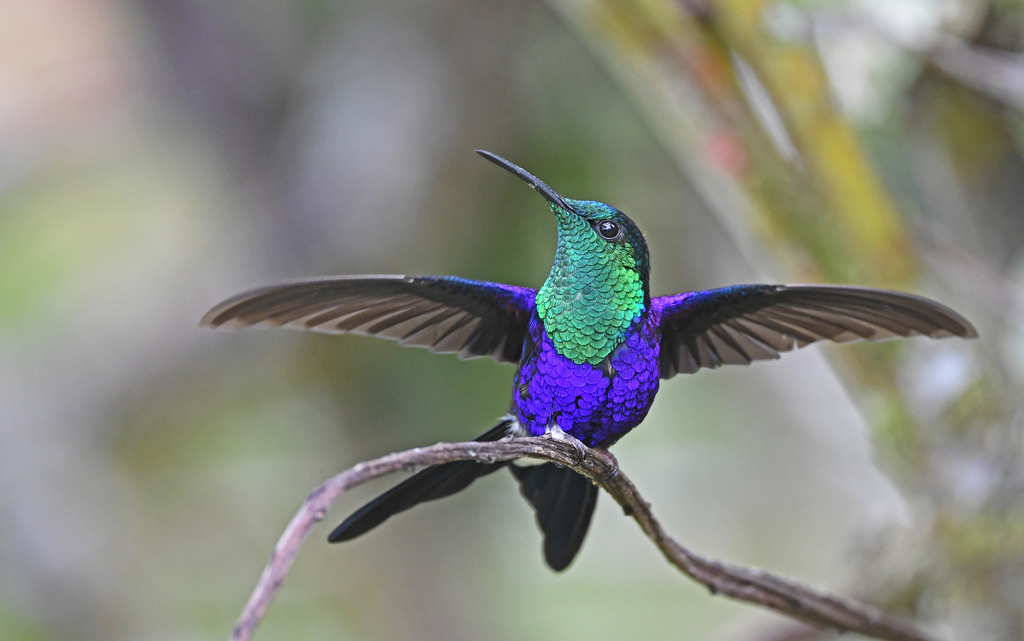
Crowned Woodnymph
Live sightings near you, the range map, bar charts of when it is seen, and Macaulay Library photos and recordings.
Crowned Woodnymph
Thalurania colombica
The crowned woodnymph (Thalurania colombica) is a species of hummingbird in the family Trochilidae. It is found in Belize and Guatemala to northern Peru. Its natural habitats are subtropical or tropical moist lowland forests, subtropical or tropical moist montane forests, and heavily degraded former forest.
From the article Crowned woodnymph on Wikipedia (CC BY-SA), quoted section by section
Description
Male crowned woodnymphs are 9.5 to 11.5 cm (3.7 to 4.5 in) long and weigh 4 to 5.5 g (0.14 to 0.19 oz). Females are 8.5 to 9.2 cm (3.3 to 3.6 in) long and weigh 3.5 to 4.2 g (0.12 to 0.15 oz). Adult males of the nominate subspecies T. c. colombica have a violet forehead, crown, upper back, and belly. Their nape is dark bronzy green and lower back and rump dark bluish green. Their throat and chest are glittering green. Their deeply forked tail is blue-black. Adult females have bright green upperparts, pale gray throat and chest, and darker gray belly. The tail is blue-black with white tips on the outer three pairs of feathers. Immature males have dusky crown, throat, and underparts with very limited iridescent purple feathers. Immature females have dull green upperparts and entirely pale gray underparts. Males of subspecies T. c. townsendi have a bronze nape and a green belly with violet on the sides. Females are dark gray below. T. c. venusta males are larger than the nominate with a longer tail and have a very dark blue-green nape. The female's belly is much darker gray than that of the nominate and has a green gloss. T. c. rostrifera males are very like the nominate but with an all-green back. T. c. fannyae males replace the nominate's violet forehead and crown with glittering green but are otherwise very similar. …
Range & habitat
The subspecies of crowned woodnymph are distributed thus:
T. c. townsendi, eastern Guatemala and Belize to southeastern Honduras T. c. venusta, eastern Nicaragua to central Panama T. c. colombica, northern Colombia to the head of the Magdalena River valley and east into northwestern Venezuela T. c. rostrifera, northwestern Venezuela's Táchira state T. c. fannyae, eastern Panama to southwestern Colombia T. c. subtropicalis, Cauca Valley and nearby Western and Central Andes of west-central Colombia T. c. verticeps, Pacific slope of extreme southwestern Colombia and western Ecuador T. c. hypochlora, Pacific lowlands of souther Ecuador and northwestern Peru The crowned woodnymph inhabits the interior, edges, and clearings of humid primary and mature secondary forest as well as semi-open landscapes like coffee and cacao plantations and gardens. It shuns open scrublands.
Wikipedia: “Distribution and habitat”
What it does
The crowned woodnymph feeds on nectar from a variety of flowering plants. It forages at epiphytes, large herbs, shrubs, and small trees but seldom at large trees, and tends to feed in covered or semi-open areas rather than open ones. During the breeding season males tend to forage in the canopy and females in the understory, but outside that season both forage at all levels. Both sexes defend rich nectar sources, but studies have shown territorial differences between them. Females are more aggressive than males in defending their territory. Females' territories also received more intruders than males, and produced higher mean nectar volume. In addition to nectar, the crowned woodnymph feeds on small arthropods. Both sexes capture them by hawking from a perch, usually in the canopy or along edges and gaps. Both also glean prey from foliage but females do so more than males.
Wikipedia: “Feeding”
Listen
Looking for field recordings…
Where it lives
Recorded sightings
—
geo-referenced records in GBIF, from museums, herbaria and field observers.
Drag the globe to turn it. Dots are where records exist, not a range map; darker means more records.
In the stacks
Searching the stacks…
Every page naming Thalurania colombica in the Biodiversity Heritage Library →
This page is assembled live from iNaturalist, GBIF, Wikipedia, the Source Library and the Internet Archive. It is not yet part of the hand-edited codex. iNaturalist taxon 339923.