- Animals
- ›Arthropods
- ›Hexapods
- ›Insects
- ›Winged and Once-winged Insects
- ›Butterflies and Moths
- ›Butterflies
- ›Brush-footed Butterflies
- ›Satyrs, Morphos, and Allies
- ›Alpines, Arctics, Nymphs and Satyrs
- ›Satyrina
- ›Arethusana
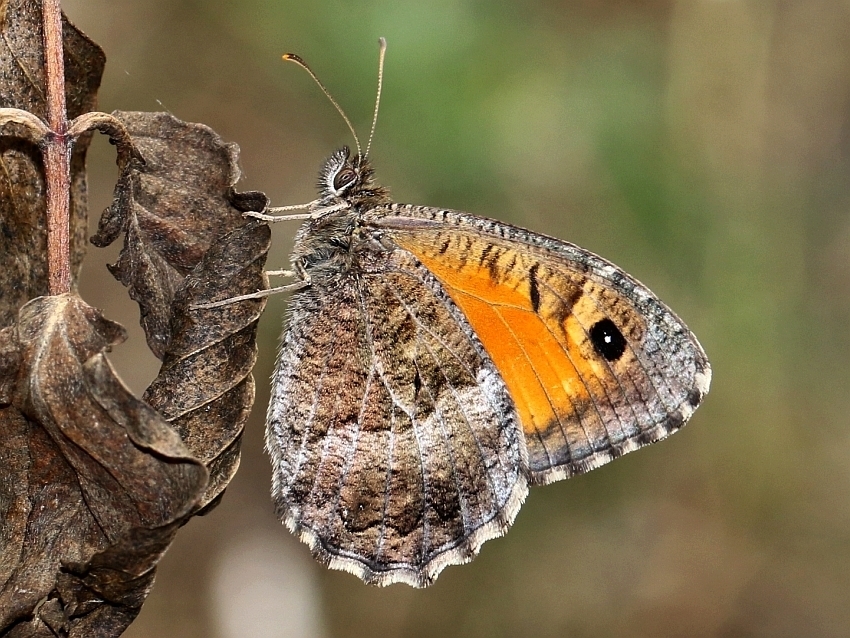
False Grayling
Arethusana arethusa
Arethusana is a butterfly genus from the subfamily Satyrinae of the brush-footed butterfly family (Nymphalidae). It is composed of only one species, Arethusana arethusa, the false grayling.
From the article Arethusana on Wikipedia (CC BY-SA), quoted section by section
Description
Arethusana arethusa has a wingspan of 42–47 millimetres (1.7–1.9 in) in males, of 50–54 millimetres (2.0–2.1 in) in females. The length of the forewings can reach 21–25 mm. The upper surface of the wings is dark brown, with a characteristic series of ocher-orange oval markings forming a V and a blackish brown large spot close to the top of the forewings. Also the hindwings have a small blackish spot near the border. The external edges of the wings has a tooth-shaped pattern. The underside of the hindwings is mottled and shows a transversal whitish band dividing the wing and well marked white veins. This species is rather similar to Pseudochazara graeca and Pseudochazara orestes.
Range & habitat
This species can be found as far west as Morocco and as far eastward as south-west Siberia and northern Tian Shan. These butterflies prefer grassy and bushy areas, steppes and arid sparse woodlands, at an elevation of 0–2,500 metres (0–8,202 ft) above sea level.
Wikipedia: “Distribution and habitat”
Listen
Looking for field recordings…
Where it lives
Recorded sightings
—
geo-referenced records in GBIF, from museums, herbaria and field observers.
Drag the globe to turn it. Dots are where records exist, not a range map; darker means more records.
In the stacks
Searching the stacks…
Every page naming Arethusana arethusa in the Biodiversity Heritage Library →
This page is assembled live from iNaturalist, GBIF, Wikipedia, the Source Library and the Internet Archive. It is not yet part of the hand-edited codex. iNaturalist taxon 337856.