- Animals
- ›Arthropods
- ›Hexapods
- ›Insects
- ›Winged and Once-winged Insects
- ›Ants, Bees, Wasps, and Sawflies
- ›Narrow-waisted Wasps, Ants, and Bees
- ›Proctotrupomorpha
- ›Gall Wasps and Allies
- ›Gall Wasps
- ›Cynipinae
- ›Oak Gall Wasps
- ›Neuroterus
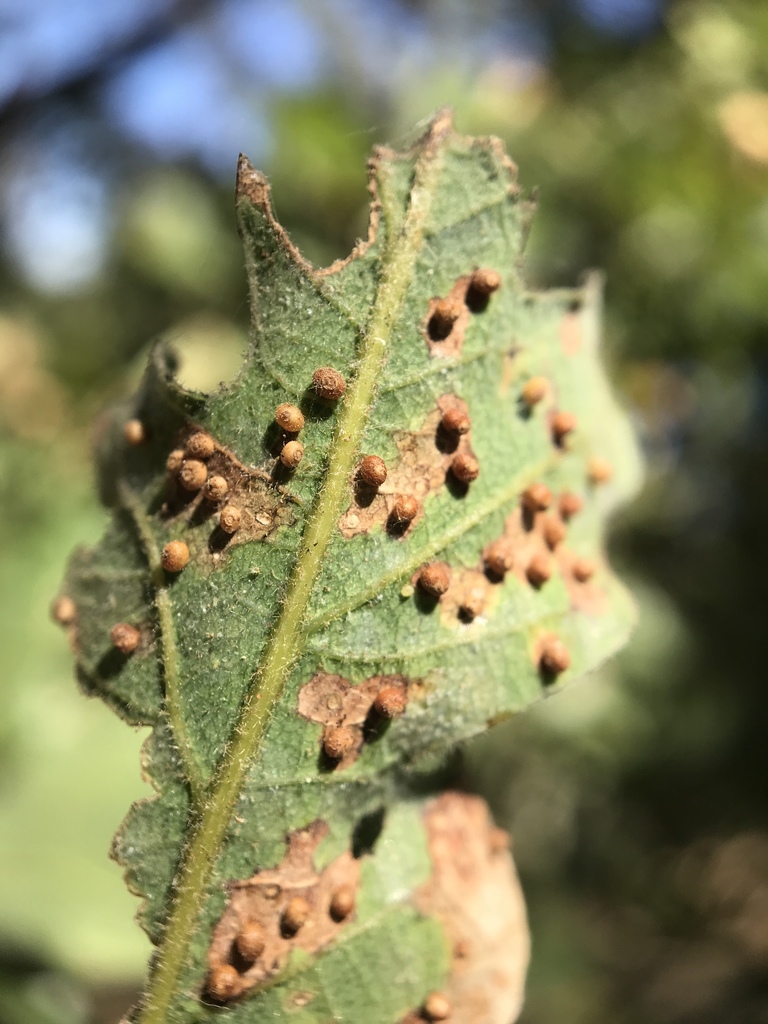
Jumping Gall Wasp
Neuroterus saltatorius
Neuroterus saltatorius, also known as the jumping gall wasp, is a species of oak gall wasp. It is found in North America, where it induces galls on a variety of oak trees, including Oregon oak, valley oak, California scrub oak, blue oak, and leather oak.
Like other oak gall wasps, it has two generations: a bisexual generation, and a parthenogenetic female generation. The all-female generation's galls appear in late spring. These round, 1 mm across galls occur on the underside of leaves, and eventually detach and fall into the leaf litter. Adults emerge early the following spring and lay eggs for the bisexual generation. This generation induces galls that are integral to the leaf.
From the article Neuroterus saltatorius on Wikipedia (CC BY-SA), quoted section by section
What it does
Once they have fallen to the ground, the unisexual galls of Neuroterus saltatorius "jump" due to the movements of the larvae inside. A study at University of California, Santa Cruz found this behavior happened during dry weather at temperatures between 20–40 °C (68–104 °F). This behavior might help the galls dig deeper into the leaf litter for protection from the elements or predators.
Wikipedia: “Jumping behavior”
Listen
Looking for field recordings…
Where it lives
Recorded sightings
—
geo-referenced records in GBIF, from museums, herbaria and field observers.
Drag the globe to turn it. Dots are where records exist, not a range map; darker means more records.
In the stacks
Searching the stacks…
Every page naming Neuroterus saltatorius in the Biodiversity Heritage Library →
This page is assembled live from iNaturalist, GBIF, Wikipedia, the Source Library and the Internet Archive. It is not yet part of the hand-edited codex. iNaturalist taxon 334129.