- Animals
- ›Arthropods
- ›Hexapods
- ›Insects
- ›Winged and Once-winged Insects
- ›Butterflies and Moths
- ›Butterflies
- ›Brush-footed Butterflies
- ›Satyrs, Morphos, and Allies
- ›Alpines, Arctics, Nymphs and Satyrs
- ›Erebiina
- ›Erebia
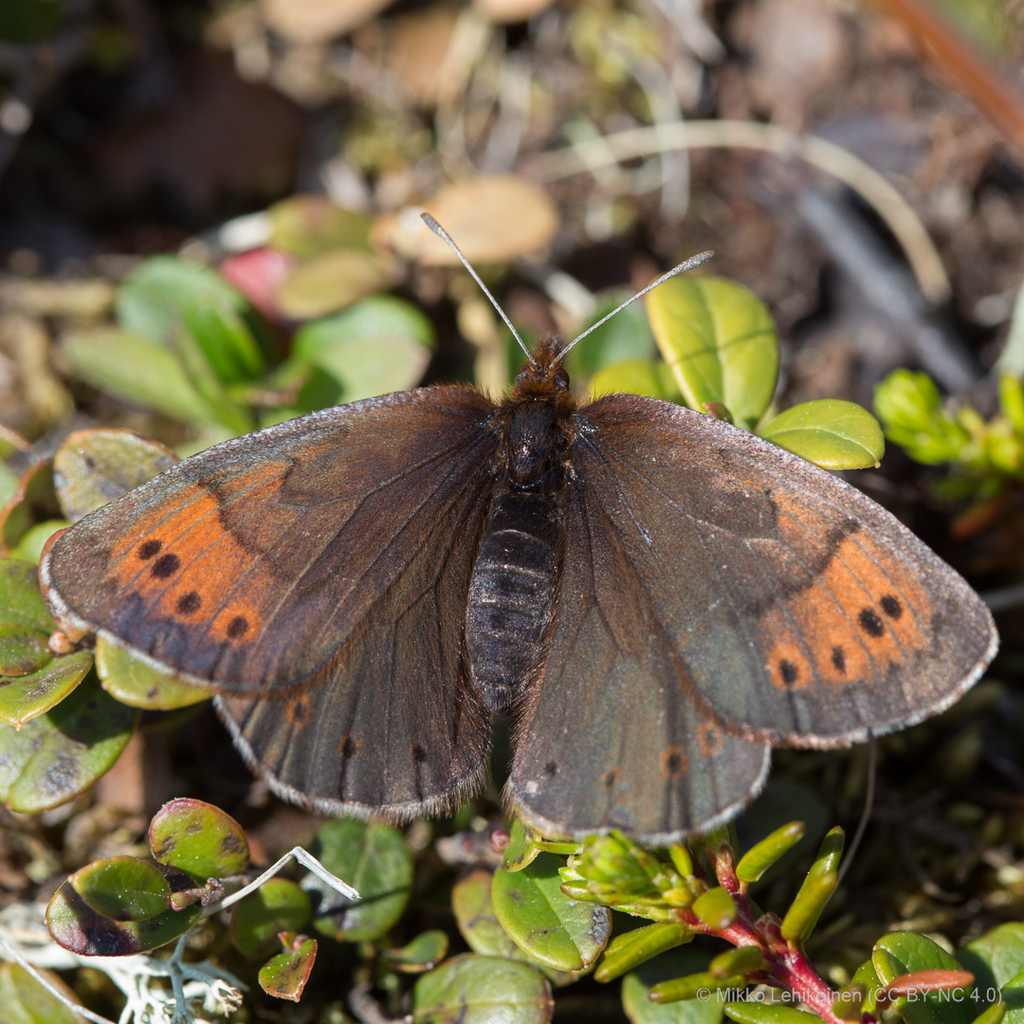
Dewy Ringlet
Erebia pandrose
Erebia pandrose, the dewy ringlet, is a member of the subfamily Satyrinae of the family Nymphalidae . It is found from the Arctic areas of northern Europe, the Pyrenees, Alps, the Apennine Mountains, the Carpathian Mountains, Kola Peninsula and Kanin Peninsula, part of the Ural and the Altai and Sayan Mountains up to Mongolia.
The wingspan is 30–38 mm. The forewing upperside ground colour is brown adorned with an orange postmedian band interspersed by the veins and marked with a line of blind black ocelli. The hind wing upperside has line of discrete orange spots each centered with a blind black ocella .
From the article Erebia pandrose on Wikipedia (CC BY-SA), quoted section by section
Description
E. lappona Esp. (= manto Frr., zilia Bkh.) (37 i). Upperside of both wings black-brown, somewhat glossy, the ground-colour of the female lighter, more grey-brown. The forewing with a rather broad russet brown band which does not reach the hindmargin and bears 4 black ocelli without pupils, the 2 upper ones standing close together and being somewhat shifted proximad. The band is not always equally distinct, varying in several directions. The hindwing has 3 - 4 black ocelli in russet -brown rings or is entirely unicolorous without markings. The forewing beneath with the central area russet -brown, the costal and distal margins being dusted with white-grey or bluish white, and the hindmargin black-brown. The ocelli as above, but mostly placed in russet -yellow rings. The hindwing beneath whitish or bluish grey with a median band which is bordered both proximally and distally by a thin brown dentate line. In the female this median band is more or less dusted with brown, the dentate lines being darker and broader and the band therefore more prominent than in the male. Before the distal margin there are 2 or 3 black dots which are sometimes absent. Head, thorax and abdomen black, the last ashy grey beneath. Antenna brown above, grey beneath, with yellow club. In the Pyrenees, Apennines, Alps and Carpathians, mostly only at considerable altitudes. — In ab. pollux Esp. …
Wikipedia: “Description in Seitz”
Listen
Looking for field recordings…
Where it lives
Recorded sightings
—
geo-referenced records in GBIF, from museums, herbaria and field observers.
Drag the globe to turn it. Dots are where records exist, not a range map; darker means more records.
In the stacks
Searching the stacks…
Every page naming Erebia pandrose in the Biodiversity Heritage Library →
This page is assembled live from iNaturalist, GBIF, Wikipedia, the Source Library and the Internet Archive. It is not yet part of the hand-edited codex. iNaturalist taxon 334019.