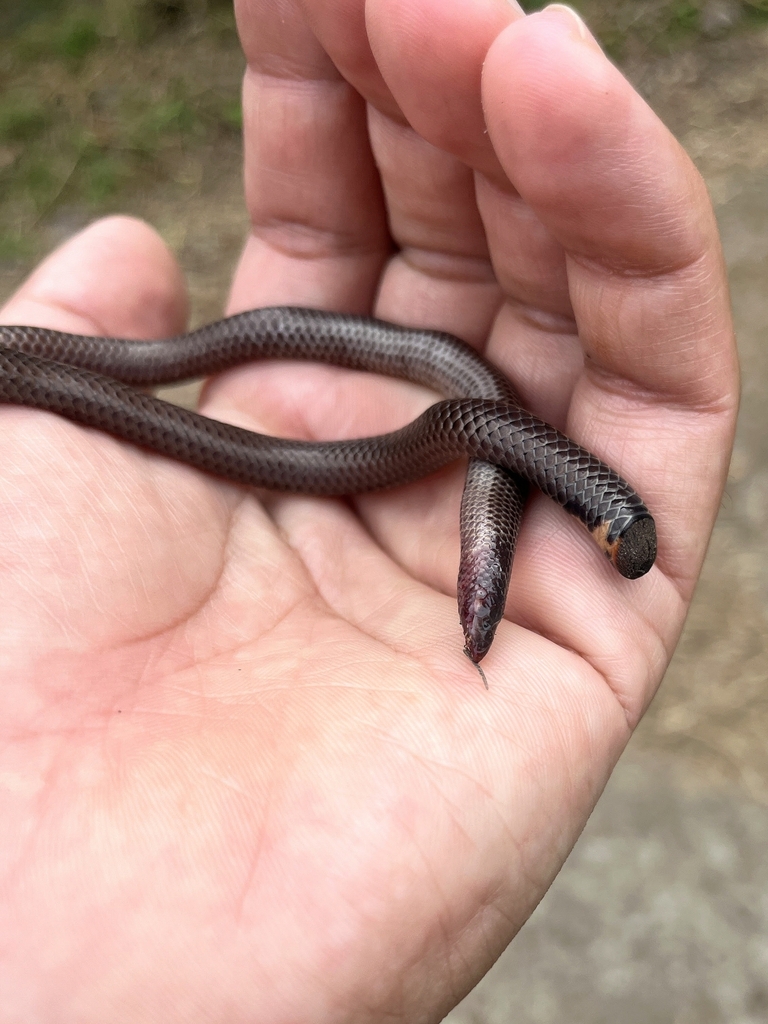
Cardamom Hills Earth Snake
Rhinophis fergusonianus
Rhinophis fergusonianus, commonly known as the Cardamom Hills earth snake, is a species of uropeltid snake endemic to the Western Ghats, India.
From the article Rhinophis fergusonianus on Wikipedia (CC BY-SA), quoted section by section
Description
The holotype of R. fergusonianus measures 32 cm (13 in) in total length (including tail), 40 times its width. The eyes are very small. The snout is acutely pointed. The body is longitudinally striated. It is blackish above, and the sides are white, dotted and spotted with black. The belly is white, with black dots and two series of large black spots, partially confluent into a zigzag band. The caudal disc is black and edged all round with yellow.
Range & habitat
R. fergusonianus is only known from the type specimen collected in the Cardamom Hills in Travancore, a part of the southern Western Ghats in modern Kerala, southeastern India. Recent studies found their occurrence in the districts of Malappuram, Palakkad, Thrissur, Ernakulam districts of Kerala, from both side of palghat gap.
Wikipedia: “Geographic range”
In human culture
The specific name, fergusonianus, is in honor of Scottish zoologist Harold S. Ferguson.
Wikipedia: “Etymology”
Where it lives
Recorded sightings
—
geo-referenced records in GBIF, from museums, herbaria and field observers.
Drag the globe to turn it. Dots are where records exist, not a range map; darker means more records.
In the stacks
Searching the stacks…
Every page naming Rhinophis fergusonianus in the Biodiversity Heritage Library →
This page is assembled live from iNaturalist, GBIF, Wikipedia, the Source Library and the Internet Archive. It is not yet part of the hand-edited codex. iNaturalist taxon 32385.