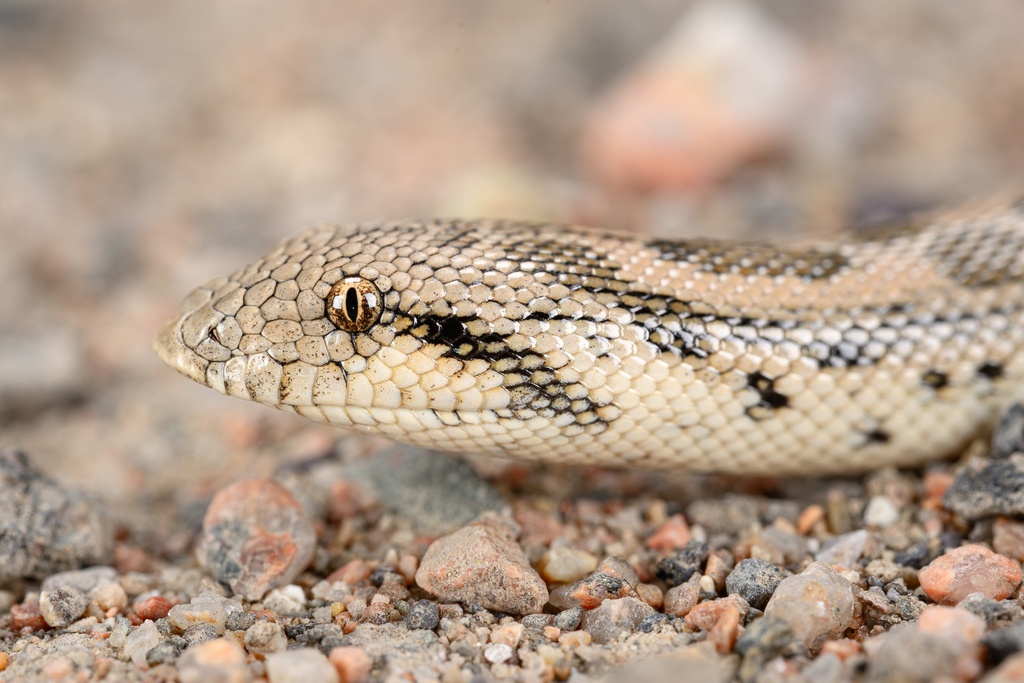
Desert Sand Boa
Eryx miliaris
Eryx miliaris, known as the dwarf sand boa, desert sand boa, and if formally synonymised with Eryx tataricus, as Tartar sand boa, is a widely distributed, largely Asian species of snake of the Boidae (boa, Erycidae) family. On behalf of the International Union for Conservation of Nature (IUCN), scientists assessed the populations of E. miliaris/tataricus across its range of habitats for the IUCN Red List of Threatened Species in April 2016, assigning them the status of "Least Concern".
The IUCN, the Reptile Database (RBD), and other contributing sources paint a relatively consistent picture of the distribution of these and other synonymous species, ranging from Iraq and Iran in the west, along the western shore of the Caspian Sea through all of central Asia, south into Afghanistan and Pakistan, and north and east into southern Russia, Mongolia, and Inner Mongolia in northern China.
From the article Eryx miliaris on Wikipedia (CC BY-SA), quoted section by section
Range & habitat
In the geographic regions Eryx miliaris occupies, the WCH-University of Adelaide describes it being found at "[e]levations up to about 2700 met[ers above mean sea level], mainly in arid and semi-arid sandy regions with bush vegetation" but that it will also "tolerate harder soils and rocky slope terrain". The International Union for Conservation of Nature (IUCN) describes it as occupying elevations from sea level to approximately 1200 meters above it. With regard to the IUCN's observed species in Mongolia referred to as E. tataricus—see earlier Reptile Database (RDB) statements on the synonymy of species E. miliaris, E. tataricus, etc.—E. tataricus was observed to occupy elevations from 80 to 1600 meters above sea level; and the IUCN's putative subspecies referred to as E. tataricus vittatus, from 700 to 1400 meters above it. The RDB describes the geographic range of E. miliaris, per se, as being:
throughout Iraq; throughout Kazakhstan, Uzbekistan, Turkmenistan, and Afghanistan; in southern Russia, from the Caspian Sea to its border with Kazakhstan; in China, from Xinjiang, through Gansu and Ningxia to Inner Mongolia; and in Mongolia itself. The RDB further presents E. miliaris nogaiorum. a subspecies (alongside E. …
Wikipedia: “Habitat, distribution, threat status”
What it does
The WCH-University of Adelaide describe E. miliaris as "[t]errestrial and mainly diurnal... with nocturnal tendencies in [its habitat's] hottest months". The IUCN description of the species, which specifically refers to E. miliaris (distinctly, from E. tataricus and E. speciosus), presents it as "nocturnal during the hot part of the year", indicates that it is "common on the surface in spring", and states that it is active from "March to October over most of its range" (and the more proscribed April to September in Kazakhstan and the eastern Ciscaucasia). With regard to its diet and prey, the WCH-University of Adelaide describes E. miliaris as feeding "mainly on rodents and lizards". Elsewhere its prey have been described as including small birds, desert lizards, and other small animals.
Wikipedia: “Activity, diet”
In human culture
The Eryx miliaris species present in Mongolia, referred via the synonym Eryx tataricus, may be the inspiration for a legendary cryptid, the Mongolian death worm. A specimen described as E. tataricus was shown to inhabitants of the Gobi Desert in Mongolia, who claimed to have seen that cryptid, locally referred to as "olgoi-khorkhoi" ("large intestine worm"), and stated it to be the same animal.
Wikipedia: “Popular culture”
Where it lives
Recorded sightings
—
geo-referenced records in GBIF, from museums, herbaria and field observers.
Drag the globe to turn it. Dots are where records exist, not a range map; darker means more records.
In the stacks
Searching the stacks…
Every page naming Eryx miliaris in the Biodiversity Heritage Library →
This page is assembled live from iNaturalist, GBIF, Wikipedia, the Source Library and the Internet Archive. It is not yet part of the hand-edited codex. iNaturalist taxon 32219.