- Animals
- ›Arthropods
- ›Hexapods
- ›Insects
- ›Winged and Once-winged Insects
- ›Flies
- ›Brachyceran Flies
- ›Cyclorrhaphan Flies
- ›Schizophoran Flies
- ›Acalyptrate Flies
- ›Fruit, Signal, and Picture-winged Flies
- ›Fruit Flies
- ›Trypetinae
- ›Trypetini
- ›Trypetina
- ›Strauzia
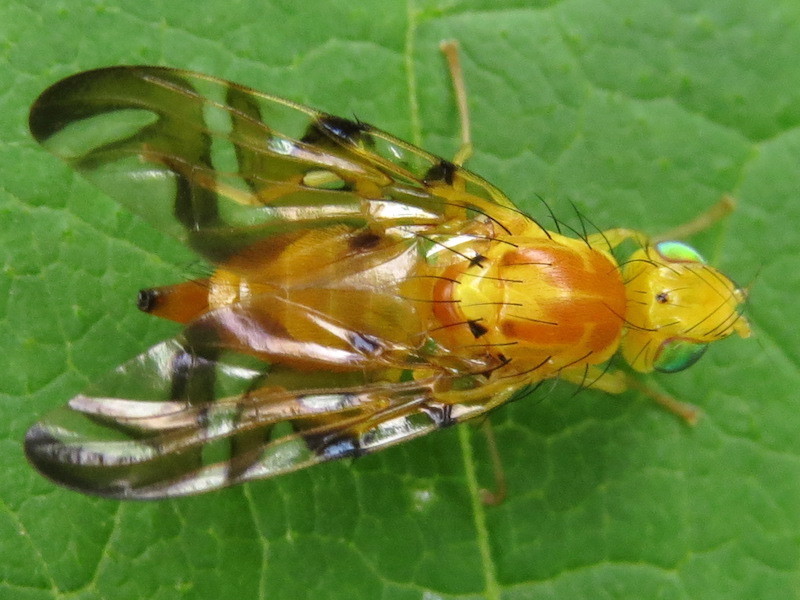
Sunflower Maggot Fly
Strauzia longipennis
Strauzia longipennis is a large species of tephritid fruit fly known by the common name sunflower maggot. It is a minor pest whose larvae mine stems of sunflowers (Helianthus spp.). Damage from larval feeding on spongy tissue is usually light. The larvae do not damage the flower head or seeds, although those of other fruit fly species do so.
Adults are about 6 mm long and a wing length of approximately 7 mm. (reasonably large for a Tephritid) The body is yellow to orange and the wing has orange to brown bands, usually forming a distinct F-shaped marking near the wing tip. The larvae are yellowish-white in color reaching a length of about 5 mm and spend around 30 days feeding within the host plant before overwintering in the base of the plant or soil as pupae. Adults are found from May to August depending on location.
Listen
Looking for field recordings…
Where it lives
Recorded sightings
—
geo-referenced records in GBIF, from museums, herbaria and field observers.
Drag the globe to turn it. Dots are where records exist, not a range map; darker means more records.
In the stacks
Searching the stacks…
Every page naming Strauzia longipennis in the Biodiversity Heritage Library →
This page is assembled live from iNaturalist, GBIF, Wikipedia, the Source Library and the Internet Archive. It is not yet part of the hand-edited codex. iNaturalist taxon 322166.