- Animals
- ›Arthropods
- ›Hexapods
- ›Insects
- ›Winged and Once-winged Insects
- ›Flies
- ›Brachyceran Flies
- ›Cyclorrhaphan Flies
- ›Aschizan Flies
- ›Hover Flies
- ›Typical Hover Flies
- ›Syrphini
- ›Sphaerophoria
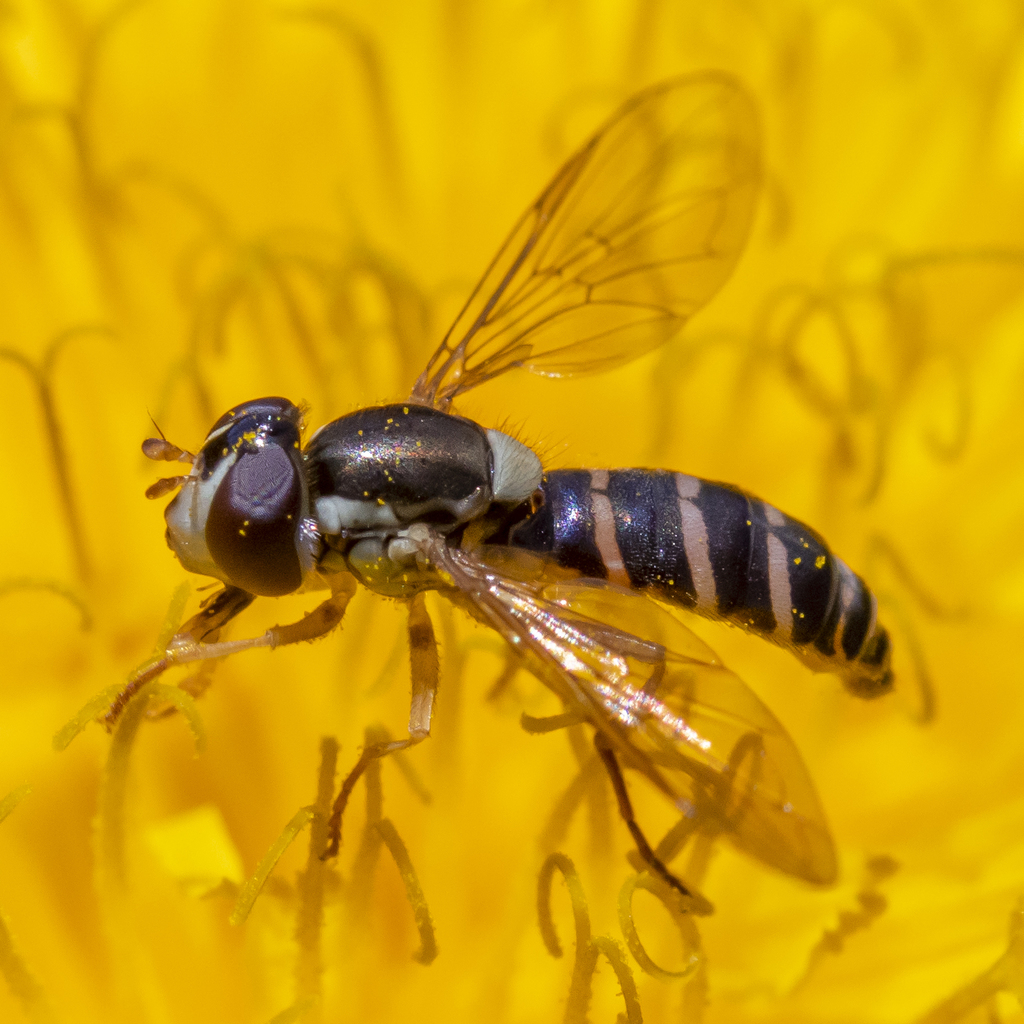
Symmetric Globetail
Sphaerophoria bifurcata
Sphaerophoria bifurcata, the symmetric globetail, is a species of syrphid fly in the family Syrphidae. The larvae of this genus are predators of aphids and other small hymenoptera. The larvae of this particular species is not known.
From the article Sphaerophoria bifurcata on Wikipedia (CC BY-SA), quoted section by section
Description
For terms see Morphology of Diptera. Diagostic characters are the black frontal stripe that is forked or incised toward anterior, and the tergites with yellow bands that are short, arcuate, narrowly divided or incised posteriorly. Examining the male genitalia is the best way to identify to species.
Size Length 7.1–8 mm (0.28–0.31 in)
In the male The frons has numerous black hairs. The scutum has lateral yellow stripes meeting the scutellum. The stripes are sometimes constricted behind suture. The legs hind femur are without long hairs posteroventrally. The legs are yellow with the fore and mid tarsi sometimes brownish. The apical tarsomeres are as pale as or paler than the basal tarsomere. Tergites 2-4 have narrow yellow bands usually entire or narrowly divided. Sternite 2 has long sparse straight hairs. ThesSurstylus has the dorsal lobe depressed, with long hairs along ventral margin. The inner lobe is present but with variable shapes. The ventral lobe is broad, abruptly constricted very near apex, with short preapical toothlike posterior process and short fingerlike apical process. The genitalia are illustrated by Vockeroth
In the female The frons has a broad median black stripe extending to antennae where it bifurcate apically. The yellow areas of frons has many black hairs. …
Range & habitat
British Columbia, Ontario, New Brunswick, Manitoba, Quebec, Nova Scotia, Alberta, Oregon, Michigan, Maine, New Hampshire.
== References ==
Wikipedia: “Distribution”
Listen
Looking for field recordings…
Where it lives
Recorded sightings
—
geo-referenced records in GBIF, from museums, herbaria and field observers.
Drag the globe to turn it. Dots are where records exist, not a range map; darker means more records.
In the stacks
Searching the stacks…
Every page naming Sphaerophoria bifurcata in the Biodiversity Heritage Library →
This page is assembled live from iNaturalist, GBIF, Wikipedia, the Source Library and the Internet Archive. It is not yet part of the hand-edited codex. iNaturalist taxon 321859.