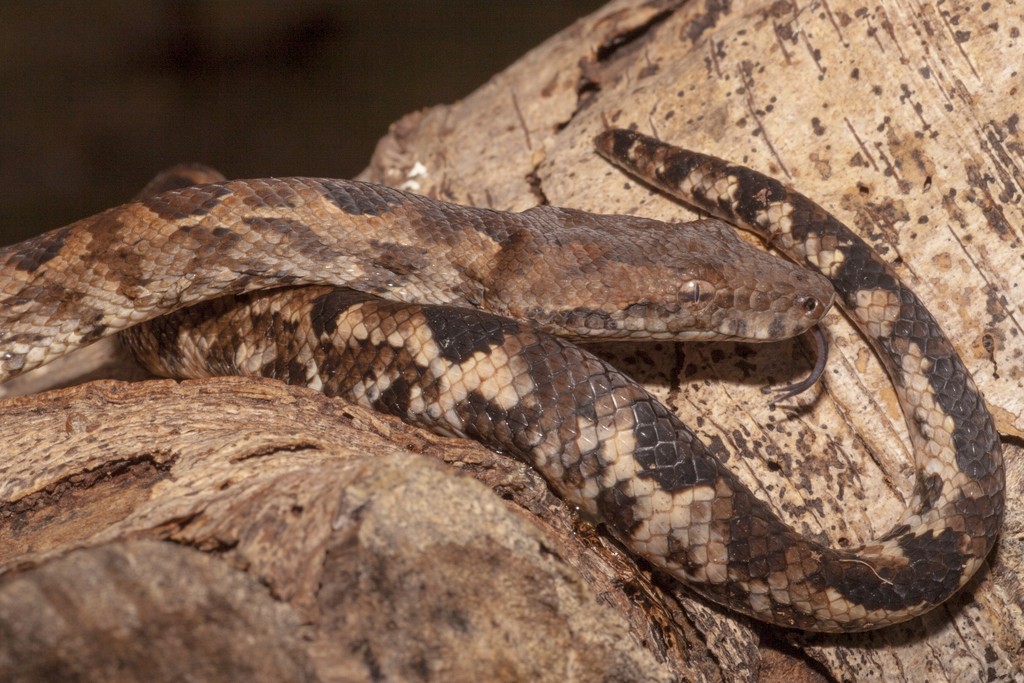
Bibron's Bevel-nosed Boa
Candoia bibroni
Candoia bibroni – commonly known as Bibron's bevel-nosed boa, Bibron's keel-scaled boa, the Pacific tree boa and the Fiji boa – is a species of snake in the subfamily Candoiinae of the family Boidae. The genus Candoia is a group of non-venomous, constricting snakes, endemic to the southern Pacific Ocean island chains of Melanesia and Polynesia. Two subspecies of Candoia bibroni are recognized, including the nominate subspecies, described here. Candoia bibroni is one of the most isolated and far-removed species of boid snakes on earth, as the majority of boa species (such as Boa constrictor) are found in the Americas and the Caribbean, or, in the case of the terrestrial sand boas (subfamily Erycinae), in Africa and Eurasia.
From the article Candoia bibroni on Wikipedia (CC BY-SA), quoted section by section
Description
Candoia bibroni is the largest member of the genus Candoia; adults can grow to up to 5 ft /1.5 meters in total length (including the tail). The color pattern usually consists of a pale brown, tan, or reddish-brown ground color overlaid with stripes, blotches, or spots. However, some individuals have no pattern at all.
Range & habitat
Candoia bibroni is found in the South Pacific, primarily across the islands of Melanesia and Polynesia, including the eastern Solomon Islands (Olu Malau, Ugi, Rennell, Makira, Santa Ana, Santa Cruz, Bellona, Vanikoro and Utupua), the Banks Islands (Vanua Lava), Vanuatu (Efate, Erromango, Espiritu Santo), the Loyalty Islands (Lifou, Ouvéa, Tiga), Fiji—including Kadavu, Rotuma, Ovalau, Taveuni, the Mamanuca (Malolo, Mana), Yasawa and Lau Islands—, Tuvalu, Western Samoa (Savaiʻi and Upolu), and American Samoa (Taʻū). The type locality given is "l'île Viti" (local name of Fiji Islands archipelago). Jacquinot and Guichenot (1853) list the type locality as "de l'archipel de Viti, Polynésie".
Wikipedia: “Geographic range”
What it does
Candoia bibroni is both an arboreal and a terrestrial hunter, preying primarily on birds, lizards (such as the many insular gecko and skink species) and small mammals, including rodents and bats.
Wikipedia: “Feeding”
Where it lives
Recorded sightings
—
geo-referenced records in GBIF, from museums, herbaria and field observers.
Drag the globe to turn it. Dots are where records exist, not a range map; darker means more records.
In the stacks
Searching the stacks…
Every page naming Candoia bibroni in the Biodiversity Heritage Library →
This page is assembled live from iNaturalist, GBIF, Wikipedia, the Source Library and the Internet Archive. It is not yet part of the hand-edited codex. iNaturalist taxon 32116.