- Animals
- ›Arthropods
- ›Hexapods
- ›Insects
- ›Winged and Once-winged Insects
- ›Flies
- ›Brachyceran Flies
- ›Cyclorrhaphan Flies
- ›Aschizan Flies
- ›Hover Flies
- ›Drone Flies and Allies
- ›Rat-tail Maggot Flies
- ›Eristalina
- ›Eristalis
- ›Eoseristalis
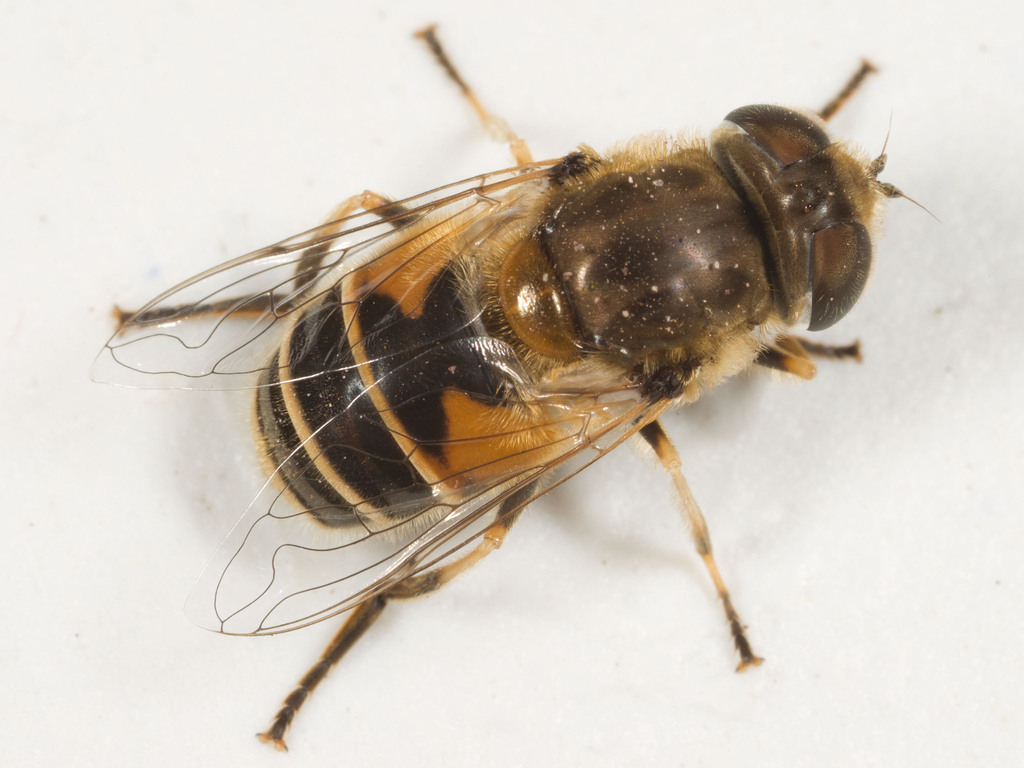
Eurasian Drone Fly
Eristalis arbustorum
Eristalis arbustorum, the European drone fly, is an abundant Northern Hemisphere species of syrphid fly, originally officially described by Linnaeus in 1758 as Musca arbustorum. The name "drone fly" is related to its similar appearance to the drone of the honeybee. Hoverflies get their names from the ability to remain nearly motionless while in flight. The adults are also known as flower flies as they are commonly found on and around flowers from which they get both energy-giving nectar and protein rich pollen. The larvae are aquatic filter-feeders of the long-tailed type.
From the article Eristalis arbustorum on Wikipedia (CC BY-SA), quoted section by section
Description
External images For terms see Morphology of Diptera The wings are 7–10 mm long. At least, the basal half of the arista is plumose. The face is entirely pale dusted; there is a shining black median stripe in rubbed specimens. The hind femora are pale at their tips only. E. arbustorum resembles E. abusiva, but they are distinguished by the plumose arista, as well as a less projecting mouth-edge and shorter hairs overall. The top quarter of tibia 2 is black. The male genitalia are figured by Hippa et al. (2001). The larva is figured by Hartley (1961).
Range & habitat
Eristalis arbustorum occurs throughout the Palaearctic, including North Africa, as well as in North India (Indomalayan realm). In North America, the species was introduced near Toronto around 1885 and is now ubiquitous throughout much of the United States and Canada. distribution map
== References ==
Wikipedia: “Distribution”
Listen
Looking for field recordings…
Where it lives
Recorded sightings
—
geo-referenced records in GBIF, from museums, herbaria and field observers.
Drag the globe to turn it. Dots are where records exist, not a range map; darker means more records.
In the stacks
Searching the stacks…
Every page naming Eristalis arbustorum in the Biodiversity Heritage Library →
This page is assembled live from iNaturalist, GBIF, Wikipedia, the Source Library and the Internet Archive. It is not yet part of the hand-edited codex. iNaturalist taxon 320786.