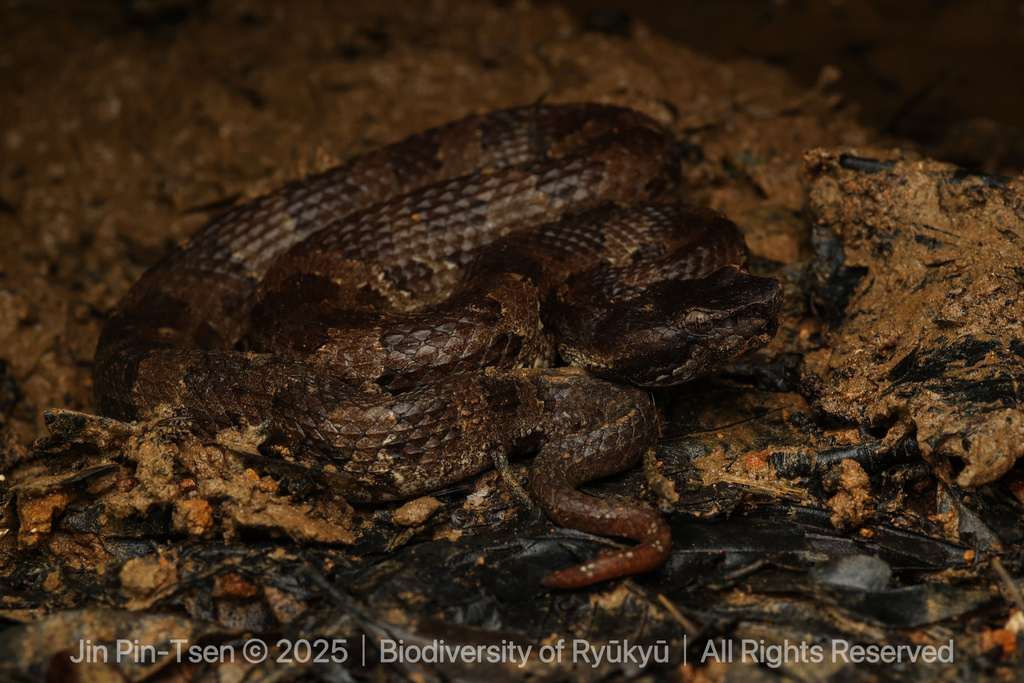
Okinawa Pitviper
Ovophis okinavensis
Ovophis okinavensis, commonly known as the hime habu (ヒメハブ), Ryukyu Island pit viper, and the Okinawan pitviper, is a pit viper species found in the Ryukyu Islands of Japan. No subspecies are currently recognized.
From the article Ovophis okinavensis on Wikipedia (CC BY-SA), quoted section by section
Description
Adults are usually 30 to 80 cm (11¾–31½ inches) long. Body usually pale greenish-brown, or yellowish-olive (sometimes pale brown), with alternating, darker brownish or greenish dorsal blotches, each bordered with yellowish scales. Head large, triangular, distinct from neck, narrow dark postocular stripe. Scalation includes: 23 or 21 rows of dorsal scales at midbody; 125–135 ventral scales; 36–55 paired subcaudal scales; and 8 (sometimes 7 or 9) supralabial scales. The color pattern consists of a gray ground color overlaid with a series of dark gray of grayish-black crossbands. A ventrolateral pattern of black spots against a gray-white background is also present.
Range & habitat
The species is found in the Ryukyu Islands of Japan, including Okinawa and the Amami Islands. The type locality given is "Okinawa".
Wikipedia: “Geographic range”
What it does
The hime habu hunts for rodents and other vertebrates in open areas, especially in sugar cane fields and, sometimes near human habitations.
Wikipedia: “Feeding”
Toxicity
The venom of Ovophis okinavensis, like that of most vipers, is mainly hemotoxin with cytotoxicity factors. People are bitten when they step on this sluggish snake at night, or when tending crops by day. Although venom from this snake is not life-threatening usually, people still should seek medical attention promptly if they are bitten. Because of its relatively weak venom, antivenom is not produced.
Wikipedia: “Venom”
Where it lives
Recorded sightings
—
geo-referenced records in GBIF, from museums, herbaria and field observers.
Drag the globe to turn it. Dots are where records exist, not a range map; darker means more records.
In the stacks
Searching the stacks…
Every page naming Ovophis okinavensis in the Biodiversity Heritage Library →
This page is assembled live from iNaturalist, GBIF, Wikipedia, the Source Library and the Internet Archive. It is not yet part of the hand-edited codex. iNaturalist taxon 31031.