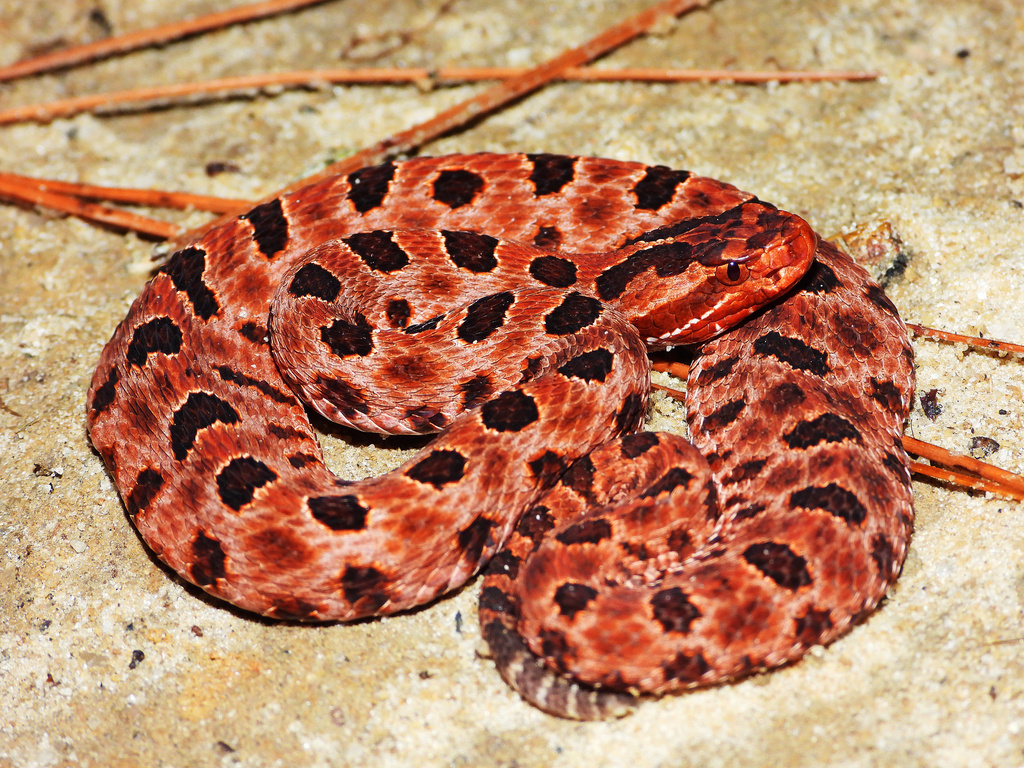
Pygmy Rattlesnake
Sistrurus miliarius
Common names: pygmy rattlesnake, eastern pygmy rattlesnake, ground rattlesnake, leaf rattler, death rattler, more.
Sistrurus miliarius, commonly called the pygmy rattlesnake, is a species of venomous snake in the subfamily Crotalinae (pit vipers) of the family Viperidae. The species is endemic to the Southeastern United States. Three subspecies are currently recognized.
From the article Sistrurus miliarius on Wikipedia (CC BY-SA), quoted section by section
Description
Sistrurus miliarius is a small species, but bulky in width, with adults usually growing to 40–60 cm (16–24 in) in total length (including tail). It is the smallest species of rattlesnake on the North American continent. The maximum reported total length is 78.8 cm (31.0 in) (Klauber, 1972). Snellings and Collins (1997) reported a specimen of S. m. barbouri measuring 80.3 cm (31.6 in), but it had been in captivity for over 12 years. The largest S. m. barbouri reported by Gloyd (1940) was a specimen measuring 63.8 cm (25.1 in) from St. Petersburg, Florida. Shine (1978) suggested that in some populations, males may be larger than females, but a later study by Bishop et al. (1996) did not find sexual dimorphism of any kind in a population in Volusia County, Florida. It is currently theorized that the lack of sexual dimorphism in the species is due to the fact that both males and females experience selective pressures to be of a larger size. At midbody, the rows of dorsal scales usually number 23. The dorsal pattern consists of a series of oval or subcircular spots with somewhat regular edges. The spots on the flanks are mostly round and not much higher than they are wide. Belly pigmentation towards the rear is more limited to indistinct blotches found on pairs of adjacent scales. …
Range & habitat
Sistrurus miliarius is found in the Southeastern United States from southern and eastern North Carolina, south through peninsular Florida and west to East Texas and Oklahoma. The type locality given is "Carolina". Schmidt (1953) proposed that this be restricted to "Charleston, South Carolina".
Wikipedia: “Geographic range”
What it does
Sistrurus miliarius is usually seen in the summer sunning itself or crossing the road late in the day. The tiny rattle makes a buzzing sound that can only be heard from a few feet away. The unusually small rattles of the pygmy rattlesnake is suggestive of the early stages of rattle evolution. Some individuals are very aggressive and strike furiously, while others seem lethargic and do not even attempt to rattle. Some research has shown that a larger portion of these rattlesnakes are usually reluctant to bite. It does not dig its own burrows, but rather uses those dug by small rodents or gopher tortoises (Gopherus polyphemus). These snakes typically don't move far from their "home burrows" and studies have shown that males may move farther than females. Pygmy Rattlesnakes are generally solitary but become social only during the breeding season. During this time, male pygmy rattlesnakes become agonistic towards each other, with fighting, challenge displays, and mate-guarding behavior all being observed.
Wikipedia: “Behavior”
Toxicity
Since Sistrurus miliarius is unable to produce much venom, it is unlikely to be able to deliver a fatal bite to a human adult. This snake produces cytotoxic venom that is strongly hemorrhagic and tissue toxic, but devoid of any neurotoxins. The venom was the basis for the development of the drug eptifibatide, which is used to prevent clotting during a heart attack. The venom is somewhat different in that it contains substantial amounts of serotonin and related tryptamine compounds.
Wikipedia: “Venom”
In human culture
The specific name, miliarius, is derived from Latin and means millet or millet-like, perhaps referring to the blotched patterns described in the species.
Wikipedia: “Etymology”
Where it lives
Recorded sightings
—
geo-referenced records in GBIF, from museums, herbaria and field observers.
Drag the globe to turn it. Dots are where records exist, not a range map; darker means more records.
In the stacks
Searching the stacks…
Every page naming Sistrurus miliarius in the Biodiversity Heritage Library →
This page is assembled live from iNaturalist, GBIF, Wikipedia, the Source Library and the Internet Archive. It is not yet part of the hand-edited codex. iNaturalist taxon 30983.