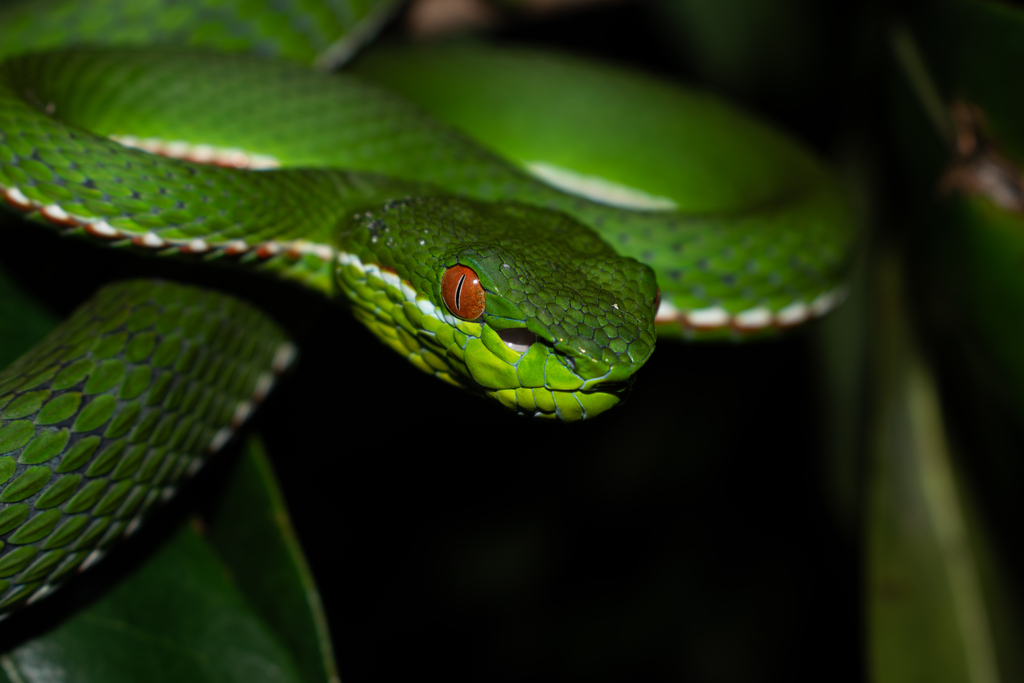
Chinese Green Tree Viper
Trimeresurus stejnegeri
Trimeresurus stejnegeri is a species of venomous pit viper endemic to Asia. Two subspecies are currently recognized, including the nominate subspecies described here.
Common names for this pit viper include Stejneger's pit viper, Chinese pit viper, Chinese green tree viper, bamboo viper, Chinese bamboo pitviper, Chinese bamboo viper, and Chinese tree viper. For other common, non-scientific names, see § Common names below.
From the article Trimeresurus stejnegeri on Wikipedia (CC BY-SA), quoted section by section
Description
Trimeresurus stejnegeri grows to a maximum total length of 75 centimetres (30 in), which includes a tail length of 14.5 centimetres (5.7 in). The males have hemipenes that are short and spinose beyond the bifurcation. The dorsal scales are arranged in 21 longitudinal rows at midbody. There are 9–11 upper labials, of which the first are separated from nasal scales by a distinct suture. The supraoculars are single, narrow, and sometimes divided by a transverse suture. There are 11–16 scales in a line between the supraoculars. The ventrals number 150–174, and the subcaudals are 54–77. All of the subcaudals are paired. The color pattern is bright to dark green above, pale green to whitish below, the two separated by a bright bicolored orange or brown (below) and white (above) (males) or bicolored or white only (females) ventrolateral stripe, which occupies the whole of the outermost scale row and a portion of the second row. Bamboo vipers are carnivores: they eat small rodents, birds, frogs, and lizards. Yellow colored mutants have been reported.
Range & habitat
Trimeresurus stejnegeri is found in India (Western Ghats & Eastern Ghats, Northeast India) and Nepal through Myanmar and Laos to much of southern China (Yunnan, Sichuan, Gansu, Jiangxi, Jiangsu, Hunan, Hubei, Guizhou, Guangxi, Guangdong, Hainan, Fujian, Anhui, Zhejiang), Vietnam, and Taiwan. The type locality was originally listed as "Shaowu, Fukien Province, China", and later amended to "N.W. Fukien Province" by Pope & Pope (1933) (Fukien being the former romanization of Fujian). this snake is often confused with Trimeresurus, Ahaetulla oxyrhyncha in India.
Wikipedia: “Geographic range”
Toxicity
Trimeresurus stejnegeri has a potent hemotoxin. The wound usually feels extremely painful, as if it had been branded with a hot iron, and the pain does not subside until about 24 hours after being bitten. Within a few minutes of being bitten, the surrounding flesh dies and turns black, highlighting the puncture wounds. The wound site quickly swells, and the skin and muscle become black due to necrosis. The size of the necrotic area depends on the amount of venom injected and the depth of the bite.
Wikipedia: “Venom”
In human culture
The specific name, stejnegeri, is in honor of Leonhard Stejneger, the Norwegian-born, American herpetologist who worked at the Smithsonian Institution for over 60 years.
Wikipedia: “Etymology”
Where it lives
Recorded sightings
—
geo-referenced records in GBIF, from museums, herbaria and field observers.
Drag the globe to turn it. Dots are where records exist, not a range map; darker means more records.
In the stacks
Searching the stacks…
Every page naming Trimeresurus stejnegeri in the Biodiversity Heritage Library →
This page is assembled live from iNaturalist, GBIF, Wikipedia, the Source Library and the Internet Archive. It is not yet part of the hand-edited codex. iNaturalist taxon 30953.