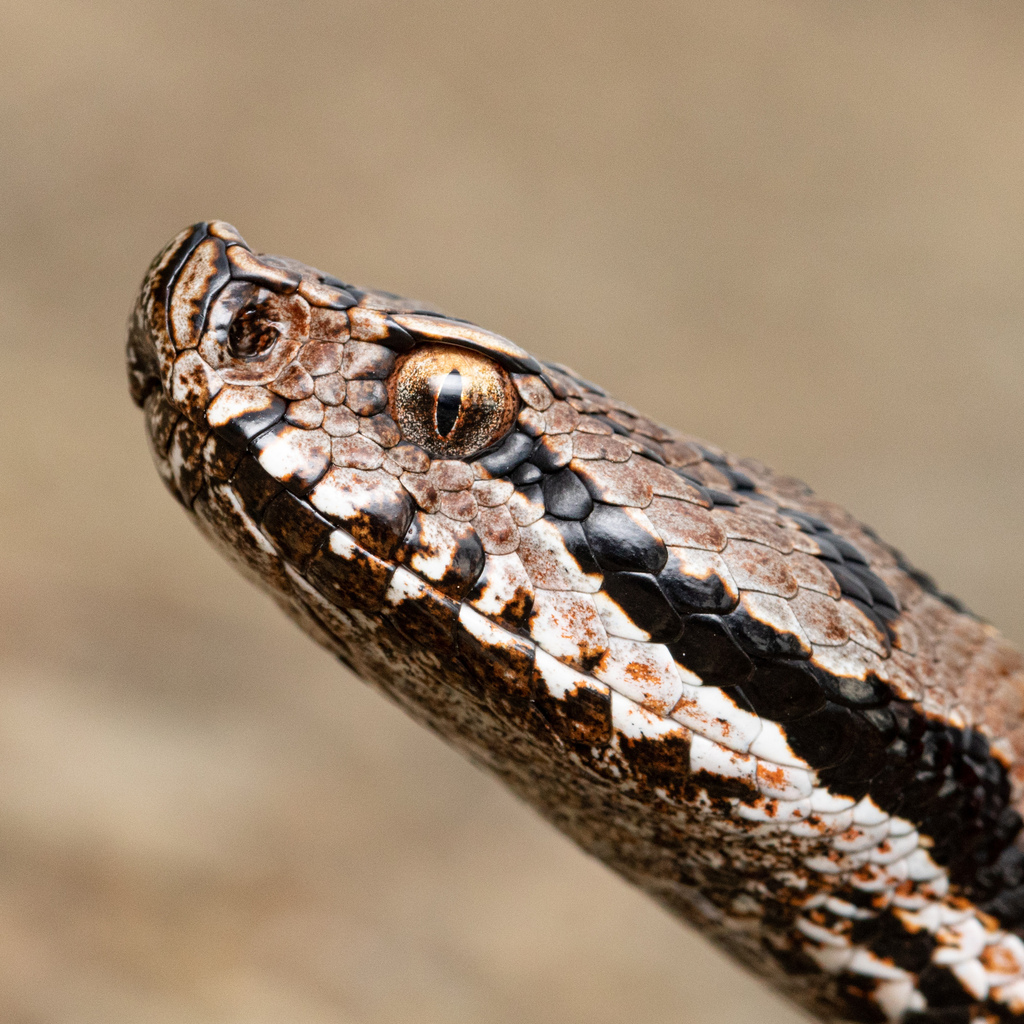
Asp
Vipera aspis
Vipera aspis is a viper species found in southwestern Europe.
Its common names include asp, asp viper, European asp, and aspic viper, among others. Like all other vipers, it is venomous. Bites from this species can be more severe than from the European adder, V. berus; not only can they be very painful, but approximately 4% of all untreated bites are fatal. The specific epithet, aspis, is a Greek word that means "viper." Five subspecies are currently recognized, including the nominate subspecies described here.
From the article Vipera aspis on Wikipedia (CC BY-SA), quoted section by section
Description
The species grows to an average total length of 60–65 centimetres (24–26 in). Males reach a maximum total length of 85 cm (33 in), females rarely more than 75 cm (30 in). Males, however, are a little slimmer than females. The tail is very short: one-seventh to one-ninth of total body length in females, and one-sixth to one-eighth in males. The head is broad, triangular and quite distinct from the neck. The tip of the snout is slightly but distinctly upturned. The rostral scale is generally higher than it is wide, touching 2 to 3 scales on the upper side of the snout. Dorsally, the snout is flat with distinct and slightly raised sharp margins. The nasal scale is single (hardly ever divided) and separated from the rostral by a single nasorostral scale. The crown is covered with numerous small and irregular scales of different sizes that are mostly smooth, but sometimes slightly keeled. Frontal and parietal scales are usually not present, but if so, they are small and irregularly shaped, with the frontal separated from the supraoculars by 2 scale rows. The supraocular scales are large and distinct, separated by 4–7 scale rows. There are 10–12 (rarely 8–18) small circumorbital scales below the supraocular. The eye is separated from the supralabials by 2 (rarely 3) scale rows. The vertical diameter of the eye is about the same as the distance between the eye and the mouth. …
Range & habitat
It is native to France, Andorra, north-eastern Spain, extreme south-western Germany in the southern Black Forest, Switzerland, Italy, and north-western Slovenia. The original type locality was listed simply as "Gallia." However, Schwarz (1936) proposed that it be restricted to "Poitou [Frankreich]" (Poitou, France). It has been extirpated from Bulgaria. In August–October 2006, a number of specimens were discovered in a wooded area near the town of Poortugaal in the Netherlands. Although they were doing quite well, the species is not native to this country. It is likely that one or more escaped or were set loose in the area.
Wikipedia: “Distribution”
Toxicity
A bite from this species can be more severe than from V. berus and is very painful. According to Stemmler (1971), about 4% of all untreated bites are fatal. Lombardi and Bianco (1974) mention that this species is responsible for 90% of all cases of snakebite in Italy and it is the only potentially lethal snake in Italian mountains. The toxicity of the venom varies. Stemmler (1971) states that the population in Passwang district, Switzerland have the strongest venom based on studies conducted on mice. Compared to venoms from other species, it is relatively toxic. Brown (1973) gives LD50 values of 1.0 mg/kg IV and 1.0–2.0 mg/kg SC. Tu et al. (1969) report 4.7 mg/kg IM. Venom yield is relatively low. Boquet (1964) reported a daily extraction figure of 9–10 mg. Envenomation symptoms include rapidly spreading acute pain, followed by edema and discoloration. Severe haemorrhagic necrosis may occur within a few hours. Vision may be severely impaired, most likely due to degradation of blood and blood vessels in the eyes. The venom has both coagulant and anticoagulant effects. The venom may also affect glomerular structure, which can lead to death due to renal failure. According to Cheymol et al. (1973), the venom does not affect neuromuscular contractions in in vitro preparations. …
Wikipedia: “Venom”
Where it lives
Recorded sightings
—
geo-referenced records in GBIF, from museums, herbaria and field observers.
Drag the globe to turn it. Dots are where records exist, not a range map; darker means more records.
In the stacks
Searching the stacks…
Every page naming Vipera aspis in the Biodiversity Heritage Library →
This page is assembled live from iNaturalist, GBIF, Wikipedia, the Source Library and the Internet Archive. It is not yet part of the hand-edited codex. iNaturalist taxon 30929.