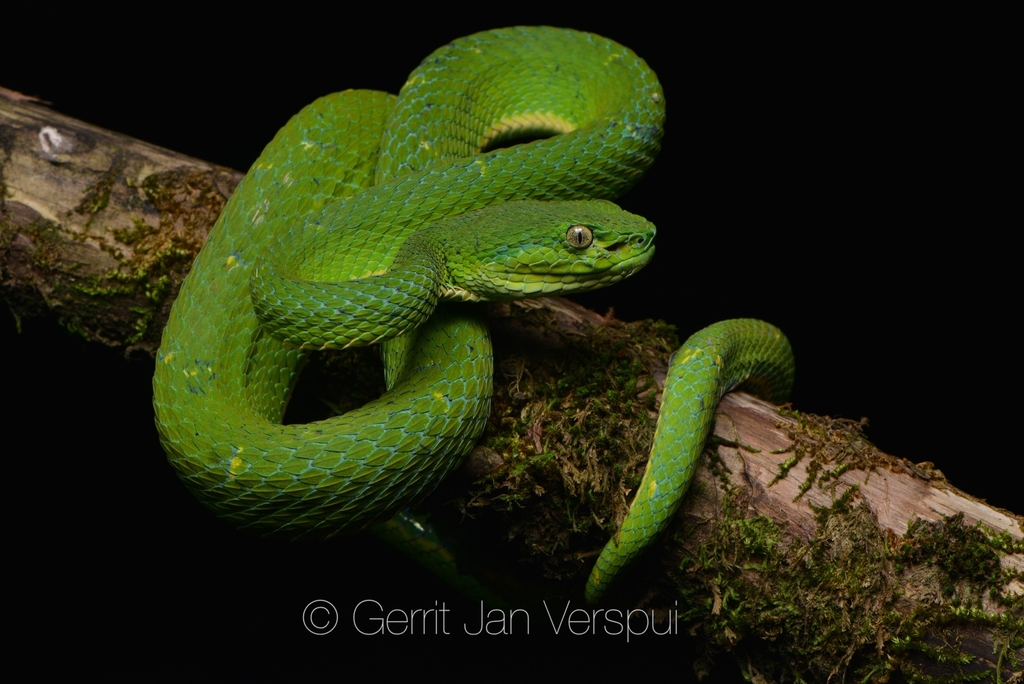
Side-striped palm pit viper
Bothriechis lateralis
Common names: side-striped palm pitviper side-striped palm viper, more.
Bothriechis lateralis is a pit viper species found in the mountains of Costa Rica and western Panama. No subspecies are currently recognized.
From the article Bothriechis lateralis on Wikipedia (CC BY-SA), quoted section by section
Description
Adult specimens may exceed 100 centimetres (39 in), but are usually less than 80 centimetres (31 in) in length. These are relatively slender snakes and have a prehensile tail.
The color pattern consists of an emerald green to bluish green ground color, overlaid with a series of yellow alternating paravertebral vertical bars. Some of the scales adjacent to the yellow in this pattern may be blue or black-tipped. The belly is a uniform yellowing-green, bordered on either side by a pale yellow stripe running along the lower portion of the paraventral scales and the extreme lateral part of the ventral scales. The head is uniformly green on top and a blue or blue-gray postocular stripe may be present. If a postocular stripe is present, it is weakly defined, especially in large adults. The iris is yellow. Juvenile specimens are usually brown with dark brown markings on the head, bronze irises, postocular stripes, paravertebral makings that are edged with yellow, and a tail tip that is yellow or chartreuse. Captive juveniles retain this color pattern for about six months, after which the ground color starts to become a dull lime green and the yellow edges of the paravertebral vertical bars more prominent. …
Range & habitat
Found in the mountains of Costa Rica and western Panama, including the Cordillera de Tilarán, the Cordillera Central and the Cordillera de Talamanca to the provinces of Chiriquí Province and Veraguas. Occurs at 850–980 m altitude. The type locality is listed as "Costa Rica vom Vulcan Barbo [Volcán Barba] ... und .. Veragua" [Panama].
Wikipedia: “Geographic range”
What it does
This is an arboreal species that spends its time in the thick foliage of forest trees and shrubbery. It is often found at the base of palm fronds. These snakes prefer to remain coiled and still, relying on their camouflage to avoid detection, rather than defending themselves aggressively. However, they will strike quickly if touched.
Wikipedia: “Behavior”
Toxicity
Bites can be serious, but fatalities are rare. A polyvalent antivenin that covers this species is produced by the Instituto Clodomiro Picado in Costa Rica.
Wikipedia: “Venom”
Where it lives
Recorded sightings
—
geo-referenced records in GBIF, from museums, herbaria and field observers.
Drag the globe to turn it. Dots are where records exist, not a range map; darker means more records.
In the stacks
Searching the stacks…
Every page naming Bothriechis lateralis in the Biodiversity Heritage Library →
This page is assembled live from iNaturalist, GBIF, Wikipedia, the Source Library and the Internet Archive. It is not yet part of the hand-edited codex. iNaturalist taxon 30845.