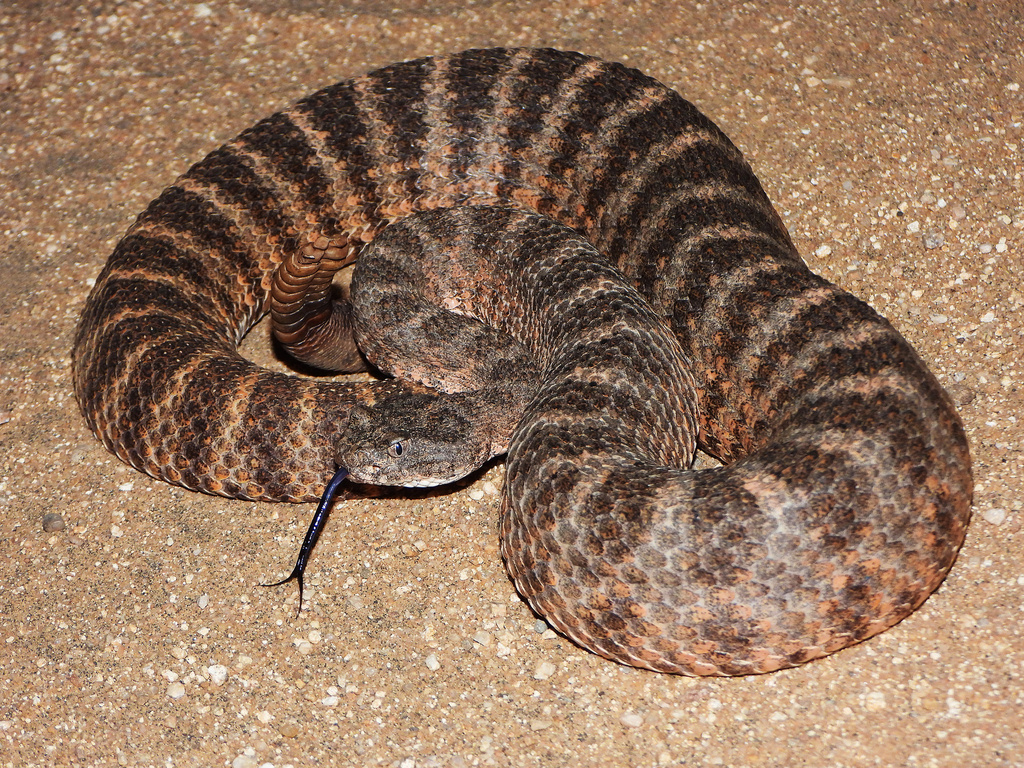
Tiger Rattlesnake
Crotalus tigris
The tiger rattlesnake (Crotalus tigris) is a highly venomous pit viper species found in the southwestern United States and northwestern Mexico. No subspecies are currently recognized. The specific name tigris, (Latin for 'tiger'), refers to the many narrow dorsal crossbands, which create a pattern of vertical stripes when viewed from the side.
From the article Tiger rattlesnake on Wikipedia (CC BY-SA), quoted section by section
Description
The tiger rattlesnake is easily identified by its small, spade-shaped head, which is about 1/25 of its total body length. It has the smallest head of any rattlesnake, and a large rattle. The color pattern consists of a gray, lavender, blue-gray, pink, or buff ground color that usually turns to pink, pale orange, or cream on the sides. Tiger rattlesnakes are the only rattlesnake with crossbands on the anterior portion of their bodies, with a series of 35 to 52 gray, olive, or brown bands across the dorsum consisting mainly of heavy punctations. These crossbands have vague borders and are wider dorsally than laterally. Also mid-dorsally, the crossbands become wider than the spaces that separate them. Posteriorly, the crossbands become darker and more clearly defined. They have six to 10 posterior rings. The markings on the head are mostly vague and irregular, although towards the rear of the head, a few dark markings may be arranged as paired occipital blotches and upper temporal streaks. The most distinguishable mark on the head is a dark cheek strip. Dorsal scales are keeled and in 21 to 27 rows. A relatively small species, individuals can weigh as much as 454 g (16.0 oz) and can range in length from 460 to 910 mm (18 to 36 in), with an average length of 609 mm (24.0 in). The largest specimen on record measured 88.5 cm (34.8 in) (Klauber, 1956), until H.M. …
Range & habitat
The species' range extends from central Arizona south through south-central Arizona in the United States, to southern Sonora, Mexico, including Isla Tiburón in the Gulf of California and was recently discovered in the southern Peloncillo Mountains of Arizona. The type locality is described as "Sierra Verde and Pozo Verde". The latter is a spring located on the Sonora side of the US-Mexico border, near Sasabe. According to Stejneger (1893), this spring is on the western slope of the southern Sierra Verde, which is also known as the Sierra del Pozo Verde. In these areas, the tiger rattlesnake is observed at elevations from sea level to about 1,465 m (4,806 ft) Reported occurrences at higher elevations have not been confirmed. Tiger rattlesnakes habitats include rocky desert canyons, foothills, and bajadas, in vegetation zones ranging from thornscrub, ocotillo-mesquite-creosote bush, saguaro-paloverde, mesquite grassland, and chaparral to tropical deciduous forest (southern Sonora) and the lower edge of oak woodland. In southeastern Arizona, this snake occurs strictly in rocky areas in winter and spring, but uses edges of arroyos in summer. …
Wikipedia: “Distribution and habitat”
What it does
Tiger rattlesnakes are terrestrial snakes and are nocturnal during the hot summer (June–August), but become diurnal and crepuscular during the fall season. They hibernate during the late fall and winter in rock crevices or animal burrows. In spite of being ground-dwelling, their activity is not restricted to the ground. They swim readily and have been found in bushes 60 cm (24 in) above the ground. Little information is available concerning communication and perception among tiger rattlesnakes. However, like other pit vipers, tiger rattlesnakes have heat-sensing pits (located on each side of the face between the eye and nostril) to detect warm-blooded predators and prey. This snake is inactive in cold temperatures (December/January) and extreme heat (July/August). It may be active both day and night; daytime activity consists mainly of basking on cool days. These snakes are often observed being active after warm rains. In southeastern Arizona, they are active mainly from March to October.
Wikipedia: “Behavior”
Toxicity
Although it has a comparatively low venom yield, its toxicity is considered to be the second highest of all rattlesnake venoms (next to the mojave), and the second highest of all snakes in the Western Hemisphere. It has a high neurotoxic fraction that is antigenically related to Mojave toxin (see Crotalus scutulatus, venom A), and includes another component immunologically identical to crotamine, which is a myotoxin also found in tropical rattlesnakes (see Crotalus durissus). A low but significant protease activity is in the venom, although it does not seem to have any hemolytic activity. Brown (1973) lists an average venom yield of 11 mg (dried venom) and an LD50 value of 0.6 mg/kg IP for toxicity. Other studies give LD50 values of 0.07 mg/kg IP, 0.056 mg/kg IV, and 0.21 mg/kg SC. Minton and Weinstein (1984) list an average venom yield of 6.4 mg (based on two specimens). Weinstein and Smith (1990) list a venom yield of 10 mg. There is very little information available for bite symptoms. Human bites by the tiger rattlesnake are infrequent, and literature available on bites by this snake is scarce. The several recorded human envenomations by tiger rattlesnakes produced little local pain, swelling, or other reaction following the bite, and despite the toxicity of its venom no significant systemic symptoms. …
Wikipedia: “Venom”
Where it lives
Recorded sightings
—
geo-referenced records in GBIF, from museums, herbaria and field observers.
Drag the globe to turn it. Dots are where records exist, not a range map; darker means more records.
In the stacks
Searching the stacks…
Every page naming Crotalus tigris in the Biodiversity Heritage Library →
This page is assembled live from iNaturalist, GBIF, Wikipedia, the Source Library and the Internet Archive. It is not yet part of the hand-edited codex. iNaturalist taxon 30758.