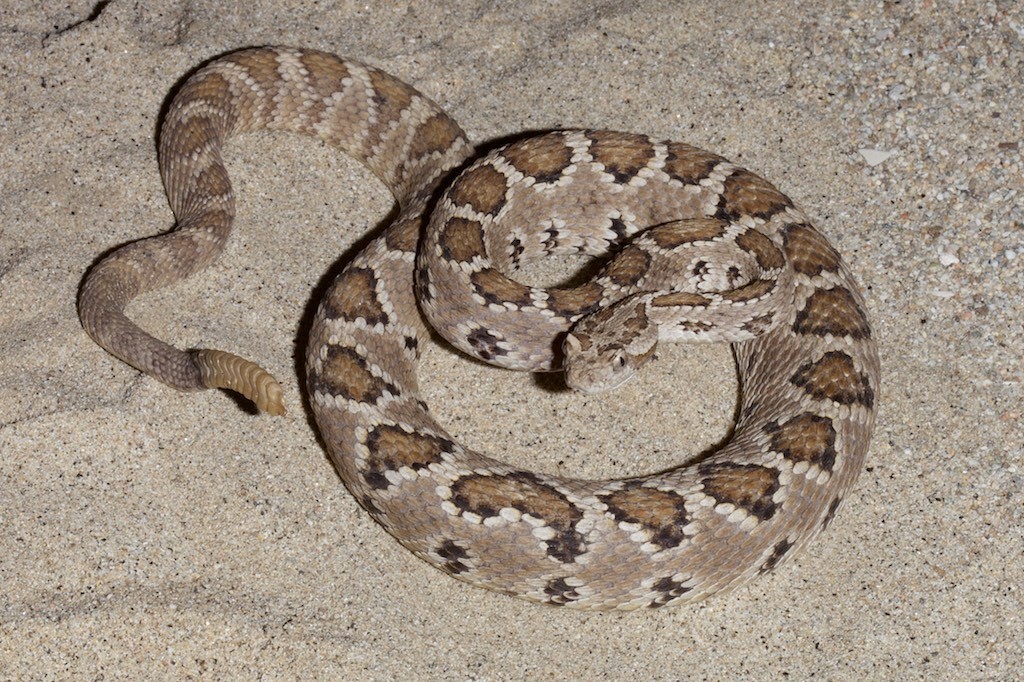
Lower California Rattlesnake
Crotalus enyo
Crotalus enyo, commonly known as the Baja California rattlesnake or Lower California rattlesnake, is a pit viper species native to the coast and islands of northwestern Mexico. Like all other pit vipers, it is venomous. Three subspecies are currently recognized, including the nominate subspecies described here.
From the article Crotalus enyo on Wikipedia (CC BY-SA), quoted section by section
Description
The maximum reported length of this species is 89.8 cm (35.4 in) (Klauber, 1972). It is sexually dimorphic, with the males typically being larger than the females. The head is remarkably small and narrow, while the eyes are proportionately large.
Range & habitat
In western Mexico in the north, it is found in the Baja California Peninsula from around Río San Telmo on the west coast and from opposite Isla Angel de la Guarda on the gulf coast, south to Cabo San Lucas. It is also found in the Gulf of California on the islands of San Marcos, Carmen, San José, San Francisco, Partida del Sur, Espírita Santo and Cerralvo. Off the Pacific coast, it is also found on the island of San Margarita. The type locality is "Cabo San Lucas, Baja California Sur".
Wikipedia: “Geographic range”
What it does
Snakes of this species, regardless of their size, are known to eat small rodents, lizards, and centipedes. This is in contrast to many other rattlesnake species that prey on lizards almost exclusively as juveniles, switching to mammals as adults. With C. enyo, small snakes eat lizards more often than do large ones, and large snakes eat mammals more often than do small ones. Adults also prey on large centipedes of the genus Scolopendra.
Wikipedia: “Feeding”
Where it lives
Recorded sightings
—
geo-referenced records in GBIF, from museums, herbaria and field observers.
Drag the globe to turn it. Dots are where records exist, not a range map; darker means more records.
In the stacks
Searching the stacks…
Every page naming Crotalus enyo in the Biodiversity Heritage Library →
This page is assembled live from iNaturalist, GBIF, Wikipedia, the Source Library and the Internet Archive. It is not yet part of the hand-edited codex. iNaturalist taxon 30748.