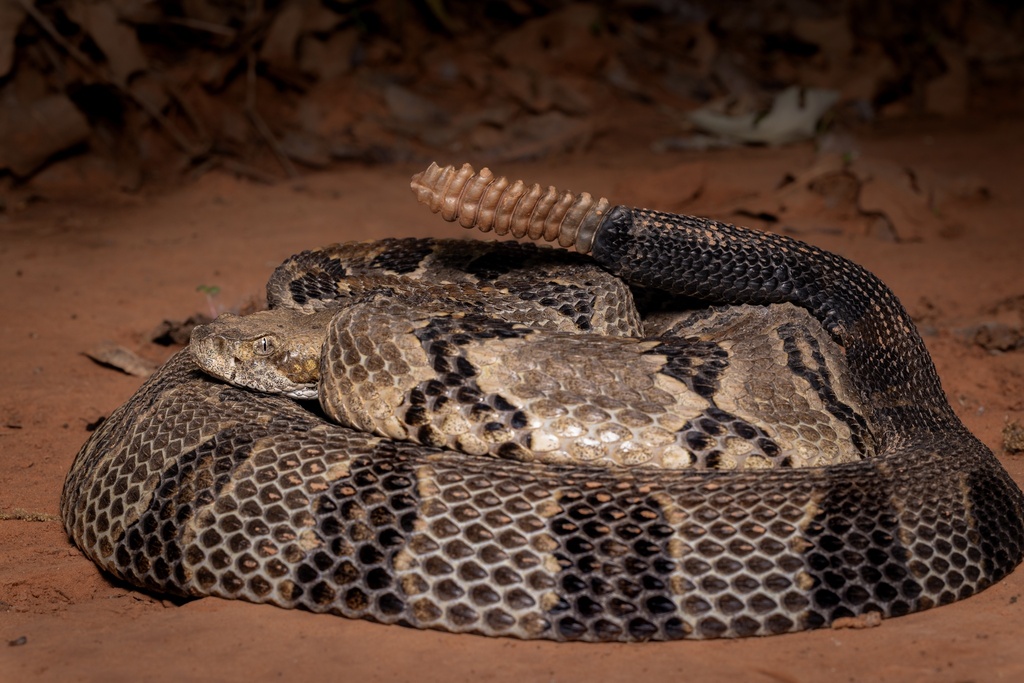
Timber Rattlesnake
Crotalus horridus
The timber rattlesnake (Crotalus horridus), also known commonly as the banded rattlesnake, and the canebrake rattlesnake in the southern United States, is a species of pit viper in the family Viperidae. The species is native to the eastern United States. Like all other pit vipers, it is venomous, with a very toxic bite. Its venom is extremely potent, and both hemorrhagic and neurotoxic venom are present depending on population and location. C. horridus is the only rattlesnake species in most of the populous Northeastern United States and is one of the most northerly distributed venomous snakes in North America. There are no subspecies that are recognized as being valid.
From the article Timber rattlesnake on Wikipedia (CC BY-SA), quoted section by section
Description
Adults usually grow to total length of 91–152 cm (36–60 in). In Pennsylvania, the smallest size females that could produce viable eggs was 72.2 cm (28.4 in). Most adult timber rattlesnakes found measure less than 115 cm (45 in) in total length and weigh between 500 and 1,500 g (1.1 and 3.3 lb), often being towards the lower end of that range. The maximum reported total length is 189.2 cm (74.5 in) (Klauber, 1956). Holt (1924) mentions a large specimen caught in Montgomery County, Alabama, which had a total length of 159 cm (62.5 in) and weighed 2.5 kg (5.5 lb). Large specimens can reportedly weigh as much as 4.5 kg (9.9 lb). The dorsal scales are keeled and arranged in 21–26 scale rows at midbody (usually 25 rows in the southern part of its geographic range, and 23 rows in the northern part). The ventral scales number 158–177 in males and 163–183 in females. Males have 20–30 subcaudal scales, while females have 15–26. The rostral scale is normally a little taller than it is wide. In the internasal-prefrontal area there are 4–22 scales that include 2 large, triangular internasal scales that border the rostral, followed by two large, quadrangular prefrontal scales (anterior canthals) that may contact each other along the midline, or may be separated by many small scales. Between the supraocular and internasal scales, only a single canthal scale is present. …
Range & habitat
Timber rattlesnakes are present in the eastern United States from southern Minnesota and southern New Hampshire, south to East Texas and North Florida. One hundred and fifteen rattlesnakes have been marked within Brown County State Park in Indiana, one of the few places where they can be found in the state. Its historic range includes southern Ontario and southern Quebec in Canada, but in May 2001, the Canadian Species at Risk Act listed it as extirpated in Canada. A Canadian government sponsored recovery strategy is under study to support the reintroducing of this predator of many pests to its former Canadian habitat. Many were present in some of the thick forest areas of central and southeastern Iowa, mostly within the Mississippi, Skunk, Iowa, and Des Moines River valleys, in several places in these areas; bites from timber rattlesnakes have been widespread, especially in a localized area of Geode State Park, in southeastern Henry County, along Credit Island Park, in southern Scott County, and in the forested areas of southern Clinton County. …
Wikipedia: “Distribution and habitat”
What it does
Female timber rattlers often bask in the sun before giving birth, in open rocky areas known as "basking knolls". During the winter, timber rattlesnakes brumate in dens and limestone crevices, often together with copperheads (Agkistrodon contortrix) and rat snakes (Pantherophis alleghaniensis, P. obsoletus, and P. spiloides). Timber rattlesnakes exhibit high levels of philopatry to their natural hibernaculum, which means that they are likely to return to the same hibernaculum, or communal wintering den, each year. Timber rattlesnakes occupying the same hibernaculum (especially juveniles and pregnant females) have been reported to be more closely related to each other than to the rattlesnakes in neighboring dens; studies have suggested this behavior may be related to juveniles' ability to track chemical cues from relatives. Timber rattlesnakes have also been found to leave dens multiple times in midwinter to briefly bask. Males often mate farther away from winter hibernacula than females.
Reproduction. A lifetime reproduction study of a population in the Adirondack Mountains of New York found that the first reproduction occurs at a mean age of 9.6 years. The mean length of reproductive cycles is 4.2 years, the mean reproductive life span is 9.6 years, and the average fecundity is 7.7 offspring per litter. Nonviable offspring were found in 20% of the field litters. …
Wikipedia: “Behavior”
In human culture
The name Crotalus is Latin for a rattle or, crŏtălisso to rattle or the sound of the castanet. Horridus is Latin, meaning horrid or dreadful, presumably in reference to its potentially lethal venom. Although southern populations are generally no longer recognized as a valid subspecies, the name canebrake rattlesnake (Crotalus horridus atricaudatus) is occasionally still used and commonly encountered in older literature. Atricaudatus is Latin meaning black-tailed (atri = black, and caudatus = tailed).
Wikipedia: “Etymology”
Where it lives
Recorded sightings
—
geo-referenced records in GBIF, from museums, herbaria and field observers.
Drag the globe to turn it. Dots are where records exist, not a range map; darker means more records.
In the old herbals & bestiaries

In the stacks
Searching the stacks…
Every page naming Crotalus horridus in the Biodiversity Heritage Library →
This page is assembled live from iNaturalist, GBIF, Wikipedia, the Source Library and the Internet Archive. It is not yet part of the hand-edited codex. iNaturalist taxon 30746.