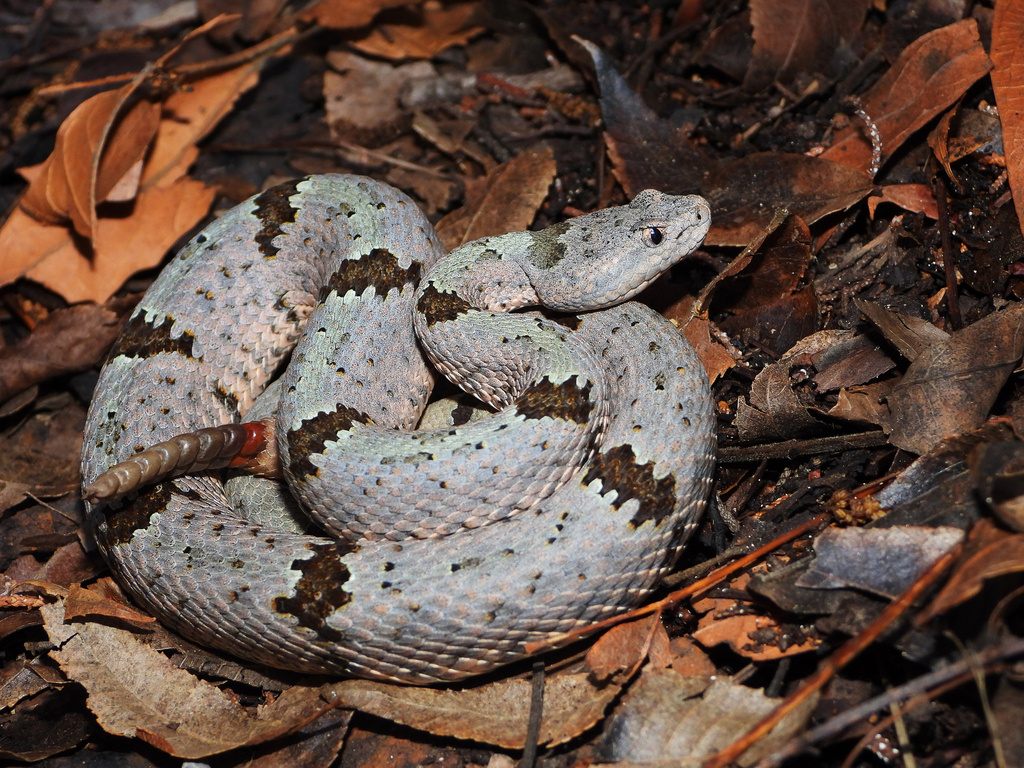
Rock Rattlesnake
Crotalus lepidus
Crotalus lepidus is a venomous pit viper species found in the southwestern United States and northern central Mexico. Four subspecies are currently recognized, including the nominate subspecies described here.
From the article Crotalus lepidus on Wikipedia (CC BY-SA), quoted section by section
Description
This small species rarely exceeds 32 in (81.3 cm) in length. It has a large, rounded head, and fairly heavy body for its size, with eyes with vertical pupils. Like other rattlesnakes, its tail has a rattle, which is composed of keratin. Each time the snake sheds its skin, a new segment is added to the rattle. However, the rattle is fragile and may break off, and the frequency of shedding can vary. So, the snake's age cannot be determined by the number of segments or length of the rattle. The color pattern varies greatly, but generally reflects the color of the rock in the snake's natural environment. Snakes found near areas of predominantly limestone tend to be a light grey in color, with darker grey banding. Snakes found at higher altitudes have darker colors. Specimens of the mottled rock rattlesnake (C. l. lepidus) from the Davis Mountains region often exhibit a more pink coloration, with dark-grey speckling rather than distinct banding.[1] The banded rock rattlesnake (C. l. klauberi) gets its common name from its distinctive, clean banding, often with little speckling or mottling.
Range & habitat
This snake is found in the Southwestern United States (southeastern Arizona, southern New Mexico, and southwestern Texas) and northern central Mexico. The type locality given is "Presidio del Norte and Eagle Pass" (Texas, USA). H.M. Smith and Taylor (1950) emended the type locality to "Presidio (del Norte), Presidio County, Texas".
Wikipedia: “Geographic range”
What it does
In general, these snakes are not aggressive. They tend to rely heavily on their camouflage, and will often not strike or even rattle their tails unless physically harassed. They spend most of their lives in rocky outcroppings and talus slopes, from which they are named. Man-made road cuts are often a favorite place. They are primarily nocturnal. Most people who get bitten by the rock rattlesnake are often hiking among rocks, where it lives. If someone steps or accidentally touches it, the snake's immediate reaction is to bite.
Wikipedia: “Behavior”
Toxicity
Their venom is primarily a hemotoxin, but has been known to have significant neurotoxic effects, as well. While not type-specific, the polyvalent antivenin CroFab is generally used to treat serious envenomations.
Wikipedia: “Venom”
Where it lives
Recorded sightings
—
geo-referenced records in GBIF, from museums, herbaria and field observers.
Drag the globe to turn it. Dots are where records exist, not a range map; darker means more records.
In the stacks
Searching the stacks…
Every page naming Crotalus lepidus in the Biodiversity Heritage Library →
This page is assembled live from iNaturalist, GBIF, Wikipedia, the Source Library and the Internet Archive. It is not yet part of the hand-edited codex. iNaturalist taxon 30740.