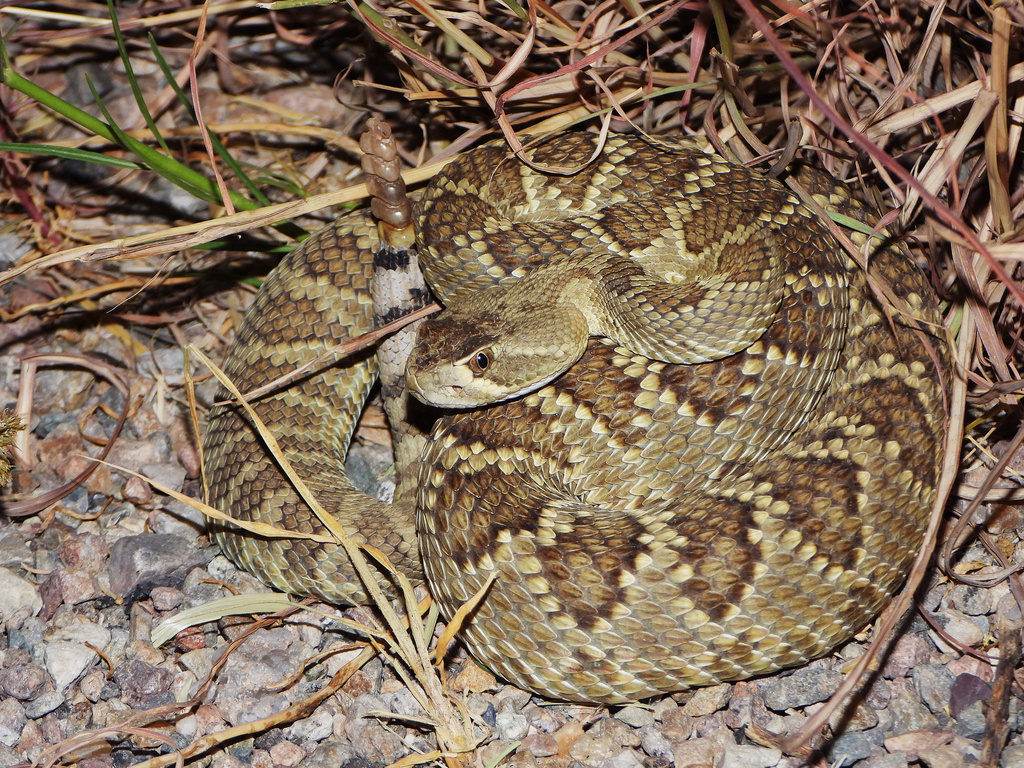
Mojave Rattlesnake
Crotalus scutulatus
Crotalus scutulatus is species of rattlesnake, a venomous pit viper in the family Viperidae.
The species is known commonly as the Mohave Rattlesnake. Other common English names include Mojave Rattlesnake and, referring specifically to the nominate (northern) subspecies: Northern Mohave Rattlesnake and Mojave Green Rattlesnake, the latter name commonly shortened to the more colloquial "Mojave green". Campbell and Lamar (2004) supported the English name "Mohave (Mojave) rattlesnake" with some reluctance because so little of the snake's range lies within the Mojave Desert. The spelling of the English name with an "h" has been advocated by multiple authors in recent years for various reasons. The most recent iteration of standard English names for North American reptiles, endorsed by the major herpetological societies in the United States and Canada, concludes that spelling with either a "j" or an "h" is correct, based on "whether the word is used in a Spanish or English context." Thus, their standard English names list adopted the "h" spelling.
From the article Crotalus scutulatus on Wikipedia (CC BY-SA), quoted section by section
Description
Crotalus scutulatus grows to an average total length (tail included) of less than 100 cm (3.3 ft), with a maximum total length of 123.6 cm (4.1 ft) for males and 92.2 cm (3.0 ft) for females.
There is no single visual trait that reliably identifies C. scutulatus and the most reliable visual identifications result from careful consideration of multiple traits. C. scutulatus is broadly sympatric with C. atrox (the Western Diamond-backed Rattlesnake), which it closely resembles. The dorsal color of C. scutulatus varies from shades of green to browns, grays, and even yellowish. C. scutulatus has a row of large diamond-shaped dorsal blotches closely resembling C. atrox but lacking the abundant dark speckling, both coarse and fine, found throughout the dorsal surfaces of C. atrox. Additionally, C. scutulatus lacks the white margins along the caudal edges of the dorsal "diamonds" that are found in most C. atrox. The postocular light facial stripe usually bends toward the neck and does not intersect with the mouth in C. scutulatus, as it does in C. atrox. The tail is usually marked with alternating pale and dark rings in both species, with the dark rings often (but not always) being narrower than the pale ones in C. scutulatus and the colors are usually less distinct than the bright white and dark black caudal rings of most C. atrox. …
Range & habitat
Crotalus scutulatus is found in arid habitats in the southwestern United States, from the Mohave Desert in California's Los Angeles and San Bernardino Counties, across most of western and southern Arizona (southwest of the Mogollon Rim), and from El Paso County south through the Big Bend region of western Texas. It also occurs as far north as Lincoln County in Nevada, the southwest corner of Washington County in Utah, and portions of extreme southern New Mexico. In Mexico, it is found in Sonora, Chihuahua, and south on the Mexican Plateau to the states of Mexico, Puebla, and Veracruz. It is found in deserts and other areas with xeric vegetation from near sea level to about 2,500 m (8,200 ft) elevation.
Wikipedia: “Geographic range”
What it does
Crotalus scutulatus is most active from April to September. They are ambush predators, eating mostly small rodents and lizards. Courtship begins in late summer/fall, is interrupted by winter, and resumes in the spring. Females bear live young, from two to 17 (average about eight), from July through September. This species is not known to den communally and they have no need to seasonally migrate between winter dens and summer foraging areas, as do some other species living at higher elevations and higher latitudes. Instead, individuals occupy well defined home ranges year around, taking shelter during the winter and hot summer weather in burrows excavated by animals like rodents, tortoises, and kit foxes. Like other rattlesnakes, this species is routinely preyed upon by larger predators like coyotes, bobcats, and raptors. As a result, it is shy, cryptic, and does not seek out confrontations with larger creatures, including humans. But like other rattlesnake species, it will strike and bite vigorously when disturbed, especially if surprised or when there is no nearby vegetation or burrow into which the snake can escape.
Wikipedia: “Behavior”
Toxicity
Both antivenoms available in the United States are licensed by the US Food and Drug Administration for the treatment of bites by all native pitvipers, including envenomations by C. scutulatus. Each product contains antibodies raised against the venoms of multiple carefully selected pitviper species. Neurotoxic C. scutulatus venom is used in the manufacture of CroFab®, while the venom of a tropical rattlesnake (C. simus) that expresses a very similar neurotoxin, is used in the production of Anavip®. Thus, both products are designed to be effective against neurotoxic C. scutulatus envenomations, and venoms from other species used in the production of both products are protective against type I/venom-B (non-neurotoxic) C. scutulatus bites.
Wikipedia: “Antivenoms”
In human culture
For decades, the bite of Crotalus scutulatus has been considered to be extraordinarily deadly, often described as "the" (or "one of the") deadliest or most dangerous rattlesnakes. For example: "the most lethal of the North American rattlesnake venoms"; "one of the most lethal venoms among the world's reptiles"; "an extremely dangerous snake"; "probably the most dangerous snake in the United States"; and "considered among the most venomous snakes on Earth". Such claims are usually attributed to the neurotoxin produced by most populations of C. scutulatus in the United States and Mexico, which has been reported to be capable of causing delayed respiratory paralysis with little or no local tissue injury. This neurotoxin was isolated and described in 1975 and named "Mojave toxin". In 1978, an area in southcentral Arizona was identified where the venom of C. scutulatus is significantly less lethal to laboratory mice than venom from the balance of the species' range. The more lethal (and more widely distributed) variant was named "venom A" and the less lethal variant was named "venom B". The difference in lethality was later determined to be lack of Mojave toxin in the venom B population. Thus, venom A became known as the neurotoxic variant and venom B became the non-neurotoxic variant. In addition to the absence of Mojave toxin, C. …
Wikipedia: “History”
Where it lives
Recorded sightings
—
geo-referenced records in GBIF, from museums, herbaria and field observers.
Drag the globe to turn it. Dots are where records exist, not a range map; darker means more records.
In the stacks
Searching the stacks…
Every page naming Crotalus scutulatus in the Biodiversity Heritage Library →
This page is assembled live from iNaturalist, GBIF, Wikipedia, the Source Library and the Internet Archive. It is not yet part of the hand-edited codex. iNaturalist taxon 30719.