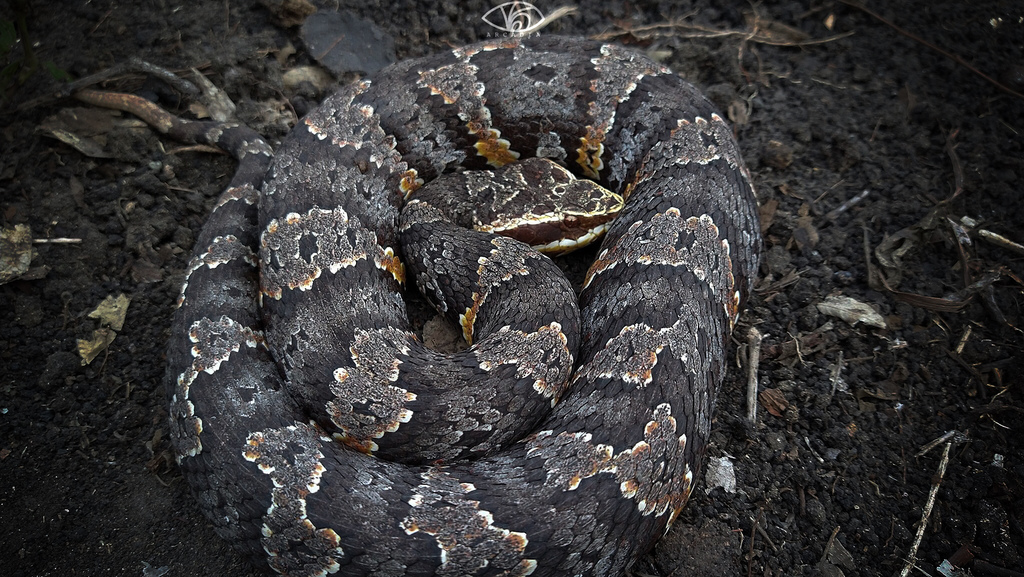
Taylor's Cantil
Agkistrodon taylori
Agkistrodon taylori is a species of venomous snake, a pitviper (Crotalinae) found only in northeastern Mexico. The standardized names are Taylor's cantil (English) and Metapil (Spanish), although it is sometimes called the ornate cantil as well as several other colloquial names. It was named in honor of American herpetologist Edward Harrison Taylor.
It is a stout, medium sized snake, averaging 64–90 cm. in length. Taylor's cantils have prominent light and dark stripes on the head, with a pattern of black and gray-brown bands on the body, accented with white, yellow, and orange. They are sexually dimorphic, with males being significantly darker than females. Some older individuals, particularly males, may grow darker, nearly black with age. It is a viviparous species, with typical litters of 3 to 10 live young. Taylor's cantils are uncommon to rare snakes in the wild and listed as a threatened species in Mexico. It occurs in a variety of habitats on the Gulf Coastal Plain and lower foothills of the Sierra Madre Oriental, including thorn scrub, tropical deciduous forest, and grasslands, sometimes said to prefer ecotones between scrubland and forest in the vicinity of rocky limestone outcroppings. Although not overtly aggressive, it is known to be very defensive with a volatile temper and may be quick to strike when approached, threatened, or restrained. No case reports of human envenomations have been published. Its venom is believed to be similar to its close relative, the cantil Agkistrodon bilineatus, and potentially fatal.
From the article Agkistrodon taylori on Wikipedia (CC BY-SA), quoted section by section
Description
Size: Taylor's cantils, and Agkistrodon in general, are relatively stout, heavy bodied snakes. Adults average 64–90 cm (25+1⁄4–35+3⁄8 in) with no significant difference between males and females in total length. The tails of adult A. taylori are proportionately shorter than other species of cantils, 16–19% of the total length in males, and 13–18% in females. The largest confirmed size was a male, 96 cm (37+3⁄4 in) in total length. One herpetologist found a specimen dead on a highway in 1974 that he estimated to be ca. 4.5 feet (1.37 m.) long, however this record is not verifiable. Scutellation: Nine large crown plates (two internasals, two prefrontals, one frontal, two supraoculars, two parietals) are characteristic of all members of the genus Agkistrodon, although on A. taylori some slight aberrations and fragmentations of these plates are typical, particularly the posterior end of the parietals which tend to be divided into small scales. A loreal scale is present. Supralabial are normally eight (occasionally seven or nine). Infralabials are normally 10 or 11 (occasionally 9 or 12). The dorsal scales are keeled with paired apical pits, although the lowest two lateral rows may be smooth. Dorsal scale rows are 25 or 23 on the anterior part of the body, 23 at midbody (rarely 21), and 19 to 21 near the tail. Ventral scales on the body range from 127 to 138. …
Range & habitat
Agkistrodon taylori is endemic to Mexico. It occurs primarily in southern Tamaulipas, with one record near the coast as far north as Carboneras. Elevations typically range from near sea level to about 500 m., with a maximum elevation of 919 m. in San Luis Potosi. The type locality is "21 km north of Villagrán, Tamaulipas, Mexico". It has been speculated that A. taylori occurs in the Sierra de San Carlos, based on the local inhabitants identifying photographs, however no confirmed records from the mountain range are available. There are also a few of scattered records from lower elevations on the eastern slopes and canyons of the Sierra Madre Oriental. These include a number of records from Nuevo Leon as far north as Monterrey, south to the vicinity of El Naranjo, San Luis Potosi, Atlapexco and Huejutla de Reyes, Hidalgo, and near Tantoyuca, Verecruz. A number of photographic records been reported on the social network iNaturalist, filling gaps in the distribution of previously published records, particularly in Nuevo Leon, San Luis Potosi, and Veracruz. A southernmost record represents a single specimen from near Palma Sola, Veracruz, which was first described as a subspecies, Agkistrodon bilineatus lemosespinali, however more recent accounts considered the defining characters of A. b. lemosespinali fell within the normal range of A. taylor. …
Wikipedia: “Distribution”
What it does
The fact that A. taylori was not described until 1951 and known only from two specimens at that time is some indication of its rarity. Paul S. Martin's work in Tamaulipas from 1948 to1953 encompassed 12 collectors and 14 months of fieldwork yielding only three specimens, and he noted interviews with two lifelong resident farmers that indicated they had seen "only one other snake of this type". Likewise, a six year field survey in the 1970s noted "A few woodcutters we queried had encountered A. b. taylori and they concurred that it is rare in the area." Several studies have commented on the scarcity of museum specimens available for research, including a landmark 1990 monographic review of the genus Agkistrodon which identified only 19 specimens, a 2007 study on Hidalgo, San Luis Potosi, and Veracruz populations identifying only one from each state, and a 2013 study reported only 27 specimens from Tamaulipas. As a rare and threatened species, Patrick Burchfield of the Gladys Porter Zoo in Brownsville, Texas, focused special attention on Taylor's cantil for conservation efforts and conducted field surveys 1974-1979 that provided much of what is known about the natural history of the species. Taylor's cantil was found to be most active in the months of October to March, which is the cool and rainy season in the region. …
Wikipedia: “Ecology and natural history”
In human culture
The original description states that the specific, or trivial name, was "Named for Dr. Edward H. Taylor in recognition of his many contributions to our knowledge of the Mexican herpetofauna." Indeed, Taylor's extensive publications on Mexico's amphibians and reptiles, culminating with the "Herpetology of Mexico", published in collaboration with his student Hobart M. Smith, is the foundation of modern Mexican herpetology. Taylor's work on Mexico alone would have secured him a prominent reputation in the field of herpetology. However, Taylor made equally important contributions to the study of Philippine land mammals, the herpetofauna of the Philippines, the herpetofauna of the south-central United States, Eumeces (skinks of the world at that time), the herpetofauna of Costa Rica, the herpetofauna of Thailand, and caecilians of the world. The common name cantil is believed to have its origins in the language of an indigenous people of Chiapas, Mexico, the Tzeltal. The Tzeltal word "kantiil" was given to the snake meaning yellow lips (kan = yellow, tiil = lips). The name is thought to have first entered herpetological literature in the publication of Albert Günther's Reptilia and Batrachia in Biologia Centrali-Americana, and later popularized in the writings of Raymond L. Ditmars. …
Wikipedia: “Etymology”
Where it lives
Recorded sightings
—
geo-referenced records in GBIF, from museums, herbaria and field observers.
Drag the globe to turn it. Dots are where records exist, not a range map; darker means more records.
In the stacks
Searching the stacks…
Every page naming Agkistrodon taylori in the Biodiversity Heritage Library →
This page is assembled live from iNaturalist, GBIF, Wikipedia, the Source Library and the Internet Archive. It is not yet part of the hand-edited codex. iNaturalist taxon 30674.