- Animals
- ›Chordates
- ›Vertebrates
- ›Reptiles
- ›Snakes and Lizards
- ›Snakes
- ›Colubrid Snakes
- ›Colubrine Snakes
- ›Ficimia
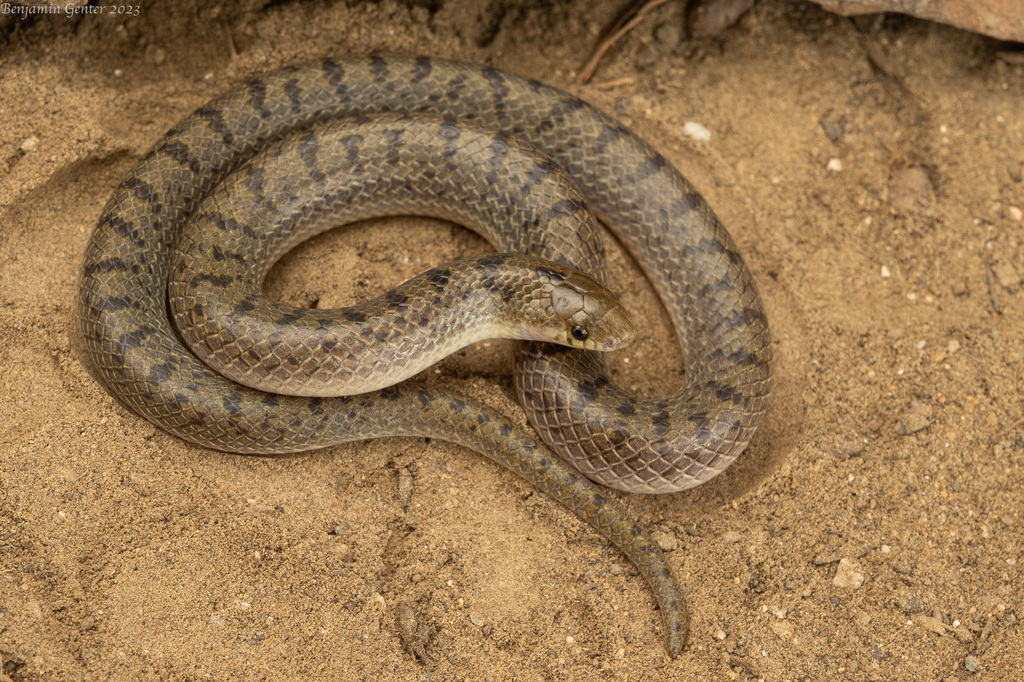
Tamaulipan Hook-nosed Snake
Ficimia streckeri
Ficimia streckeri, also commonly known as the Mexican hooknose snake, the Tamaulipan hooknose snake, and the Texas hook-nosed snake, is a small species of snake in the family Colubridae. The species is native to northeastern Mexico and adjacent southern Texas.
From the article Ficimia streckeri on Wikipedia (CC BY-SA), quoted section by section
Description
The Mexican hooknose snake is usually 5 to 11 in (13 to 28 cm) in total length (including tail). H.M. Smith and Brodie (1982) report a maximum total length of 47.9 cm (almost 19 inches). It is typically brown or gray in color, with as many as 60 brown or brown-green blotches down the back, which are elongated to almost appear as stripes. Its underside is white or cream-colored. Its most distinctive feature is an upturned snout, much like hognose snakes, which gives it its common name. However, unlike hognose snakes, the Mexican hooknose snake has smooth dorsal scales. Also distinctive is the arrangement of the head shields. There are no internasals, and the rostral separates the prefrontals and contacts the frontal. The smooth dorsal scales are arranged in 17 rows at midbody. The ventrals number 126–155, and the subcaudals number 28–41.
Range & habitat
F. streckeri is found primarily in the Mexican states of Hidalgo, Nuevo León, Puebla, eastern San Luis Potosí, and Tamaulipas, but its geographic range extends as far north as southern Texas in the United States.
Wikipedia: “Geographic range”
What it does
The Mexican hooknose snake is mostly nocturnal, and is a burrower. It is fairly slow-moving and harmless to humans.
Wikipedia: “Behavior”
In human culture
The specific name or epithet, streckeri, is in honor of the American naturalist John Kern Strecker Jr.
Wikipedia: “Etymology”
Where it lives
Recorded sightings
—
geo-referenced records in GBIF, from museums, herbaria and field observers.
Drag the globe to turn it. Dots are where records exist, not a range map; darker means more records.
In the stacks
Searching the stacks…
Every page naming Ficimia streckeri in the Biodiversity Heritage Library →
This page is assembled live from iNaturalist, GBIF, Wikipedia, the Source Library and the Internet Archive. It is not yet part of the hand-edited codex. iNaturalist taxon 30095.