- Animals
- ›Chordates
- ›Vertebrates
- ›Reptiles
- ›Snakes and Lizards
- ›Snakes
- ›Colubrid Snakes
- ›Dipsadine Snakes
- ›Heterodon
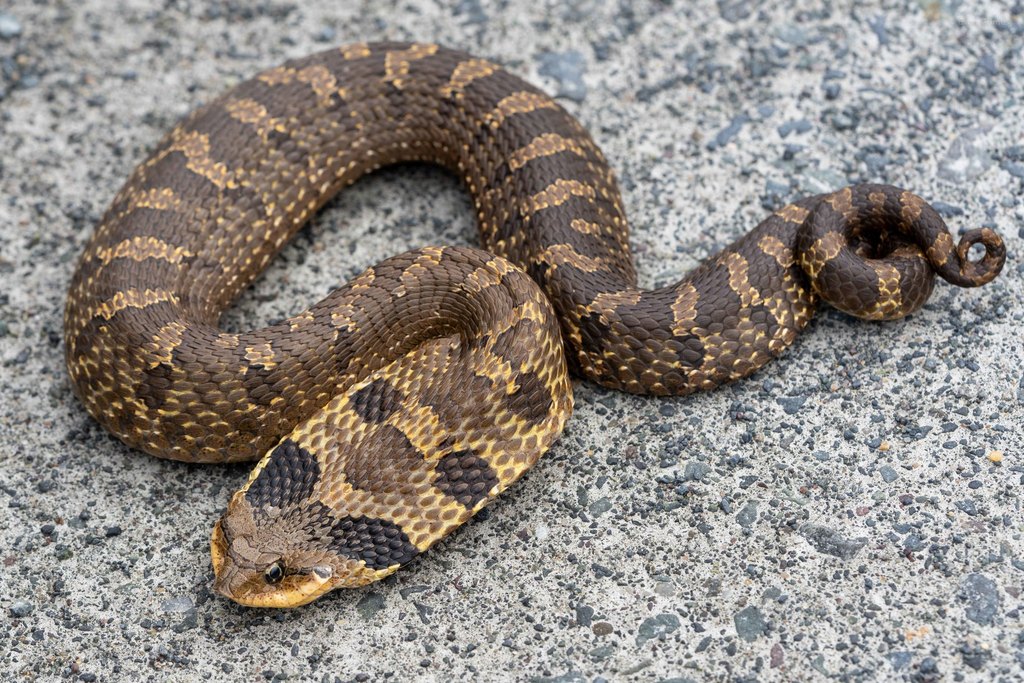
Eastern Hognose Snake
Heterodon platirhinos
The eastern hog-nosed snake (Heterodon platirhinos) is a species of mildly venomous rear-fanged snake in the family Colubridae. The venom is specifically adapted to amphibian prey and is harmless to humans. However, some people may have an allergic reaction and as a result experience local swelling and other symptoms. The species is endemic to North America. There are no subspecies that are recognized as being valid. This species prefers habitats with sandy soils and a combination of grass fields and forest edges. It comes in many different colorations and has the identifiable upturned "snout." It can be found in captivity, but is a relatively difficult species to keep due to a specialized diet of toads. As with other Heterodon species, it has a distinctive threat reaction of first bluffing by striking with a closed mouth and then, if this fails to deter the threat, pretending to die.
From the article Eastern hognose snake on Wikipedia (CC BY-SA), quoted section by section
Description
Heterodon platyrhinos is described as being quite stout-bodied. Its color pattern is extremely variable, from red, green, or orange to brown, gray, or black, or any combination thereof depending on locality. Dorsally, it can be blotched, checkered, or patternless. The belly tends to be a solid gray, yellow, or cream-colored. In this species, the underside of the tail is lighter than the belly. Its most distinguishing feature is the upturned snout, used for digging in sandy soils. The average adult of H. platirhinos measures 71 cm (28 in) in total length (tail included), with females being larger than males. The maximum recorded total length is 116 cm (46 in).
Range & habitat
Heterodon platirhinos has a wide geographical range from the central United States to the East Coast. In the northern parts of its range, it can be found in southern Ontario, southern New Hampshire, Minnesota, Wisconsin, and Massachusetts. Farther west, the snake can be found in Texas and Kansas. The southern part of its range extends into southern Florida. Populations start to dwindle as the species reaches the northern limit of its range.
Wikipedia: “Geographic distribution”
What it does
The eastern hognose is a diurnal species. It occurs in low densities, preferring to remain cryptic. It is typically most active during April–September after coming out of hibernation. Because it has such a wide range, the snake is found there is variation in the population's climates which can cause the period of activity to change. In northern climates, hibernation comes earlier and begins late September–October whereas in southern climates, the snake might not retreat until November. There have been some recorded to still be active between December–February in Florida and along the Gulf Coast. If the temperature reaches or drops below 19 degrees Celsius, hibernation will begin for the snake. This hibernation period takes place alone in burrows either dug by the snake or already made mammal burrows. To burrow, a snake forces its head into the soil then moves its head back and forth. For hibernation, these burrows will reach depths of 25 centimeters or more.
Defensive behavior. When the eastern hognose snake is threatened, its neck is flattened and the head is raised off the ground, like a cobra. It also hisses and may strike with its mouth closed, but it does not attempt to bite— a behavior known as "bluffing." The result can be likened to a high speed head-butt. …
Wikipedia: “Behavior”
Toxicity
Heterodon platirhinos is a mildly venomous species, but the effects are not deadly to humans. Heterodon means "different tooth", which refers to the enlarged teeth at the rear of the upper jaw. These teeth inject a mild amphibian-specific venom into prey. The fangs receive the venom from the snake's Duvernoy's gland. Bitten humans who are allergic to the saliva have been known to experience local swelling, burning, discoloration, and bleeding from the wounds, but no human deaths have been documented.
Wikipedia: “Venom”
In human culture
The generic name Heterodon is derived from the Greek words heteros meaning "different" and odon meaning "tooth." The specific name platirhinos is derived from the Greek words platys meaning "broad or flat" and rhinos meaning "snout."
Wikipedia: “Etymology”
Where it lives
Recorded sightings
—
geo-referenced records in GBIF, from museums, herbaria and field observers.
Drag the globe to turn it. Dots are where records exist, not a range map; darker means more records.
In the stacks
Searching the stacks…
Every page naming Heterodon platirhinos in the Biodiversity Heritage Library →
This page is assembled live from iNaturalist, GBIF, Wikipedia, the Source Library and the Internet Archive. It is not yet part of the hand-edited codex. iNaturalist taxon 29925.