- Animals
- ›Arthropods
- ›Hexapods
- ›Insects
- ›Winged and Once-winged Insects
- ›Cockroaches and Termites
- ›Typical Cockroaches and Termites
- ›Termites
- ›Drywood Termites
- ›Incisitermes
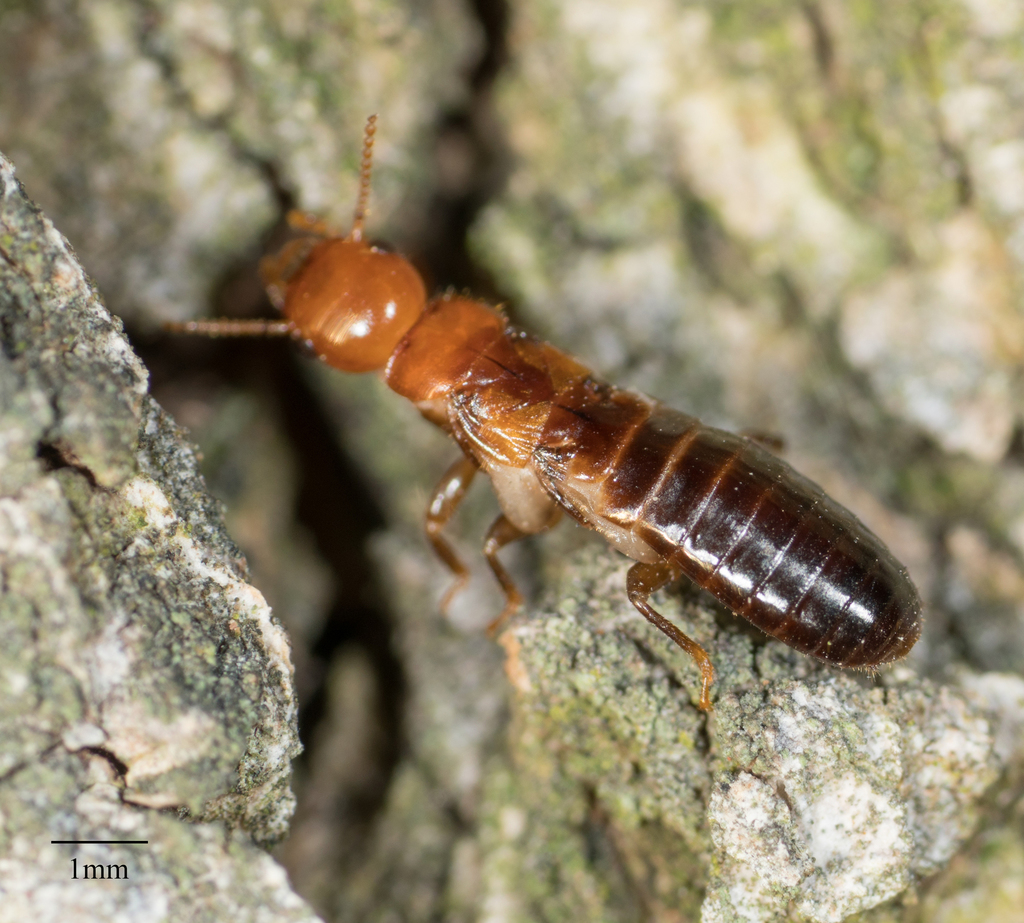
Western Drywood Termite
Incisitermes minor
Incisitermes minor is a species of termite in the family Kalotermitidae known commonly as the western drywood termite. It is native to western North America, including the western United States and northern Mexico. It has been found in many other parts of the United States, all the way to the East Coast. It has been reported from Toronto. It has been introduced to Hawaii. It has been noted in China and it is not uncommon in Japan. This is an economically important pest of wooden structures, including houses. In California and Arizona alone its economic impact is estimated to be about $250 million per year.
Within a single colony there are three types of termites, the alates, soldier, and worker. This eusocial species is a dark brown color and has an orange head. The colonies are most active during the spring and summer, preferring to be active in higher temperatures.
From the article Incisitermes minor on Wikipedia (CC BY-SA), quoted section by section
Description
There are three types of termites within the colony: the alate (swarmer), the soldier and the worker. Alates have an orange-brown head and pronotum, an 11–12.5 mm long, dark brown abdomen. This is the only caste that leaves the colony, which happens when they seek a mate. If they are successful, they will form the new kings and queens. There are also soldiers, which are large, reddish-brown, and have two teeth visible on the left mandible. They are noted for having a larger third antennal segment. They are 8–12 mm long, and can weigh from 20 to 25 mg. This eusocial species does not have a normal worker caste. There are "pseudergates" which are false workers characterized by their lack of wing pads, as well as "nymphs" which do possess wing pads. These wing pads allow the nymphs to molt into a soldier or an alate, because they are not sterile. These workers are not the bottom class, meaning they are capable of becoming soldiers and alates. The pseudergates group is also able to change into male or female alates just by molting, which is very different from other insect species. They are dark brown and have an orange head. The soldiers are larger than the alates, and they reach an average length of 0.4 inches, and have a broad red head with black mandibles. They have a larger third segment as well.
Wikipedia: “Morphology”
Range & habitat
In the United States the termite is found in northern California, Oregon, and Washington. In California it is found mainly in the central valley. It is also found in central Arizona and into Baja California and Sonora. Due to travel there has also been isolated groups of this termite found in other states, particularly Florida. Infestations have been found in Arkansas, Iowa, Maryland, New Jersey, New York, Oklahoma, Ohio, Georgia, South Carolina, and Louisiana. There have also infestations in China and Japan.
Wikipedia: “Distribution”
What it does
Termites swarm in order to reproduce. This is when large groups of the termite gather in a specific location to mate, before going separate ways to establish colonies. The alate group engages in the swarming behavior. The alate group swarms in late September through November in Southern California. On warmer days, the termites will swarm earlier in the day. Swarming occurs on days with temperatures between 26.7 and 37.8 °C (80.1 and 100.0 °F). The alates emerge from inside the wood nest, and as they reach the outside they will take off. The alates are not able to fly well, and therefore do not move far from their emergence point. When they land, they remove their wings and crawl around (wingless) to find a mate. Once a mate is found they engage in courtship activity. In finding a mate, the females crawl with the male behind. Once the female accepts the male they are now mated for life, and are now the king and the queen. In order to begin a colony, the male and female have to find a piece of wood with a hole in it, which they will enter and create a royal cell. This whole process can take three to four days. When they are done excavating they have to plug the hole with gut contents. Afterwards they enter a long period of inactivity, for approximately nine months; during this period the queen will begin to lay eggs. …
Wikipedia: “Life cycle and reproduction”
At the table
The termites feed on wood and excavate very similarly to other termites. Their feeding behavior results in larger, more cavernous, irregular evacuations. I. minor also excavates toward the outer edge of the food, but it does not break the wood. They accomplish this by leaving a thin, outer layer, which is protective. This often gives the wood the appearance of being strong, but it is still weakened from the eating on the inside. The termites are also known to feed on dead tree branches, and not just feeding on live trees. There is also a feeding hierarchy within the colony. In an experiment, filter paper was marked with Rb (Rubidium) to show that not all the termites in the colonies feed. The analysis of the Rb levels indicated that in the hierarchy the nymphs are the primary donors, the primary eaters, and the larvae are the primary recipients. This experiment is able to show this because those that directly eat the Rb labeled filter paper have a higher concentration of Rb in their body than those termite that are eating the food second hand after being fed. The alates might also require more care before swarming. As the termites eat, they leave very little signs that they are present in the wood. However, they do have a small hole on the surface of the wood through which they eject their fecal pellets. …
Wikipedia: “Food gathering”
Listen
Looking for field recordings…
Where it lives
Recorded sightings
—
geo-referenced records in GBIF, from museums, herbaria and field observers.
Drag the globe to turn it. Dots are where records exist, not a range map; darker means more records.
In the stacks
Searching the stacks…
Every page naming Incisitermes minor in the Biodiversity Heritage Library →
This page is assembled live from iNaturalist, GBIF, Wikipedia, the Source Library and the Internet Archive. It is not yet part of the hand-edited codex. iNaturalist taxon 296456.