- Animals
- ›Chordates
- ›Vertebrates
- ›Reptiles
- ›Snakes and Lizards
- ›Snakes
- ›Colubrid Snakes
- ›Natricine Snakes
- ›Nerodia
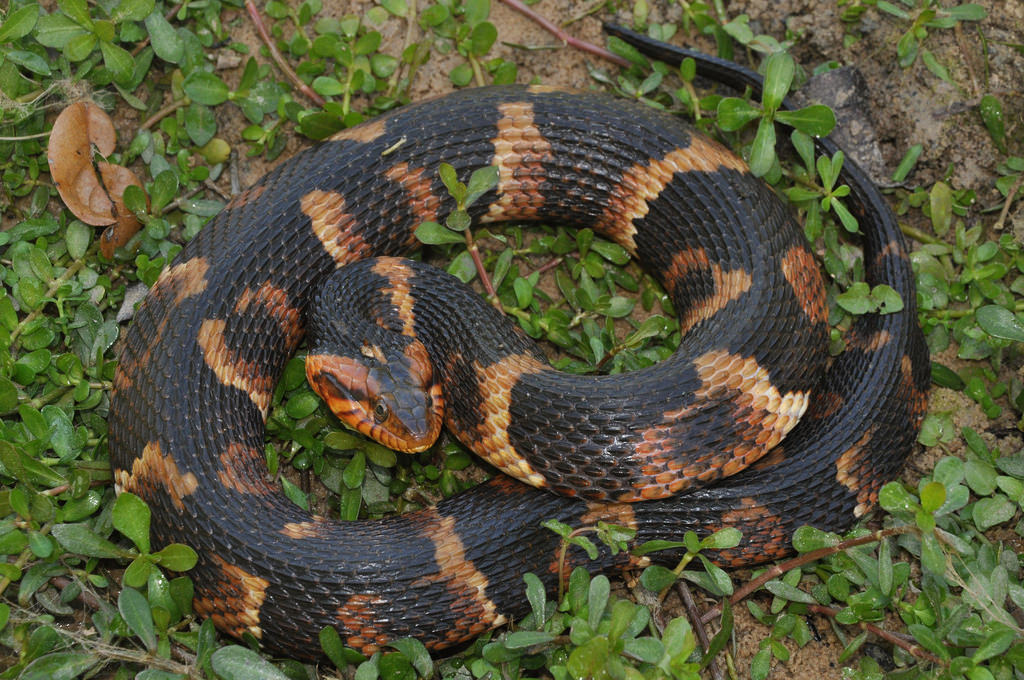
Banded Watersnake
Nerodia fasciata
The banded water snake or southern water snake (Nerodia fasciata) is a species of mostly aquatic, nonvenomous, colubrid snakes most commonly found in the Midwest, Southeastern United States.
From the article Banded water snake on Wikipedia (CC BY-SA), quoted section by section
Description
Adults of the banded water snake typically range from 56 to 107 cm (22 to 42 in) in total length, with a record size (in the Florida subspecies) of 159 cm (62.5 in) in total length. It is typically gray, greenish-gray, or brown in color, with dark crossbanding. Many specimens are so dark in color that their patterning is barely discernible. The ventrum (belly) is typically an off-white to white. They have flat heads, and are fairly heavy-bodied. Banded water snakes may also be identified by a dark stripe which extends from the eye to the angle of the jaw. If irritated, they release a foul-smelling musk to deter predators. This species also exhibits sexual dimorphism in which the female is generally longer and heavier than the male. The average frequency of skin shedding has been found to be every four weeks. Their appearance leads them to be frequently mistaken for other snakes with which they share a habitat, including the venomous cottonmouth.
Range & habitat
Nerodia fasciata is natively found from southern Illinois, south to Louisiana, and east to North Carolina and Florida. Introduced populations exist in Texas and California; other sources include eastern Texas in its natural range. In 1992, its congener Nerodia sipedon (northern or common water snake) and it were found in three sites in California by the US Fish and Wildlife Service (USFWS). In 2009, more than 300 banded water snakes were caught in suburbs of Los Angeles by the Nerodia Working Group of USFWS. Then in May 2016, the species was found in the Colorado River basin near Yuma, Arizona. Further trapping did indeed catch large numbers of them, indicating that a thriving invasive population exists in that area.
Wikipedia: “Geographic range”
What it does
The species preys mainly on fish and frogs. On occasion, they prey on small turtles, small snakes, birds, earthworms, and crawfish. Juveniles mainly consume fish and shift towards eating frogs as adults. This shift may be caused by large frogs being mechanically too difficult for juveniles to consume (which may suggest juveniles may be unable to open their jaws wide enough for adult frogs), because large frogs are energetically too costly for juveniles to catch, or because juveniles are at risk if swallowing prey requires a long time. Individuals less than 500 mm snout–vent length (SVL) primarily consume relatively light mosquito fish and topminnows, whereas individuals exceeding 500 mm SVL begin taking massive bufonid (toad) and ranid (frog) prey. Using its vomeronasal organ, also called Jacobson's organ, the snake can detect parvalbumins in the cutaneous mucus of its prey.
Wikipedia: “Diet”
Where it lives
Recorded sightings
—
geo-referenced records in GBIF, from museums, herbaria and field observers.
Drag the globe to turn it. Dots are where records exist, not a range map; darker means more records.
In the stacks
Searching the stacks…
Every page naming Nerodia fasciata in the Biodiversity Heritage Library →
This page is assembled live from iNaturalist, GBIF, Wikipedia, the Source Library and the Internet Archive. It is not yet part of the hand-edited codex. iNaturalist taxon 29317.