- Animals
- ›Chordates
- ›Vertebrates
- ›Reptiles
- ›Snakes and Lizards
- ›Snakes
- ›Colubrid Snakes
- ›Natricine Snakes
- ›Nerodia
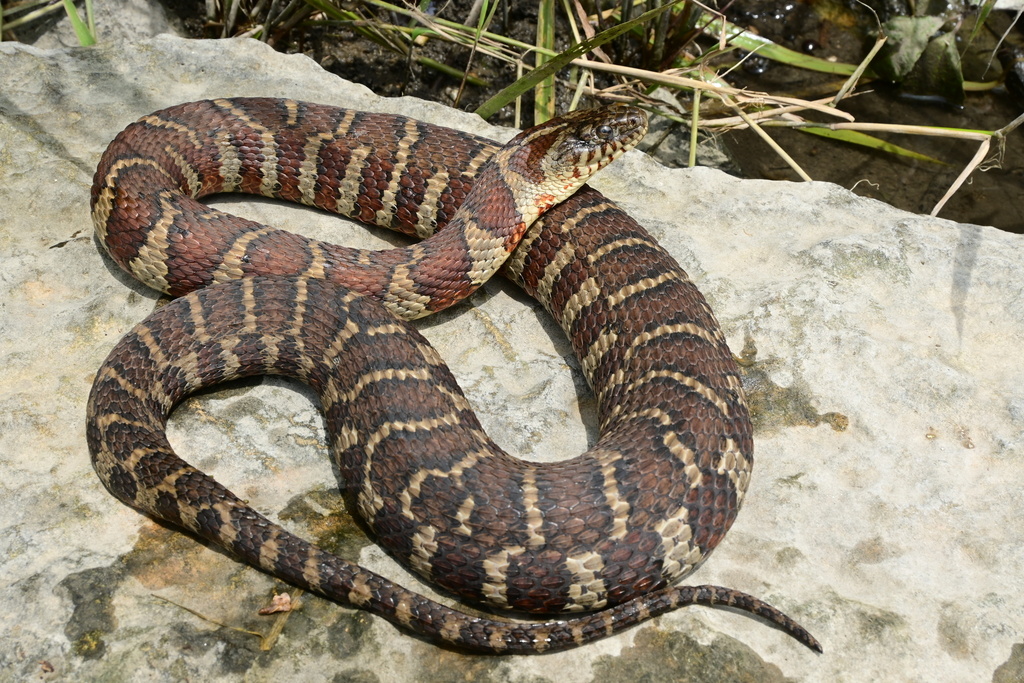
Common Watersnake
Nerodia sipedon
The common watersnake (Nerodia sipedon) is a species of large, nonvenomous, common snake in the family Colubridae. The species is native to North America. It is frequently mistaken for the venomous cottonmouth (Agkistrodon piscivorus).
From the article Common watersnake on Wikipedia (CC BY-SA), quoted section by section
Description
The common watersnake can grow up to 135 cm (4 ft 5 in) in total length (including tail). Per one study, the average total length of females was 81.4 cm (2 ft 8 in), while that of males was 69.6 cm (2 ft 3+1⁄2 in). From known studies of this species in the wild, adult females can weigh between 159 and 408 g (5+1⁄2 and 14+1⁄2 oz) typically, while the smaller male can range from 80.8 to 151 g (2+7⁄8 to 5+3⁄8 oz). The largest females can weigh up to 560 g (20 oz) while the largest males can scale 370 g (13 oz). N. sipedon can be brown, gray, reddish, or brownish-black. It has dark crossbands on the neck and dark blotches on the rest of the body, often leading to misidentification as a cottonmouth or copperhead by novices. As N. sipedon ages, the color darkens, and the pattern becomes obscure. Some individuals become almost completely black. The belly also varies in color. It can be white, yellow, or gray; usually, it also has reddish or black crescents. The common watersnake is nonvenomous and harmless to humans, but superficially resembles the venomous cottonmouth. It is often killed by humans out of fear; attempting to kill snakes greatly increases the chance of being bitten. The two can be easily distinguished: the watersnake has a longer, more slender body and a flattened head the same width as the neck, round pupils, and no heat-sensing pits. …
Range & habitat
The common watersnake is found throughout eastern and central North America, from southern Ontario and southern Quebec in the north, to Texas and Florida in the south. The northern watersnake (Nerodia s. sipedon) naturally occurs as far west as Colorado, east of the Rocky Mountains, and is commonly found in riparian ecosystems along river systems, such as the South Platte River and Arkansas River. In 2007 an introduced population was discovered in California, where the related species N. fasciata has been introduced since at least 1992.
Introduction. While native to the eastern US, water snakes in California are considered invasive species likely to compete with native giant garter snake Thamnophis gigas, a threatened species. Garter snakes in the western U.S. have filled the aquatic snake niche in the absence of true water snakes. The common watersnake may threaten vulnerable fish and amphibian species via excess predation. Common watersnakes are thought to have been introduced to western states as pets that were released. In 2008 it was made illegal in California to own or import common watersnakes without a permit.
Wikipedia: “Geographic range”
What it does
N. sipedon is active during the day and at night. It is most often seen basking on rocks, stumps, or brush. During the day, it hunts among plants at the water's edge, looking for small fish, tadpoles, frogs, worms, leeches, crayfish, large insects, mollusks, annelids, salamanders, other snakes, turtles, small birds, and mammals. At night, it concentrates on minnows and other small fish resting in shallow water. It hunts using smell and sight. The Lake Erie watersnake subspecies, N. s. insularum, was once endangered, but now benefits from the introduction of the round goby, an invasive species, which constitutes up to 90% of its diet. The common watersnake is common over most of its range and is frequently seen basking on stream banks, from which it dives into the water at the slightest disturbance. "Water snakes are highly aquatic, spending nearly all their time either on the surface of the water or on substrate just above or beside the water". It is quick to flee from danger, but if cornered or captured, it usually does not hesitate to defend itself. Larger specimens can inflict a painful bite. Female movement during the mating period was directly and positively related to male mate location success and this effect was intensified when females were freshly-shed.
Wikipedia: “Behavior”
Where it lives
Recorded sightings
—
geo-referenced records in GBIF, from museums, herbaria and field observers.
Drag the globe to turn it. Dots are where records exist, not a range map; darker means more records.
In the stacks
Searching the stacks…
Every page naming Nerodia sipedon in the Biodiversity Heritage Library →
This page is assembled live from iNaturalist, GBIF, Wikipedia, the Source Library and the Internet Archive. It is not yet part of the hand-edited codex. iNaturalist taxon 29305.