- Animals
- ›Chordates
- ›Vertebrates
- ›Reptiles
- ›Snakes and Lizards
- ›Snakes
- ›Colubrid Snakes
- ›Natricine Snakes
- ›Nerodia
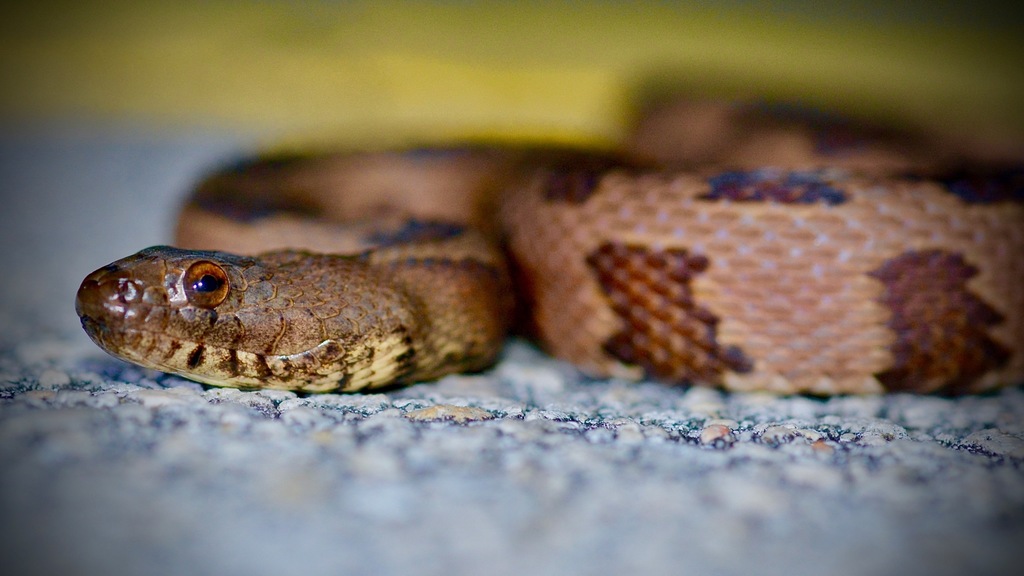
Brown Watersnake
Nerodia taxispilota
The brown water snake (Nerodia taxispilota) is a large species of nonvenomous natricine snake endemic to the southeastern United States. This snake is often one of the most abundant species of snakes found in rivers and streams of the southeastern United States, yet many aspects of its natural history are poorly known. Due to abundance and distribution throughout its biological range, this species could be used to investigate anthropogenic impacts on aquatic ecosystems by studying their movements.
Lycodonomorphus rufulus is sometimes also called the brown water snake, but L. rufulus is found in South Africa.
From the article Brown water snake on Wikipedia (CC BY-SA), quoted section by section
Description
The brown water snake is very heavy-bodied, and its neck is distinctly narrower than its head. Dorsally, it is brown or rusty brown with a row of about 25 black or dark brown, square blotches down its back. Smaller similar blotches alternate on the sides. Ventrally, it is yellow, heavily marked with black or dark brown. Dorsal scales are in 27–33 rows (more than any other North American water snake), and it has two to four anterior temporals (usually one in others). Adults measure 30–60 in. (76–152 cm) in total length; record 69 in. (175 cm).
Range & habitat
Nerodia taxispilota is found in lower coastal regions from southeastern Virginia, through North Carolina, South Carolina, and Georgia, to northern and western Florida (Gulf Coast), then west through Alabama, and Mississippi, to Louisiana, normally from sea level to 500 ft. (150 m) elevation.
Wikipedia: “Geographic range”
What it does
Nerodia taxispilota is ovoviviparous. Mating takes place in the spring on land or on tree branches. On average, adult females are larger than adult males. The young are born alive, usually in August, in broods of 14–58, more commonly 30–40. The newborns are 7–10¾ in (18–27 cm) long, with males longer than females, opposite of adults.
Wikipedia: “Reproduction”
Where it lives
Recorded sightings
—
geo-referenced records in GBIF, from museums, herbaria and field observers.
Drag the globe to turn it. Dots are where records exist, not a range map; darker means more records.
In the stacks
Searching the stacks…
Every page naming Nerodia taxispilota in the Biodiversity Heritage Library →
This page is assembled live from iNaturalist, GBIF, Wikipedia, the Source Library and the Internet Archive. It is not yet part of the hand-edited codex. iNaturalist taxon 29304.