- Animals
- ›Chordates
- ›Vertebrates
- ›Reptiles
- ›Snakes and Lizards
- ›Snakes
- ›Colubrid Snakes
- ›Reed Snakes
- ›Pseudorabdion
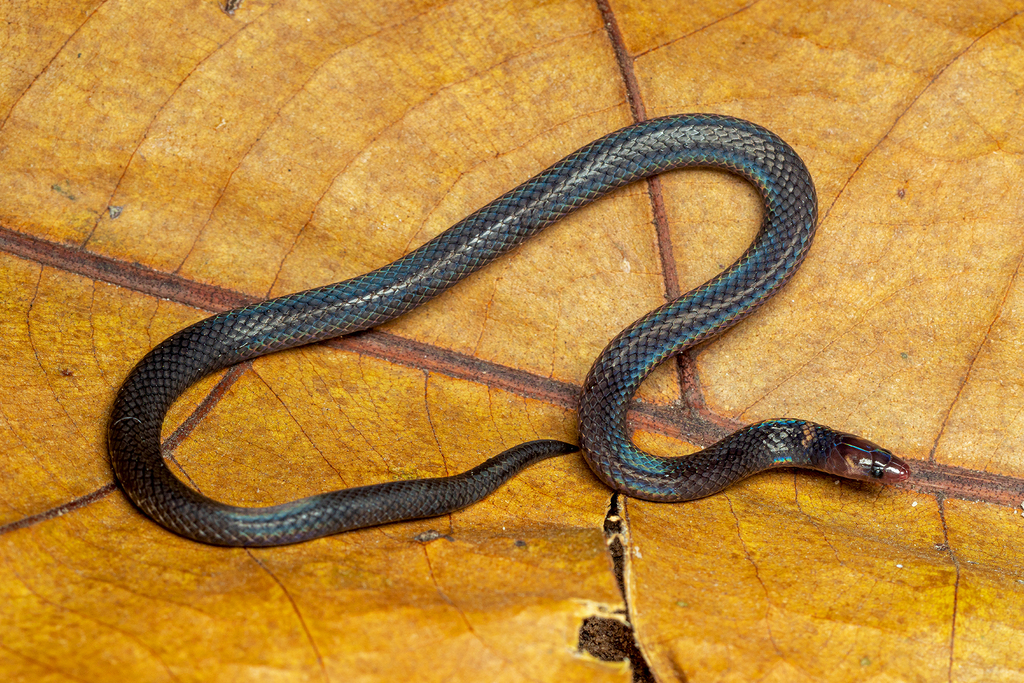
Cantor's Dwarf Reed Snake
Pseudorabdion longiceps
Pseudorabdion longiceps, the dwarf reed snake or Cantor's dwarf reed snake, is a species of snake in the family Colubridae. The species is found in Indonesia, Malaysia, Brunei, Singapore, Thailand, and the Philippines.
From the article Pseudorabdion longiceps on Wikipedia (CC BY-SA), quoted section by section
What it does
Dwarf reed snakes are nocturnal, semi-fossorial (adapted to living underground) and shy. When above ground, they often hide under objects or among fallen leaves. They have not been extensively studied, partly because they are hard to find. They measure 11–28 centimetres (4.3–11.0 in) long. It is known to be preyed on by larger snakes, including the banded coral snake Calliophis intestinalis; by birds such as the slaty-backed forktail; and by Scolopendra subspinipes, a species of extremely large centipede.
Cartwheeling. A 2023 study recorded a dwarf reed snake "cartwheeling" to escape when startled. The rolling motion is four times faster than the snake's normal slither, reaching speeds of around 9 miles per hour (14 km/h), and requires a great deal of energy, limiting its use to emergencies such as an immediate threat. The authors of the 2023 paper speculated that it may also hinder predators by confusing them, or by making the snake's scent trail harder to follow, as only a small portion of the snake's body contacts the ground. The cartwheel may have evolved from simpler saltation (jumping) defense mechanisms, which are known in several different groups of snakes. A 2026 paper found that the 'cartwheel' is produced by a complex and precise chain of twisting movements that allow the snake to keep its head approximately stable even when rolling at high speed. …
Wikipedia: “Behavior”
Where it lives
Recorded sightings
—
geo-referenced records in GBIF, from museums, herbaria and field observers.
Drag the globe to turn it. Dots are where records exist, not a range map; darker means more records.
In the stacks
Searching the stacks…
Every page naming Pseudorabdion longiceps in the Biodiversity Heritage Library →
This page is assembled live from iNaturalist, GBIF, Wikipedia, the Source Library and the Internet Archive. It is not yet part of the hand-edited codex. iNaturalist taxon 28926.