- Animals
- ›Chordates
- ›Vertebrates
- ›Reptiles
- ›Snakes and Lizards
- ›Snakes
- ›Colubrid Snakes
- ›Colubrine Snakes
- ›Spalerosophis
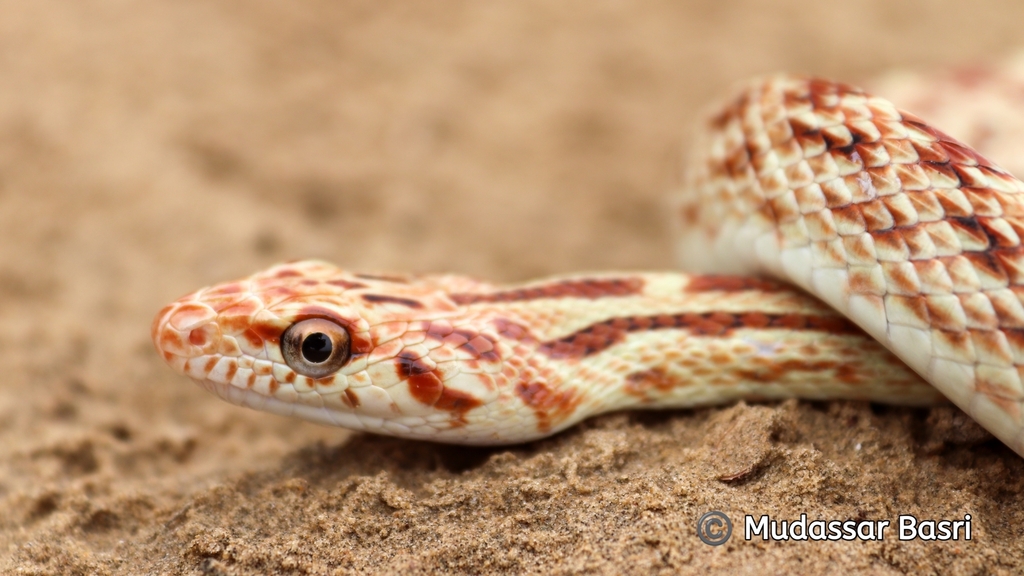
Red-spotted Royal Snake
Spalerosophis arenarius
Spalerosophis arenarius, commonly known as the red-spotted diadem snake or the red-spotted royal snake, is a species of snake in the subfamily Colubrinae of the family Colubridae. The species is endemic to South Asia.
From the article Spalerosophis arenarius on Wikipedia (CC BY-SA), quoted section by section
Description
S. arenarius grows to a total length (including tail) of about 1 m (39 inches). Dorsally, it is cream-colored or pale buff, with darker spots arranged quincuncially. There is also a darker stripe on each side of the neck. Ventrally, it is uniform white.
What it does
S. arenarius is oviparous.
They do hibernate in the season of December to February and pairs start to mate in late March to April. Eggs are laid from May to July. A female weighing above 250 grams can produce a clutch of 7 to 10 eggs. A female finds a good spot for the incubation of eggs with a temperature of 28°-30 °C and humidity around 80-95%. A female lays and burrow its eggs at the laying site, no parental care is observed. Each eggs weigh around 7 grams. eggs take around 60 days to hatch. babies are 15 cm in length and feeds on lizards or small rodents at the first stage of their life.
Wikipedia: “Reproduction”
Where it lives
Recorded sightings
—
geo-referenced records in GBIF, from museums, herbaria and field observers.
Drag the globe to turn it. Dots are where records exist, not a range map; darker means more records.
In the stacks
Searching the stacks…
Every page naming Spalerosophis arenarius in the Biodiversity Heritage Library →
This page is assembled live from iNaturalist, GBIF, Wikipedia, the Source Library and the Internet Archive. It is not yet part of the hand-edited codex. iNaturalist taxon 28638.