- Animals
- ›Chordates
- ›Vertebrates
- ›Reptiles
- ›Snakes and Lizards
- ›Snakes
- ›Colubrid Snakes
- ›Colubrine Snakes
- ›Tantilla
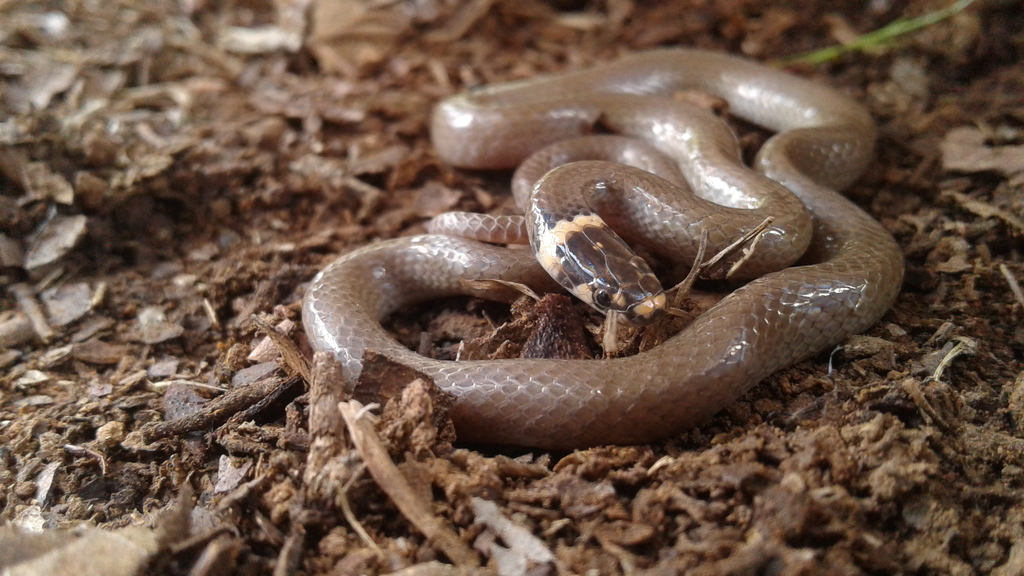
Bocourt's Black-headed Snake
Tantilla bocourti
Tantilla bocourti, also known commonly as Bocourt's black-headed snake and la serpiente de cabeza negra de Bocourt in Mexican Spanish, is a species of snake in the subfamily Colubrinae of the family Colubridae. The species is endemic to Mexico.
From the article Tantilla bocourti on Wikipedia (CC BY-SA), quoted section by section
Description
A small snake, the holotype of Tantilla bocourti has a total length of 24.5 cm (9.6 in), which includes a tail 5 cm (2.0 in) long. It has the following coloration in alcohol. Dorsally, it is pale reddish, without spots or markings. The head is black, with a yellowish crossbar on the snout and a yellowish, black-edged occipital crossbar (nuchal collar) just behind the parietals. Ventrally, the body is whitish, as is the upper lip.
Range & habitat
Tantilla bocourti is found in central Mexico, in the Mexican states of Aguascalientes, Colima, Durango, Guanajuato, Guerrero, Hidalgo, Jalisco, Michoacán, Morelos, Nayarit, Oaxaca, Puebla, Querétaro, San Luis Potosí, Sinaloa, Veracruz, and Zacatecas.
Wikipedia: “Geographic range”
In human culture
The specific name, bocourti, is in honor of French zoologist Marie Firmin Bocourt.
Wikipedia: “Etymology”
Where it lives
Recorded sightings
—
geo-referenced records in GBIF, from museums, herbaria and field observers.
Drag the globe to turn it. Dots are where records exist, not a range map; darker means more records.
In the stacks
Searching the stacks…
Every page naming Tantilla bocourti in the Biodiversity Heritage Library →
This page is assembled live from iNaturalist, GBIF, Wikipedia, the Source Library and the Internet Archive. It is not yet part of the hand-edited codex. iNaturalist taxon 28524.