- Animals
- ›Chordates
- ›Vertebrates
- ›Reptiles
- ›Snakes and Lizards
- ›Snakes
- ›Colubrid Snakes
- ›Natricine Snakes
- ›Thamnophis
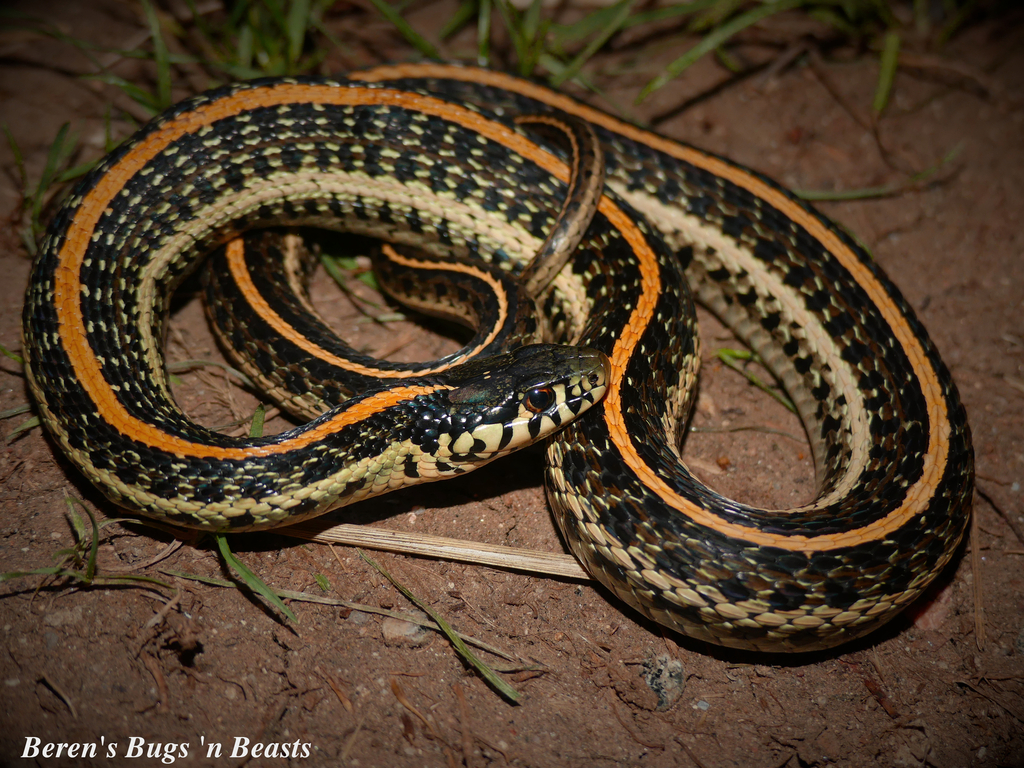
Plains Garter Snake
Thamnophis radix
The plains garter snake (Thamnophis radix) is a species of garter snake native to most of the central United States as far north as Canada and as far south as Texas. It has a distinctive orange or yellow stripe from its head to tail, and the rest of its body is mainly a gray-green color. The snake is commonly found living near water sources such as streams and ponds, but can also be found in urban areas and vacant lots. Although the IUCN lists the species as "Least Concern", some states have given it their own special status. This species is mildly venomous, although the venom is not toxic to humans.
From the article Plains garter snake on Wikipedia (CC BY-SA), quoted section by section
Range & habitat
The plains garter snake is commonly found in meadows and prairies adjacent to water sources, such as marshes, streams, and ponds. In built-up areas of the Chicago area, it has been observed in abandoned buildings, trash heaps, and vacant lots. Populations in urban and suburban areas have been greatly reduced due to building activities and pesticide use. Its habitat range overlaps with that of the common garter snake (Thamnophis sirtalis) in many areas, and it is thought the two species may hybridize.
Geographic range. The snake ranges across a broad area of North America from as far north as central Alberta to as far south as Northern Texas and New Mexico. In the United States, it is also found in Iowa, eastern Wyoming, northern Kentucky, eastern Colorado, Minnesota, southern Wisconsin, Illinois, northwestern Indiana, Oklahoma, Nebraska and the northern half of Missouri. A small population is also in Ohio. In Canada, the species is also found in Manitoba. It can be found at elevations from 400 to 7,500 feet, but prefers to stay under 6,000 feet.
Wikipedia: “Habitat”
What it does
Described as "one of the most cold-tolerant snakes", on warmer winter days, it often comes out of hibernation to bask in the sun. It is most active between April and late October depending on location. Mating normally takes place in April or May and birth takes place between August and October. Courtship usually occurs near the communal hibernation site, and polygynous mating systems have been observed. The snake's typical diet consists of earthworms, slugs, and small amphibians, including the larvae of salamanders. It has also been observed eating small mammals and birds, such as bank swallows and eastern meadowlarks.
Wikipedia: “Behavior”
Where it lives
Recorded sightings
—
geo-referenced records in GBIF, from museums, herbaria and field observers.
Drag the globe to turn it. Dots are where records exist, not a range map; darker means more records.
In the stacks
Searching the stacks…
Every page naming Thamnophis radix in the Biodiversity Heritage Library →
This page is assembled live from iNaturalist, GBIF, Wikipedia, the Source Library and the Internet Archive. It is not yet part of the hand-edited codex. iNaturalist taxon 28378.