- Animals
- ›Chordates
- ›Vertebrates
- ›Reptiles
- ›Snakes and Lizards
- ›Snakes
- ›Colubrid Snakes
- ›Natricine Snakes
- ›Thamnophis
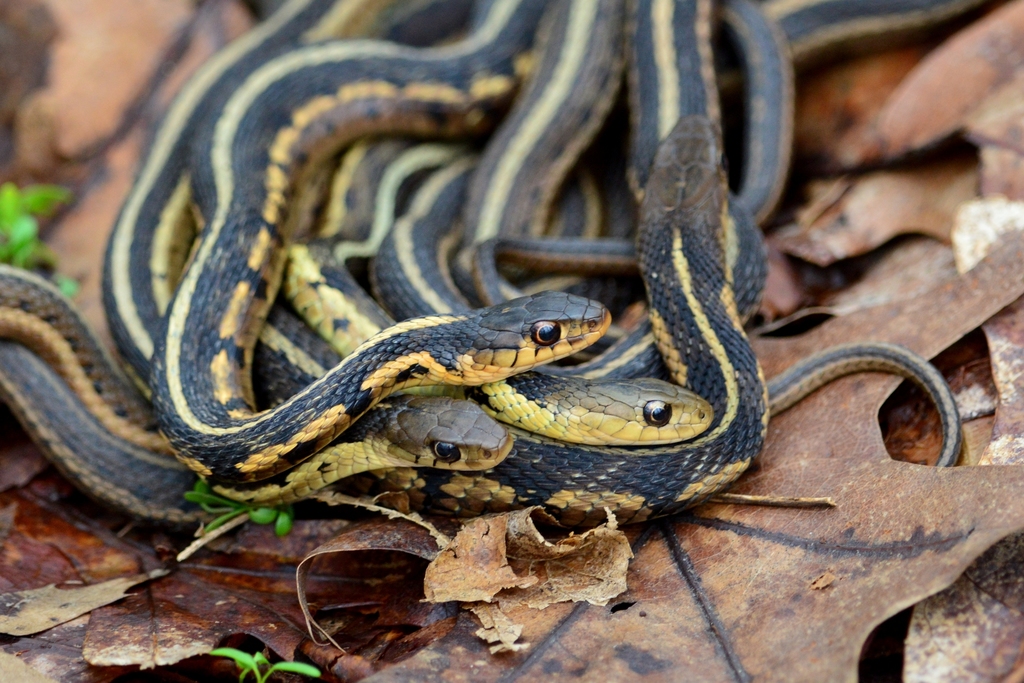
Common Garter Snake
Thamnophis sirtalis
The common garter snake (Thamnophis sirtalis) is a species of snake in the subfamily Natricinae of the family Colubridae. The species is indigenous to North America and found widely across the continent. There are several recognized subspecies. Most common garter snakes have a pattern of yellow stripes on a black, brown or green background, and their average total length (including tail) is about 55 cm (22 in), with a maximum total length of about 137 cm (54 in). The average body mass is 150 g (5.3 oz). The common garter snake is the state reptile of Massachusetts.
From the article Common garter snake on Wikipedia (CC BY-SA), quoted section by section
Description
Common garter snakes are thin snakes. Few grow over about 4 ft (1.2 m) long, and most stay smaller. Most have longitudinal stripes in many different colors. Common garter snakes come in a wide range of colors, including green, blue, yellow, gold, red, orange, brown, and black.
Venom. Garter snakes have a mild venom in their saliva, which may be toxic to the amphibians and other small animals that they prey upon. For humans, a bite is not dangerous, and many handlers can attest to garter snakes gently biting in protest when held or restrained; these bites do not often break the skin, given the garter snake's smaller size, but may cause slight itching, burning, and/or swelling at the location of the bite. However, it is more likely that, prior to expending their energy through biting, garter snakes will secrete a foul-smelling fluid ("musk", "musking", "skunking") from postanal glands. Common garter snakes are resistant to naturally occurring poisons in their prey, such as that of the American toad and rough-skinned newt, the latter of which can kill a human if ingested. Garter snakes (in addition to their own mildly venomous saliva) have the ability to retain poisons from their consumed amphibian prey, thus making them poisonous and deterring any would-be predators. The common garter snake uses toxicity for both offense and defense. …
Wikipedia: “Anatomy and description”
Range & habitat
The habitat of the common garter snake ranges from forests, fields, and prairies to streams, wetlands, meadows, marshes, and ponds, and it is often found near water. Depending on the subspecies, the common garter snake can be found as far south the southernmost tip of Florida in the United States and as far north as the southernmost tip of the Northwest Territories in Canada. It is found at altitudes from sea level to mountains.
Wikipedia: “Habitat”
What it does
The common garter snake is a diurnal snake. In summer, it is most active in the morning and late afternoon; in cooler seasons or climates, it restricts its activity to the warm afternoons. In warmer southern areas, the snake is active year-round; otherwise, it sleeps in common dens, sometimes in great numbers. On warm winter afternoons, some snakes have been observed emerging from their hibernacula to bask in the sun.
Antipredatory displays. Garter snakes exhibit many different behaviors to ward off predators. Garter snakes exhibit a greater variety of body postures than other snakes. Under selection by predation, these snakes have developed postural responses that are highly variable and heritable. These are highly variable even within a single population. Different postures indicate whether the snake is preparing to flee, fight, or protect itself. Different biological factors such as body temperature and sex also influence whether the snake exhibits certain antipredatory behaviors. The warmer the temperature of a garter snake, the more likely the snake is to flee a predator; a snake with a cooler body temperature is more likely to remain stationary or attack. Male garter snakes are also more likely to flee. Garter snakes that exhibit more aggressive antipredatory displays tend to also be fast and have high stamina. …
Wikipedia: “Behavior and life history”
In human culture
The subspecific name fitchi is in honor of the American herpetologist Henry Sheldon Fitch. The subspecific name pickeringii is in honor of the American naturalist Charles E. Pickering.
Subspecies. Current scientific classification recognizes 12 subspecies (ordered by date):
A trinomial authority in parentheses indicates that the subspecies was originally described in a genus other than Thamnophis.
Wikipedia: “Taxonomy and etymology”
Where it lives
Recorded sightings
—
geo-referenced records in GBIF, from museums, herbaria and field observers.
Drag the globe to turn it. Dots are where records exist, not a range map; darker means more records.
In the stacks
Searching the stacks…
Every page naming Thamnophis sirtalis in the Biodiversity Heritage Library →
This page is assembled live from iNaturalist, GBIF, Wikipedia, the Source Library and the Internet Archive. It is not yet part of the hand-edited codex. iNaturalist taxon 28362.