- Animals
- ›Chordates
- ›Vertebrates
- ›Reptiles
- ›Snakes and Lizards
- ›Snakes
- ›Colubrid Snakes
- ›Colubrine Snakes
- ›Boiga
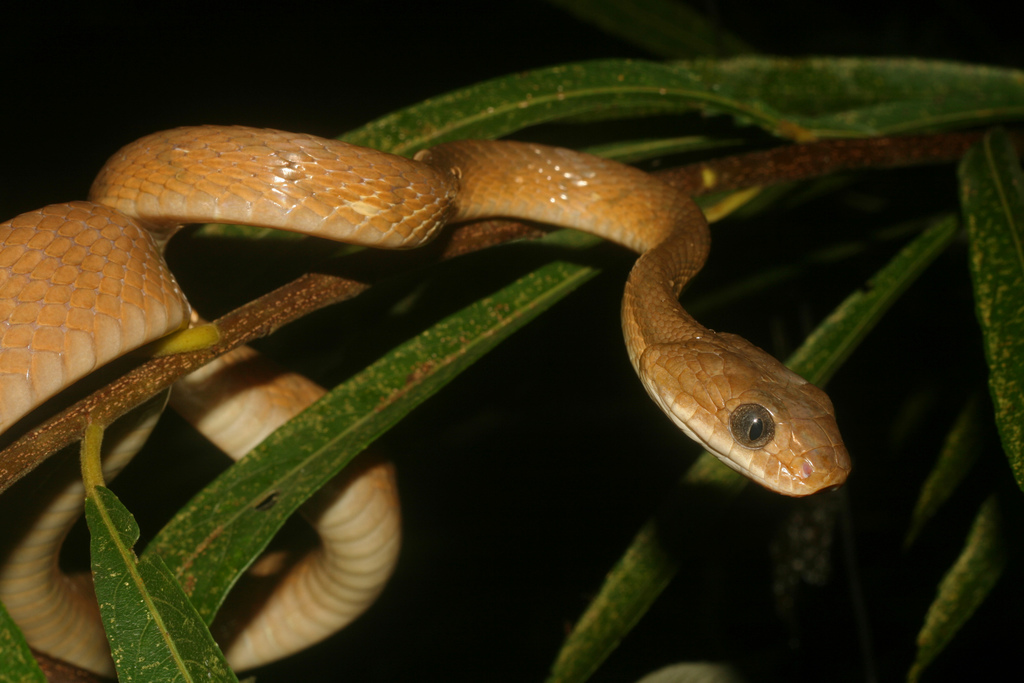
Philippine Cat Snake
Boiga philippina
Boiga philippina, also known as the tawny cat-eyed snake or Philippine cat snake, a species of rear-fanged colubrid snake that is endemic to the Philippines.
From the article Boiga philippina on Wikipedia (CC BY-SA), quoted section by section
Description
It has a very slender body that can reach lengths of up to 213 cm (7.0 ft). The big head is of typical Boiga fashion with big eyes and elliptical pupils much like a cat's eye. The white chin extends down the neck to almost half of its body. Body coloration maybe tan, light brown, brown, coffee-color to a pale orange. The underside is made-up of big belly scute scales that is usually tan to orange in color. Underneath the scales of the neck are yellow, black and white markings. Tongue color is black with white or gray tips.
Range & habitat
Boiga philippina is endemic to the Philippines. It is found in Luzon, Camiguin Norte, Babuyan Claro, and Dalupiri at elevations of 50–800 m (160–2,620 ft) above sea level. This snakes has sighting also on any other Luzon province like Quezon/Rizal Boundary according to FB Group Snake Identification of the Philippines and another sighting from Catanduanes according to John Gil and FB pages called Catanduanes Biodiversity: List of Native and Non Native Species.
Wikipedia: “Distribution”
What it does
Like all Boigas, it is highly nocturnal. Its generally docile but a very nervous snake when alarmed. It will not hesitate to bite, however. When threatened; it raises its head, expands the scales of its neck to show off its warning coloration, as well as to make itself appear bigger than it really is, then makes a puffing noise and may strike repeatedly. An arboreal snake, it will rarely descend on the ground unless it is looking for prey or a place to hide in times of heavy rain.
Wikipedia: “Behavior”
Toxicity
Like most rear-fanged snakes, the tawny cat-eyed snake is mildly venomous. Although its venom is said to be slightly stronger than most Boiga species, its rounded mouth is very unlikely to cause an envenomating bite. If it does come to a point of envenomation, there is swelling in the bite area that usually subsides within two to three days. No fatalities have been reported so far.
Wikipedia: “Venom”
Where it lives
Recorded sightings
—
geo-referenced records in GBIF, from museums, herbaria and field observers.
Drag the globe to turn it. Dots are where records exist, not a range map; darker means more records.
In the stacks
Searching the stacks…
Every page naming Boiga philippina in the Biodiversity Heritage Library →
This page is assembled live from iNaturalist, GBIF, Wikipedia, the Source Library and the Internet Archive. It is not yet part of the hand-edited codex. iNaturalist taxon 27642.