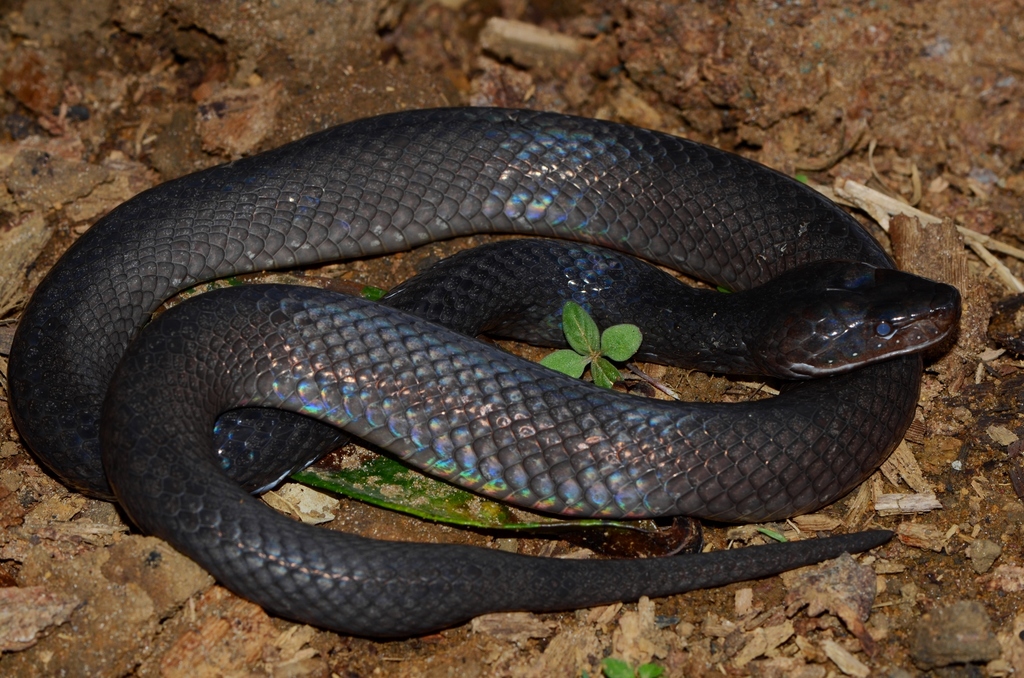
Günther's Black Snake
Bothrolycus ater
Günther's black snake (Bothrolycus ater) is a species of poorly known lamprophiid snake endemic to central Africa. It is the only member of the genus, Bothrolycus. This snake is notable as one of the few snakes with notable sexual dimorphism (males have 17 scale rows, females have 19), as well as possessing a small pit anterior to the eye. While superficially similar to the thermal pits of vipers, its function remains unknown.
From the article Günther's black snake on Wikipedia (CC BY-SA), quoted section by section
Description
The 20 maxillary teeth form a continuous series, with the six anterior teeth strongly enlarged. The anterior mandibular teeth are strongly enlarged. The head is distinct from the neck, and the eyes are rather small, with round pupils. The loreal region is deeply concave, with the pit entering the eye. Its body is short and cylindrical, and the tail is very short. The dorsal scales are smooth, without apical pits, in 19 [or 17] rows. Ventral scales are rounded; the subcaudals occur in two rows. The vertebral column has hypapophyses developed throughout. Dorsally, this snake is blackish-brown, with a paler head. The lips and chin have a few whitish, black-edged dots. Ventrally, it is pale brown, with whitish dots or short streaks. Adult females may attain a total length of 46 cm (18 in), with a tail 4 cm (1.5 in) long. Their dorsal scales are smooth, arranged in 19 rows. Ventral scales are 147–148 in number; the anal plate is entire. The 18–22 subcaudals are divided. Males have smooth dorsal scales in 17 rows. The anal plate entire, and the subcaudals are divided. The snout is projecting and obliquely truncated; the loreal region is vertical. The rostral is slightly broader than high, and not visible from above. The internasals are much shorter than the prefrontals. …
Range & habitat
It is found in Cameroon, Equatorial Guinea, Gabon, and the Democratic Republic of Congo (Zaire).
Wikipedia: “Geographic range”
Where it lives
Recorded sightings
—
geo-referenced records in GBIF, from museums, herbaria and field observers.
Drag the globe to turn it. Dots are where records exist, not a range map; darker means more records.
In the stacks
Searching the stacks…
Every page naming Bothrolycus ater in the Biodiversity Heritage Library →
This page is assembled live from iNaturalist, GBIF, Wikipedia, the Source Library and the Internet Archive. It is not yet part of the hand-edited codex. iNaturalist taxon 27612.