- Animals
- ›Chordates
- ›Vertebrates
- ›Reptiles
- ›Snakes and Lizards
- ›Snakes
- ›Colubrid Snakes
- ›Dipsadine Snakes
- ›Carphophis
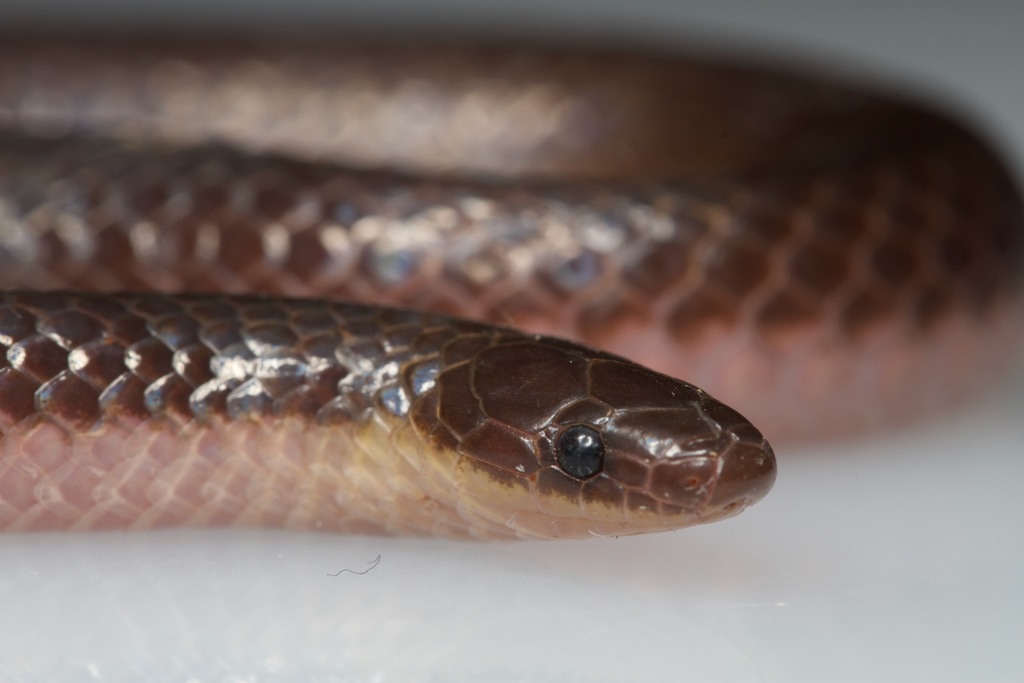
Common Wormsnake
Carphophis amoenus
Carphophis amoenus, commonly known as the worm snake, is a species of nonvenomous colubrid snake endemic to the eastern United States. C. amoenus can be found east of the Mississippi, from southwest Massachusetts south to southern Alabama west to Louisiana and then north to Illinois. This species of snake protects a large range, and normally prefers a moist habitat in the rocky woodlands, under rotten wood of logs and stumps. Though this snake is quite abundant over its range, it is rarely seen because of its dormant lifestyle and where it usually resides. This snake is most common on the edges or in the ecotonal areas of open to thick woodlands, and the borders of wetlands. It may also be found in the grasslands next to woodlands. The best chance to spot it is after heavy rains, when its small size and distinct color make it easy to spot. This species prefers moist soil inhabited by earthworms, which are its main prey, so the soil needs to be sufficiently moist. The snake's skin naturally evaporates water; so the soil needs to be moist enough to offset this. C. amoenus is mostly found under rocks and in sufficient leaf litter during the extreme daytime heat. Peak activity falls between 15:00 to 18:00.
From the article Carphophis amoenus on Wikipedia (CC BY-SA), quoted section by section
Description
The worm snake is a small snake. Adults are 19–28 cm (7.5–11.0 in) in total length, record 34 cm (13 in) . It is brown dorsally, and bright pink ventrally, with the belly color including one or two dorsal scale rows. The dorsal scales are smooth, in 13 rows. It has five upper labials and one postocular. C. amoenus coloration is unpatterned and can be tan to dark brown in color; it has a pointed head, and small, black eyes. It has pinkish ventral pigmentation which extends dorsally onto dorsal scale rows one to two. The tail is short in comparison with its body and ends in an abrupt, spine-like scale. Females are longer than males, but have shorter tails. The head is small, conical and no wider than the neck. Other small, unpatterned brownish snakes, such as earth snakes (genus Virginia) and red-bellied snakes (Storeria occipitomaculata), have keeled body scales and lack the spine-tipped tail. Other ways to distinguish between C. amoenus and other species are that the body scales usually occur in 13 rows and are smooth and pitless, and the anal plate is split. Another snake commonly confused with C. amoenus is the western worm snake (Carphophis vermis), which used to be considered a subspecies of C. amoenus, and has the slight ventral pigmentation extending onto the third body scale row, and a dark gray or gray-violet dorsum. …
Range & habitat
It is found in southern Connecticut, southwestern Massachusetts, southeastern New York, New Jersey, southeastern Pennsylvania, Delaware, Maryland, Virginia, eastern West Virginia, North Carolina, South Carolina, northern Georgia and Alabama, In Mississippi, it is common only in the northeastern part of the state and in the northern and eastern parts of the Short-Leaf Pine Belt. in the Appalachian Mountains of Kentucky and Tennessee.
Wikipedia: “Geographic range”
What it does
The worm snake is a burrower, and is seldom seen. Its annual activity period varies with latitude and elevation. Some have found them active in every month but February on the coastal plain of South Carolina. Farther north, the worm snake is active from March–April to October- November. Few are active above ground in the summer, but a second, lesser period of activity occurs in the fall. To escape overheating or desiccation, it has adopted a fossorial lifestyle and it usually spends most of the year underground or in rotting logs. They are normally found in forests with high leaf litter and canopy cover. They generally remain inactive during extreme temperatures. However, most of their surface activity is positively correlated with very high temperatures. They burrow by working their small, pointed heads into cracks and crevices. Activity periods begin mainly in the late afternoon and early evenings and rarely last more than 12 hours. C. amoenus amoenus does not move much but has been seen traveling 45 m in a 24-hour period. Males travel much farther than females and their diets consist primarily of earthworms, but may also include other soft-bodied invertebrates, such as insect larvae. Predators include other snakes, thrushes, American robins, barn owls, and opossums. Occasionally, road traffic kills C. …
Wikipedia: “Ecology”
In human culture
The specific name, amoenus, is Latin for "pleasing, charming" in reference to the snake's temperament. The generic name, Carphophis, translates to "straw snake"
Wikipedia: “Etymology”
Where it lives
Recorded sightings
—
geo-referenced records in GBIF, from museums, herbaria and field observers.
Drag the globe to turn it. Dots are where records exist, not a range map; darker means more records.
In the stacks
Searching the stacks…
Every page naming Carphophis amoenus in the Biodiversity Heritage Library →
This page is assembled live from iNaturalist, GBIF, Wikipedia, the Source Library and the Internet Archive. It is not yet part of the hand-edited codex. iNaturalist taxon 27388.