- Animals
- ›Chordates
- ›Vertebrates
- ›Reptiles
- ›Snakes and Lizards
- ›Snakes
- ›Colubrid Snakes
- ›Colubrine Snakes
- ›Cemophora
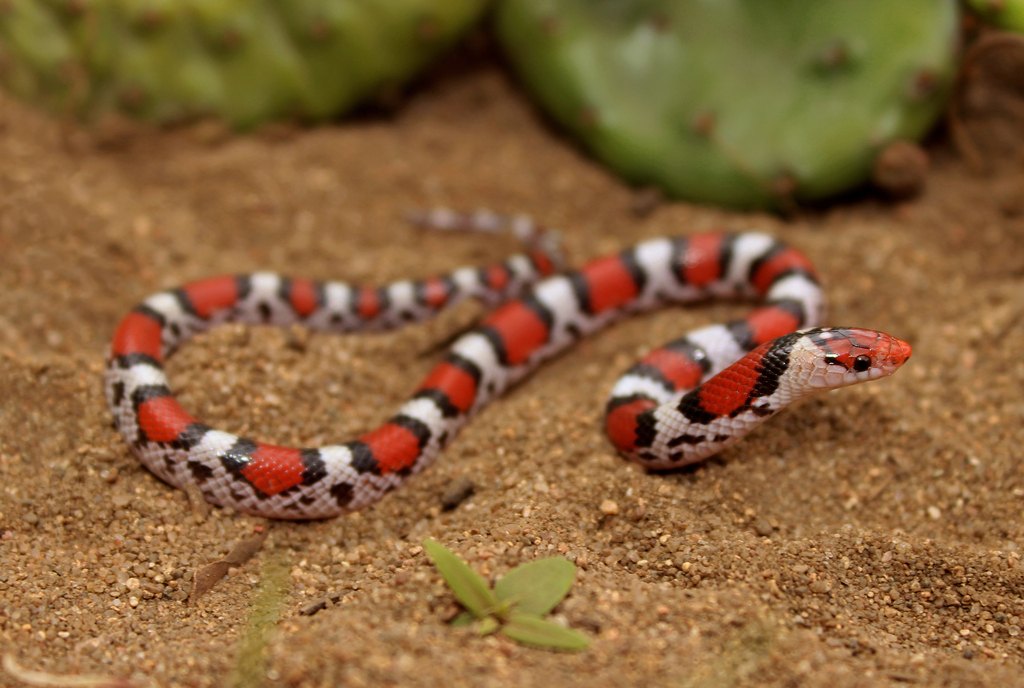
Scarletsnake
Cemophora coccinea
Cemophora coccinea, commonly known as the scarlet snake, is a species of nonvenomous snake in the subfamily Colubrinae of the family Colubridae. The species is native to the southeastern United States. There are two subspecies of C. coccinea that are recognized as being valid. The Texas scarlet snake (C. lineri) was previously considered a subspecies.
From the article Cemophora coccinea on Wikipedia (CC BY-SA), quoted section by section
Description
The scarlet snake is relatively small, semi fossorial habitat specialists from southeastern United States, growing to a total length (tail included) of 14–26 inches (36–66 cm) at adult size. The dorsal pattern consists of a light gray ground color, with a series of black-bordered red, white or yellow blotches down the back. The belly is either a uniform light gray or white color. The dorsal blotches can extend down the sides of the body, appearing somewhat like banding or rings, which sometimes leads to confusion with other sympatric species such as the venomous coral snakes or the harmless scarlet king snake. The similar pattern exhibited by these three snakes is a form of mimicry known as batesian mimicry. This is a phenomenon in which members of a palatable species gain protection from predation by resembling or mimicking the defensive signaling of an unpalatable or defended species.
Range & habitat
C. coccinea is found only in the United States. It is native to peninsular Florida, and found in southeastern Texas, eastern Oklahoma, Arkansas, parts of Louisiana, Mississippi, Alabama, Georgia, South Carolina, North Carolina, Tennessee, Kentucky, Illinois, Indiana, Virginia, Maryland, and Delaware; with disjunct populations in New Jersey and central Missouri. The species is more commonly found throughout most of the Atlantic coastal plain areas. It prefers open forested areas with sandy soil, ground litter, and organic debris.
In Indiana, the scarlet snake is listed as an endangered species. In New Jersey, the scarlet snake has been recommended by the New Jersey Endangered and Nongame Advisory Committee to be given threatened status for the species within the state, but no formal rule proposal has been filed to date. The threatened status is largely due to population declines and habitat loss. Reasons for the decline in the population are loss of habitat, illegal capture for the pet trade, road mortality, and direct intentional killing.
Wikipedia: “Geographic distribution”
What it does
The scarlet snake is nocturnal and is active only during the summer months. It can be found during the day beneath logs and under pine debris or other organic litter. It also burrows underground during daytime hours, or uses previously dug tunnels as shelter. At night it is often seen crossing roads, or prowling the forest floor searching for prey. The diet of C. coccinea consists of lizards, small rodents, and eggs of lizards, turtles, and other snakes. Its large, very sharp posterior teeth are used to slash open large reptile eggs. The snake will either squeeze an egg to expel its contents or thrust its head into the egg to break it open. The smallest reptile eggs are eaten in their entirety.
Wikipedia: “Behavior and diet”
In human culture
The generic name, Cemophora, is derived from the Greek words Kemos, meaning "muzzle", and phoros, meaning "bearing", referring to the pronounced rostral scale characteristic of members of the genus.
Wikipedia: “Etymology”
Where it lives
Recorded sightings
—
geo-referenced records in GBIF, from museums, herbaria and field observers.
Drag the globe to turn it. Dots are where records exist, not a range map; darker means more records.
In the stacks
Searching the stacks…
Every page naming Cemophora coccinea in the Biodiversity Heritage Library →
This page is assembled live from iNaturalist, GBIF, Wikipedia, the Source Library and the Internet Archive. It is not yet part of the hand-edited codex. iNaturalist taxon 27376.