- Animals
- ›Arthropods
- ›Hexapods
- ›Insects
- ›Winged and Once-winged Insects
- ›Beetles
- ›Water, Rove, Scarab, Long-horned, Leaf, and Snout Beetles
- ›Cucujiform Beetles
- ›Lady, Fungus, Scavenger, and Bark Beetles
- ›Lady Beetles
- ›Coccidulinae
- ›Coccidulini
- ›Rhyzobius
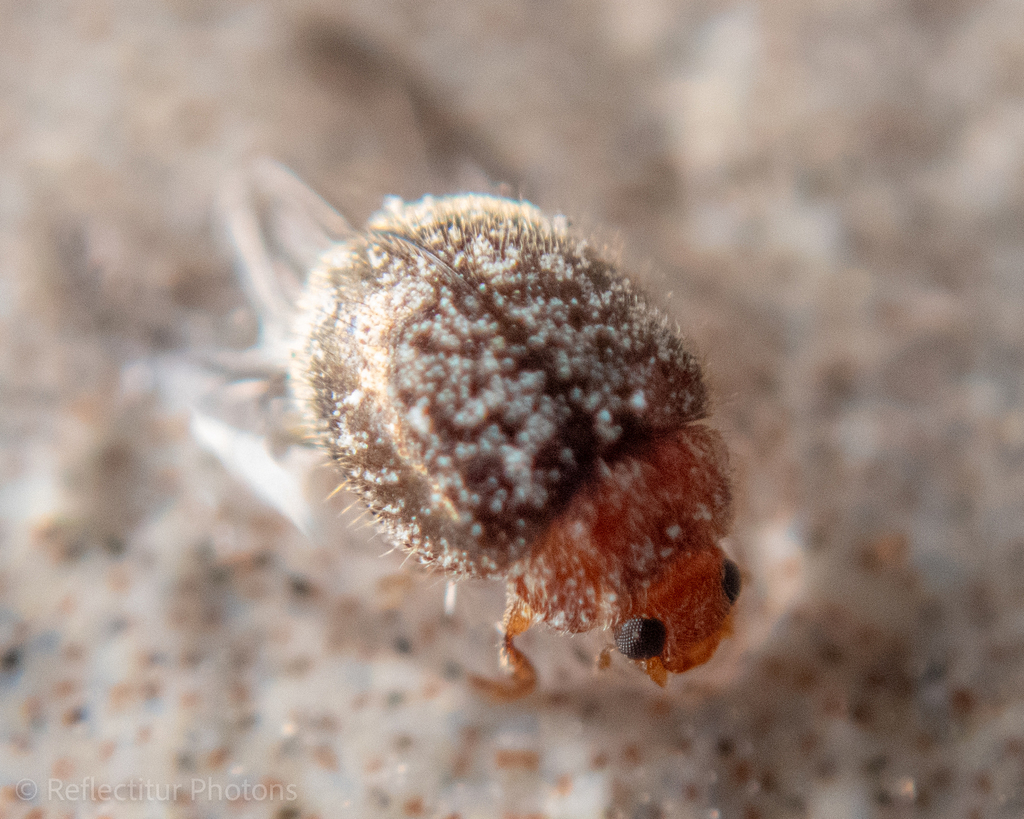
Purple Scale Predator
Rhyzobius lophanthae
Rhyzobius lophanthae, commonly known as the purple scale predator or the scale-eating ladybird, is a species of ladybird native to Queensland and Southern Australia. It was introduced into the United States in the 1890s and has since spread over the southern half of the country.
From the article Rhyzobius lophanthae on Wikipedia (CC BY-SA), quoted section by section
Description
Rhyzobius lophanthae is a small ladybird with a length between 1.7 and 2.85 mm (0.07 and 0.11 in) and a width of between 1.35 and 2.0 mm (0.05 and 0.08 in). The head and prothorax are reddish-brown, as is the underside, both being densely covered with short hairs of two lengths. The elytra (wing cases) are blackish, often with a metallic bronze sheen. The larvae are dark brown and is clad in stout spines.
Range & habitat
Rhyzobius lophanthae is native to Australia where it is present in Queensland and Southern Australia. It was introduced into California in 1892 in an attempt to control the olive scale (Saissetia oleae). It has since spread over much of the southern United States. It can also be found in Europe.
Wikipedia: “Distribution and habitat”
What it does
Both adults and larvae feed on scale insects, and especially on armoured scales at all periods of their development; they also feed on mealybugs. The younger beetle larvae crawl under the adult scale insect's protective scale, feeding on the scale nymphs before they disperse. These insects are a pest of citrus, sucking the sap from the plants, and the ladybirds have been used in biological pest control, in order to reduce the number of scale insects in the crop.
Wikipedia: “Ecology”
Listen
Looking for field recordings…
Where it lives
Recorded sightings
—
geo-referenced records in GBIF, from museums, herbaria and field observers.
Drag the globe to turn it. Dots are where records exist, not a range map; darker means more records.
In the stacks
Searching the stacks…
Every page naming Rhyzobius lophanthae in the Biodiversity Heritage Library →
This page is assembled live from iNaturalist, GBIF, Wikipedia, the Source Library and the Internet Archive. It is not yet part of the hand-edited codex. iNaturalist taxon 272002.