- Animals
- ›Chordates
- ›Vertebrates
- ›Birds
- ›Pelicans, Herons, Ibises, and Allies
- ›Ibises and Spoonbills
- ›Threskiornis
On eBird ↗
Reunion Ibis
Live sightings near you, the range map, bar charts of when it is seen, and Macaulay Library photos and recordings.
Réunion Ibis
Threskiornis solitarius
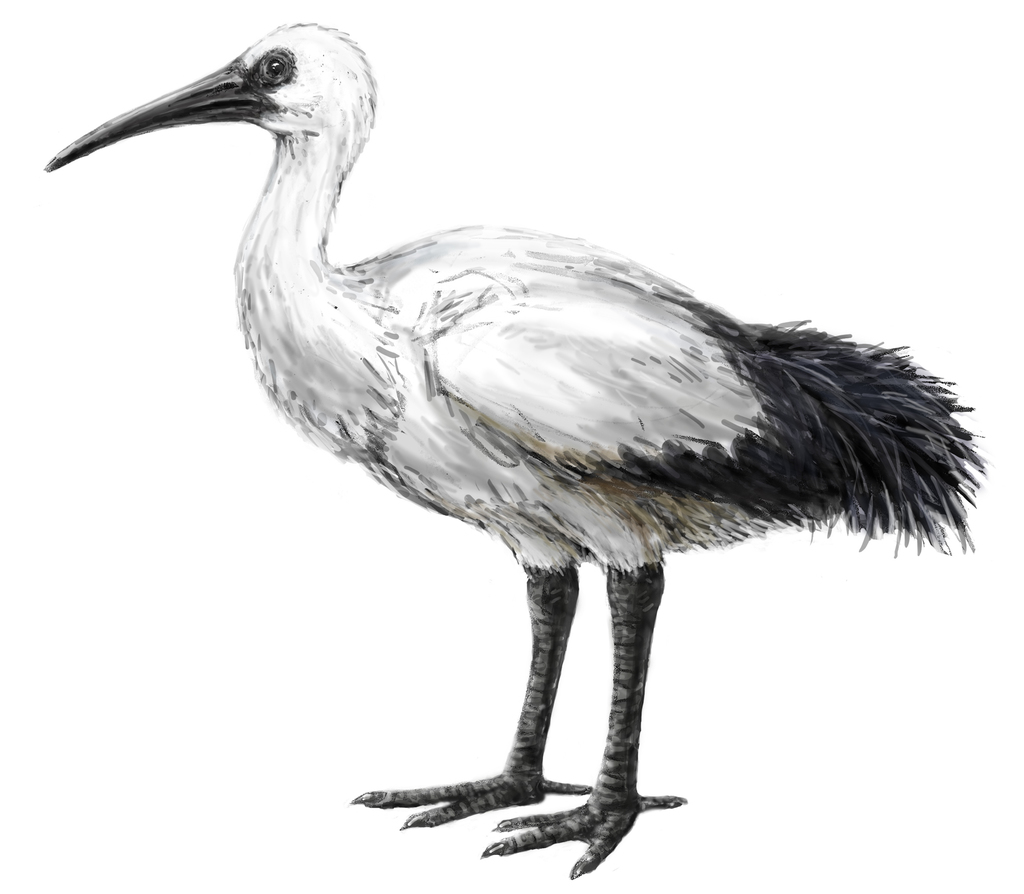
The Réunion ibis or Réunion sacred ibis (Threskiornis solitarius) is an extinct species of ibis that was endemic to the volcanic island of Réunion in the Indian Ocean. The first subfossil remains were found in 1974, and the ibis was first scientifically described in 1987. Its closest relatives are the Malagasy sacred ibis, the African sacred ibis, and the straw-necked ibis. Travellers' accounts from the 17th and 18th centuries described a white bird on Réunion that flew with difficulty and preferred solitude, which was subsequently referred to as the "Réunion solitaire".
In the mid 19th century the old travellers' accounts were incorrectly assumed to refer to white relatives of the dodo. This was assumed because one of the accounts specifically mentioned dodos on the island, and 17th-century paintings of white dodos had recently surfaced. Additionally, both it and the Rodrigues solitaire, an actual dodo relative, were referred to as "solitaires" due to shared habits. However, no fossils referable to dodo-like birds were ever found on Réunion, and it was later questioned whether the paintings had anything to do with the island. Other identities were suggested as well, based only on speculations. In the late 20th century, the discovery of ibis subfossils led to the idea that the old accounts actually referred to an ibis species instead. The idea that the "solitaire" and the subfossil ibis are identical was met with limited dissent, but is now widely accepted.
From the article Réunion ibis on Wikipedia (CC BY-SA), quoted section by section
Description
Contemporary accounts described the species as having white and grey plumage merging into yellow, black wing tips and tail feathers, a long neck and legs, and limited flight capabilities. Dubois' 1674 account is the most detailed contemporary description of the bird, here as translated by Strickland in 1848:
Solitaires. These birds are so called because they always go alone. They are the size of a large Goose, and are white, with the tips of the wings and tail black. The tail feathers resemble those of an Ostrich; the neck is long, and the beak is like that of a Woodcock, but larger; the legs and feet like those of Turkeys. This bird has recourse to running, as it flies but very little. According to Mourer-Chauviré and colleagues, the plumage colouration mentioned is similar to that of the related African sacred ibis and straw-necked ibis, which are also mainly white and glossy black. In the reproductive season, the ornamental feathers on the back and wing tips of the African sacred ibis look similar to the feathers of an ostrich, which echoes Dubois' description. Likewise, a subfossil lower jaw found in 1994 showed that the bill of the Réunion ibis was relatively short and straight for an ibis, which corresponds with Dubois' woodcock comparison. …
What it does
As contemporary accounts are inconsistent on whether the "solitaire" was flightless or had some flight capability, Mourer-Chauvire and colleagues suggested that this was dependent on seasonal fat-cycles, meaning that individuals fattened themselves during cool seasons, but were slim during hot seasons; perhaps it could not fly when it was fat, but could when it was not. However, Dubois specifically stated the "solitaires" did not have fat-cycles, unlike most other Réunion birds. The only mention of its diet and exact habitat is the account of the French cartographer Jean Feuilley from 1708, which is also the last record of a living individual:
The solitaires are the size of an average turkey cock, grey and white in colour. They inhabit the tops of mountains. Their food is only worms and filth, taken on or in the soil. The diet and mode of foraging described by Feuilley matches that of an ibis, whereas members of the Raphinae are known to have been fruit eaters. The species was termed a land-bird by Dubois, so it did not live in typical ibis habitats such as wetlands. This is similar to the Réunion swamphen, which lived in forest rather than swamps, which is otherwise typical swamphen habitat. Cheke and Hume proposed that the ancestors of these birds colonised Réunion before swamps had developed, and had therefore become adapted to the available habitats. …
Wikipedia: “Behaviour and ecology”
Listen
Looking for field recordings…
Where it lives
Recorded sightings
—
geo-referenced records in GBIF, from museums, herbaria and field observers.
Drag the globe to turn it. Dots are where records exist, not a range map; darker means more records.
In the stacks
Searching the stacks…
Every page naming Threskiornis solitarius in the Biodiversity Heritage Library →
This page is assembled live from iNaturalist, GBIF, Wikipedia, the Source Library and the Internet Archive. It is not yet part of the hand-edited codex. iNaturalist taxon 2714.