On eBird ↗
Dodo
Live sightings near you, the range map, bar charts of when it is seen, and Macaulay Library photos and recordings.
Dodo
Raphus cucullatus
The dodo (Raphus cucullatus) is an extinct flightless bird that was endemic to Mauritius, an island east of Madagascar in the Indian Ocean. The dodo's closest relative was the also-extinct and flightless Rodrigues solitaire. The two formed the subtribe Raphina, a clade of extinct flightless birds that are a part of the group that includes pigeons and doves (the family Columbidae). The closest living relative of the dodo is the Nicobar pigeon. A white dodo was once thought to have existed on the nearby island of Réunion, but it is now believed that this assumption was merely confusion based on the also-extinct Réunion ibis and paintings of white dodos.
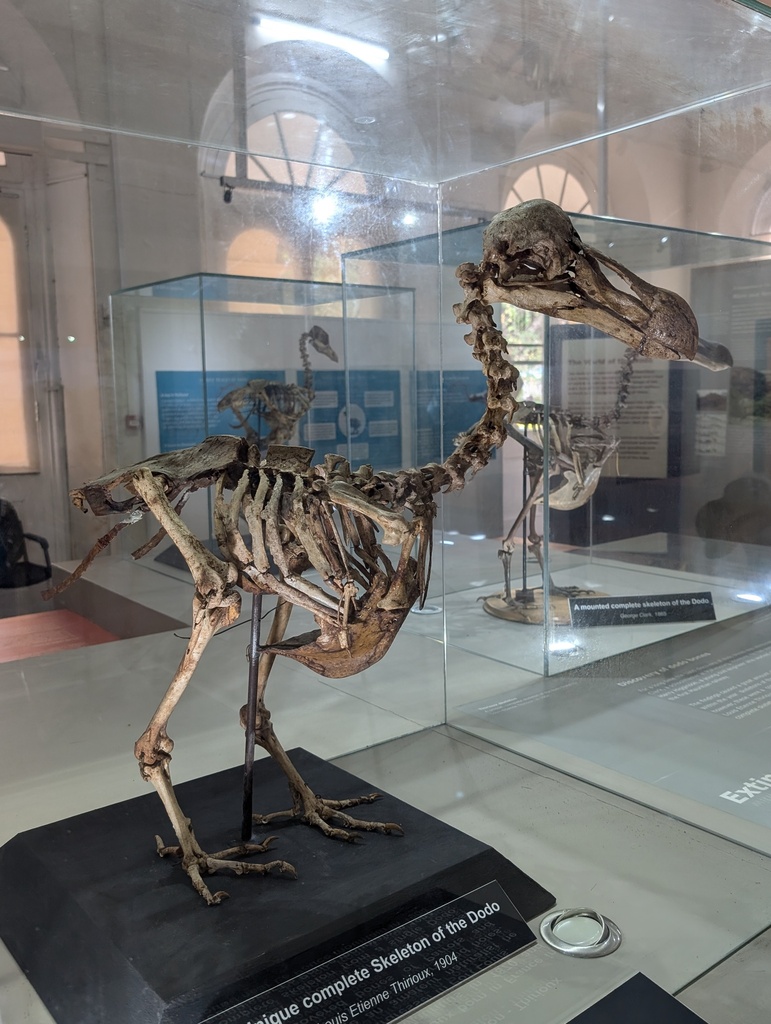
Subfossil remains show the dodo measured about 62.6–75 centimetres (2.05–2.46 ft) in height and may have weighed 10.6–17.5 kg (23–39 lb) in the wild. The dodo's appearance in life is evidenced only by drawings, paintings, and written accounts from the 17th century. Since these portraits vary considerably, and since only some of the illustrations are known to have been drawn from live specimens, the dodos' exact appearance in life remains unresolved, and little is known about its behaviour. It has been depicted with brownish-grey plumage, yellow feet, a tuft of tail feathers, a grey, naked head, and a black, yellow, and green beak. It used gizzard stones to help digest its food, which is thought to have included fruits, and its main habitat is believed to have been the woods in the drier coastal areas of Mauritius. One account states its clutch consisted of a single egg.
From the article Dodo on Wikipedia (CC BY-SA), quoted section by section
Description
As no complete dodo specimens exist, its external appearance, such as plumage and colouration, is hard to determine. Illustrations and written accounts of encounters with the dodo between its discovery and its extinction (1598–1662) are the primary evidence for its external appearance. According to most representations, the dodo had greyish or brownish plumage, with lighter primary feathers and a tuft of curly light feathers high on its rear end. The head was grey and naked, the beak green, black and yellow, and the legs were stout and yellowish, with black claws. A study of the few remaining feathers on the Oxford specimen head showed that they were pennaceous rather than plumaceous (downy) and most similar to those of other pigeons. Subfossil remains and remnants of the birds that were brought to Europe in the 17th century show that dodos were very large birds, measuring about 62.6–75 cm (24.6–29.5 in) in height. The bird was sexually dimorphic; males were larger and had proportionally longer beaks. Weight estimates have varied from study to study. In 1993, Bradley C. Livezey proposed that males would have weighed 21 kg (46 lb) and females 17 kg (37 lb). Also in 1993, Andrew C. …
Range & habitat
The preferred habitat of the dodo is unknown, but old descriptions suggest that it inhabited the woods on the drier coastal areas of south and west Mauritius. This view is supported by the fact that the Mare aux Songes swamp, where most dodo remains have been excavated, is close to the sea in south-eastern Mauritius. Such a limited distribution across the island could well have contributed to its extinction. A 1601 map from the Gelderland journal shows a small island off the coast of Mauritius where dodos were caught. Julian Hume has suggested this island was l'île aux Bénitiers in Tamarin Bay, on the west coast of Mauritius. Subfossil bones have also been found inside caves in highland areas, indicating that it once occurred on mountains. Work at the Mare aux Songes swamp has shown that its habitat was dominated by tambalacoque and Pandanus trees and endemic palms. The near-coastal placement and wetness of the Mare aux Songes led to a high diversity of plant species, whereas the surrounding areas were drier. A 2009 study found that 63% of the fossils collected in the swamp belonged to Cylindraspis turtles, and 7.1% belonged to dodos, which had been deposited within several centuries, 4,000 years ago. …
Wikipedia: “Habitat”
What it does
Little is known of the behaviour of the dodo, as most contemporary descriptions are very brief. Based on weight estimates, it has been suggested the male could reach the age of 21, and the female 17. Studies of the cantilever strength of its leg bones indicate that it could run quite fast. The legs were robust and strong to support the bulk of the bird, and also made it agile and manoeuvrable in the dense, pre-human landscape. Though the wings were small, well-developed muscle scars on the bones show that they were not completely vestigial, and may have been used for display behaviour and balance; extant pigeons also use their wings for such purposes. Unlike the Rodrigues solitaire, there is no evidence that the dodo used its wings in intraspecific combat. Though some dodo bones have been found with healed fractures, it had weak pectoral muscles and more reduced wings in comparison. The dodo may instead have used its large, hooked beak in territorial disputes. Since Mauritius receives more rainfall and has less seasonal variation than Rodrigues, which would have affected the availability of resources on the island, the dodo would have less reason to evolve aggressive territorial behaviour. The Rodrigues solitaire was therefore probably the more aggressive of the two.
Diet and feeding. …
Wikipedia: “Behaviour and ecology”
In human culture
One of the original names for the dodo was the Dutch "Walghvoghel", first used in the journal of Dutch Vice admiral Wybrand van Warwijck, who visited Mauritius during the Second Dutch Expedition to Indonesia in 1598. Walghe means "tasteless", "insipid", or "sickly", and voghel means "bird". The name was translated by Jakob Friedlib into German as Walchstök or Walchvögel. The original Dutch report titled Waarachtige Beschryving was lost, but the English translation survived:
On their left hand was a little island which they named Heemskirk Island, and the bay it selve they called Warwick Bay... Here they taried 12. daies to refresh themselues, finding in this place great quantity of foules twice as bigge as swans, which they call Walghstocks or Wallowbirdes being very good meat. But finding an abundance of pigeons & popinnayes [parrots], they disdained any more to eat those great foules calling them Wallowbirds, that is to say lothsome or fulsome birdes. Another account from that voyage, perhaps the first to mention the dodo, states that the Portuguese referred to them as penguins. The meaning may not have been derived from penguin (the Portuguese referred to those birds as "fotilicaios" at the time), but from pinion, a reference to the small wings. …
Wikipedia: “Etymology”
Listen
Looking for field recordings…
Where it lives
Recorded sightings
—
geo-referenced records in GBIF, from museums, herbaria and field observers.
Drag the globe to turn it. Dots are where records exist, not a range map; darker means more records.
In the old herbals & bestiaries

Ten Books of Exotic Things
Carolus Clusius · 1605 · p.120

De Indiae utriusque re naturali et medica
Willem Piso · 1658 · p.472

Jan Moninckx; Maria Moninckx — Moninckx Atlas, vol. 1 (1686)
Jan Moninckx; Maria Moninckx · 1687 · p.32

Jan Jonston — Naeukeurige beschryving van de natuur der viervoetige dieren (1660)
Jan Jonston · 1660 · p.253

Rariorum Plantarum Historia (with Fungorum Historia)
Carolus Clusius · 1601 · p.614

History of Rare Plants
Carolus Clusius · 1601 · p.608

Hortus Eystettensis
Basilius Besler · 1640 · p.135

New Genera of American Plants
Charles Plumier · 1703 · p.119

Herbarium Portatile, Oder Behendes Kräuter- und Gewächs-Buch: Darinn nicht allein 1363. so wol Einheimische als Außländndische Kräuter mit Lateinisch und Deutscher Benennung abgebildet, sondern auch die meisten, so in der Medicin gebräuchlich, kürtzlich erkläret werden
Panckow, Thomas · 1656 · p.301

Herbarium Portatile, Oder Behendes Kräuter- und Gewächs-Buch: Darinn nicht allein 1363. so wol Einheimische als Außländndische Kräuter mit Lateinisch und Deutscher Benennung abgebildet, sondern auch die meisten, so in der Medicin gebräuchlich, kürtzlich erkläret werden
Panckow, Thomas · 1656 · p.126

Herbarium Portatile, Oder Behendes Kräuter- und Gewächs-Buch: Darinn nicht allein 1363. so wol Einheimische als Außländndische Kräuter mit Lateinisch und Deutscher Benennung abgebildet, sondern auch die meisten, so in der Medicin gebräuchlich, kürtzlich erkläret werden
Panckow, Thomas · 1656 · p.103

Herbarium Portatile, Oder Behendes Kräuter- und Gewächs-Buch: Darinn nicht allein 1363. so wol Einheimische als Außländndische Kräuter mit Lateinisch und Deutscher Benennung abgebildet, sondern auch die meisten, so in der Medicin gebräuchlich, kürtzlich erkläret werden
Panckow, Thomas · 1656 · p.261
In the stacks
Searching the stacks…
Every page naming Raphus cucullatus in the Biodiversity Heritage Library →
This page is assembled live from iNaturalist, GBIF, Wikipedia, the Source Library and the Internet Archive. It is not yet part of the hand-edited codex. iNaturalist taxon 2713.