- Animals
- ›Chordates
- ›Vertebrates
- ›Birds
- ›Rollers, Kingfishers, and Allies
- ›Kingfishers
- ›Tree Kingfishers
- ›Syma
On eBird ↗
Mountain Kingfisher
Live sightings near you, the range map, bar charts of when it is seen, and Macaulay Library photos and recordings.
Mountain Kingfisher
Syma megarhyncha
The mountain kingfisher (Syma megarhyncha) is a species of bird in the subfamily Halcyoninae in the family Alcedinidae.
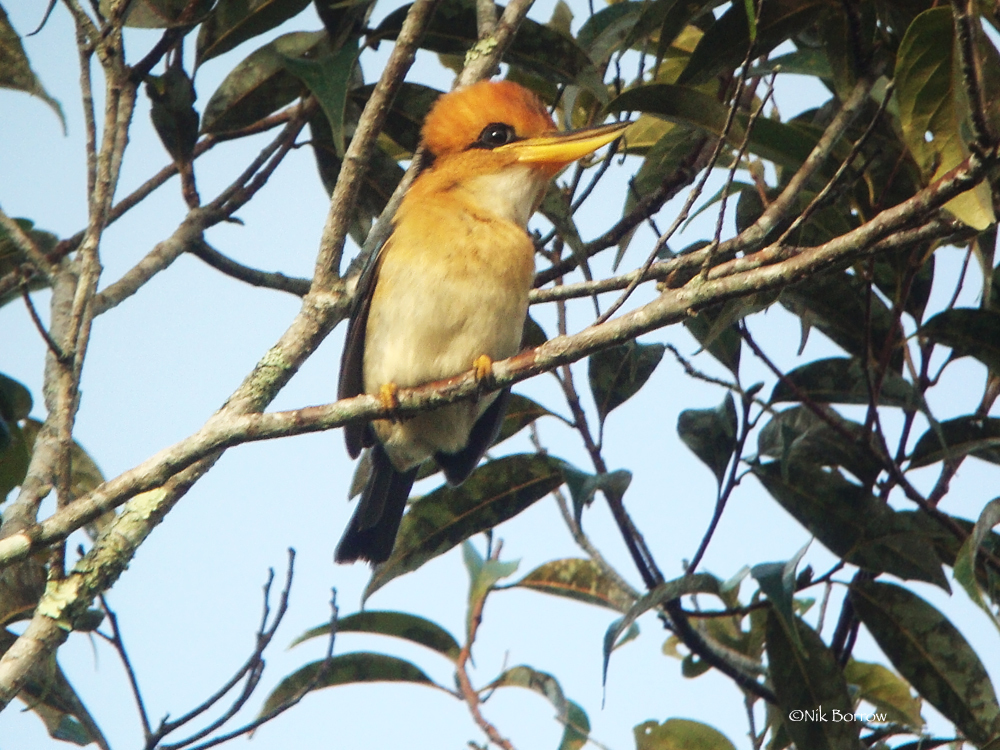
Adult males are 21–24 cm (8.3–9.4 in) long, and have a rufous head and underparts, greenish-blue upperparts, a dark blue tail, and black flight feathers. They also have dark neck patches and loral patches. Females have dark crowns and the neck patches join at the nape. It is similar to the yellow-billed kingfisher, but can be distinguished by its larger size and a proportionally larger bill, along with a dark ridge along its culmen.
From the article Mountain kingfisher on Wikipedia (CC BY-SA), quoted section by section
Description
It is a small kingfisher, with males weighing 52–60 g (1.8–2.1 oz) and females weighing 49–63 g (1.7–2.2 oz). Adults are between 21–24 cm (8.3–9.4 in) in length. Males have a rufous head and underparts and greenish-blue upperparts, along with black loral and nape patches. The tail is dark blue and it has black wing feathers with bluish edges and tips. Females have a black crown and paler underparts. The neck patches are joined at the nape in females, making a bar across the back of the neck. The bill is bright yellow with a dark ridge along the culmen. The iris is dark brown and the feet and legs are dull yellow. Juveniles have a grayish-black bill and mottled-black ear coverts. They also have a larger black area around the eye and dark-tipped feathers on the cheeks and breast. The yellow-billed kingfisher is similar in appearance, but has an all-yellow bill instead and is found at lower altitudes than the mountain kingfisher. It is also larger with a proportionally larger bill.
Vocalisations. It typically vocalises from the canopy and mid-story. It has a loud whistled trilling call, typically composed of 3–4 descending trills separated by pauses. The song ends with a distinctive trill that drops, rises and drops in pitch. The initial trills are similar to the song of the chestnut-breasted cuckoo, but are longer and richer, and the cuckoo's song is much higher-pitched. …
Range & habitat
The mountain kingfisher is endemic to the island of New Guinea, and is found in both Western New Guinea and Papua New Guinea. It is common to uncommon through most of the New Guinea Highlands, except for the Bird's Head peninsula. Reports of the species from the Adelbert Mountains and the Foja Mountains are unconfirmed. The species mostly occurs between elevations of 1,200–2,400 m (3,900–7,900 ft), although they have been reported at elevations as low as 700 m (2,300 ft). At lower elevations, the species is replaced by the yellow-billed kingfisher. The mountain kingfisher mainly inhabits primary forest and secondary growth within its range.
Wikipedia: “Distribution and habitat”
What it does
It feeds on small lizards, insects, and larvae. It hunts by perching in middle and upper canopy for long periods of time, before diving to capture prey. Nests are dug into earthen riverbanks and dry timber. On Papua New Guinea, eggs are laid in December. Eggs are laid in clutches of two and are white in color.
Wikipedia: “Behaviour and ecology”
Listen
Looking for field recordings…
Where it lives
Recorded sightings
—
geo-referenced records in GBIF, from museums, herbaria and field observers.
Drag the globe to turn it. Dots are where records exist, not a range map; darker means more records.
In the stacks
Searching the stacks…
Every page naming Syma megarhyncha in the Biodiversity Heritage Library →
This page is assembled live from iNaturalist, GBIF, Wikipedia, the Source Library and the Internet Archive. It is not yet part of the hand-edited codex. iNaturalist taxon 2695.