- Animals
- ›Chordates
- ›Vertebrates
- ›Birds
- ›Rollers, Kingfishers, and Allies
- ›Kingfishers
- ›Tree Kingfishers
- ›Syma
On eBird ↗
Yellow-billed Kingfisher
Live sightings near you, the range map, bar charts of when it is seen, and Macaulay Library photos and recordings.
Yellow-billed Kingfisher
Syma torotoro
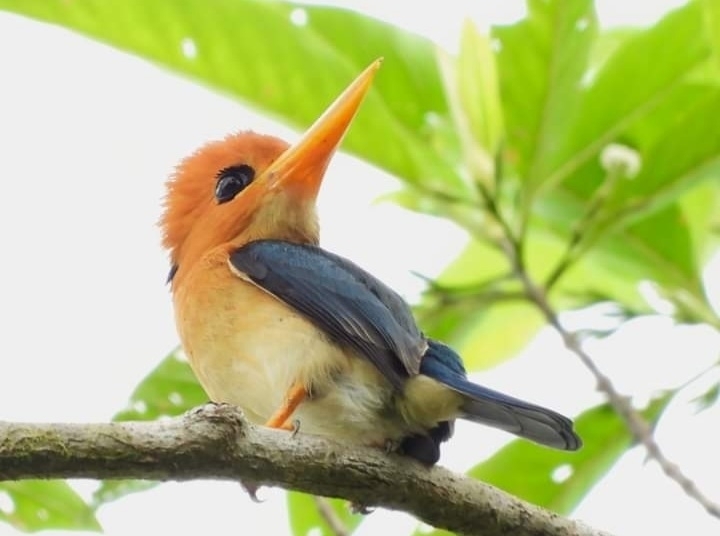
The yellow-billed kingfisher (Syma torotoro) is a medium-sized (length 20 cm, wingspan 29 cm, weight 40 g) tree kingfisher.
From the article Yellow-billed kingfisher on Wikipedia (CC BY-SA), quoted section by section
Description
The yellow-billed kingfisher is 20 cm (7.9 in) long, with a wingspan of 29 cm (11 in), and it weighs 30–50 g (1.1–1.8 oz). Its orange colouring and yellow bill are distinctive; it has an orange head and neck with a black nape patch and white throat. Adult females also have a black crown patch. The upper mantle is blackish grading to olive green on the back, blue-green on rump and with a blue tail. The upperwing is dull green-blue with dark olive-black flight feathers. The underparts are pale orange-grey. The bill is orange-yellow in adults, dark grey in juveniles.
Range & habitat
The yellow-billed kingfisher is widespread throughout lowland New Guinea and the adjacent islands, extending to northern Cape York Peninsula in Australia. It may be found in rainforest, monsoon forest and along forest edges.
Wikipedia: “Distribution and habitat”
What it does
The yellow-billed kingfisher is known to prey on large insects, earthworms, and small snakes and lizards. It perches in the low canopy, swaying from side to side, before swooping down to the ground to take its prey.
Wikipedia: “Feeding”
Listen
Looking for field recordings…
Where it lives
Recorded sightings
—
geo-referenced records in GBIF, from museums, herbaria and field observers.
Drag the globe to turn it. Dots are where records exist, not a range map; darker means more records.
In the stacks
Searching the stacks…
Every page naming Syma torotoro in the Biodiversity Heritage Library →
This page is assembled live from iNaturalist, GBIF, Wikipedia, the Source Library and the Internet Archive. It is not yet part of the hand-edited codex. iNaturalist taxon 2690.